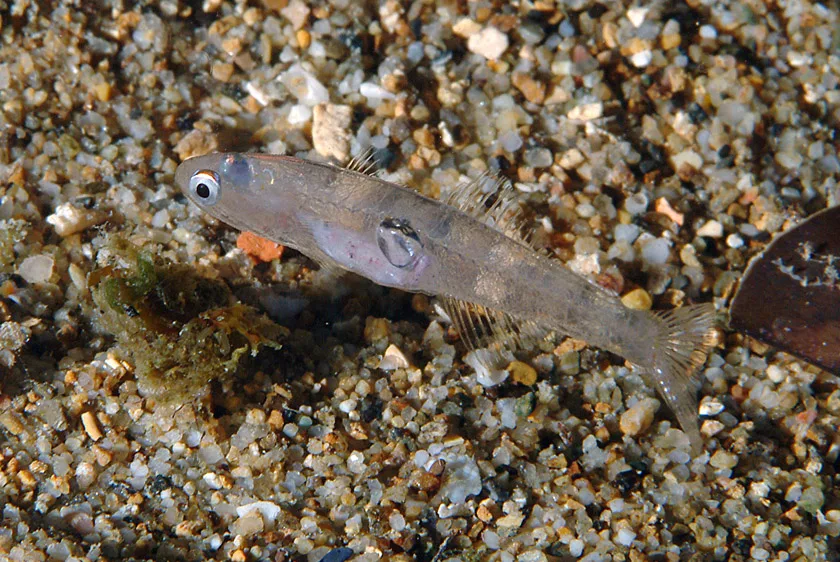
The Howard Hughes Medical Institute's Janelia Research Campus just announced it is tripling its fish tank space, hiring up to 100 new scientists, and pointing a whole lot of artificial intelligence at a tiny, see-through fish the size of your thumbnail. The goal is nothing less than understanding how the physical firing of neurons becomes memory, decision-making, and behavior. No pressure.
A Fish With Nothing to Hide
The fish in question is called Danionella cerebrum, and its best quality, scientifically speaking, is that you can see right through it. According to NPR, Danionella lacks the top part of its skull and has transparent skin, which means researchers can watch its entire brain firing in real time without cutting into anything.
Most lab animals make this impossible. Rodents have skulls. Zebrafish are only transparent when they're larvae, which puts a hard time limit on experiments. Danionella cerebrum, which wasn't even officially classified as its own species until 2021, turns out to be the rare organism that just... lets you watch it think.
"Having an animal that has a clear head and a clear body is extremely useful for neuroscience," Matt Lovett-Barron, a scientist studying Danionella at UC San Diego, told NPR. That's an understatement comparable to saying a window is useful for looking outside.
From Fruit Flies to Fish Brains
Janelia already has a reputation for swinging big. NPR reports the center pulled off one of the most audacious projects in the history of biology in 2024, when its researchers successfully mapped all 54.5 million neural connections inside a fruit fly brain. Every single one.
Now they want to do the same thing for a fish. The problem is scale. Danionella has about 650,000 neurons, which is roughly eight times more than the fruit fly. Adult zebrafish, the other common transparent lab model, have around 80,000 neurons in their larval stage, and scientists have already managed to monitor all of those simultaneously. Danionella is the next step up the ladder.
For context, the human brain has about 86 billion neurons. Nobody is mapping that anytime soon. But the logic here is real: if you can understand how a 650,000-neuron brain produces complex social behavior from scratch, you have a fighting chance at understanding how the much bigger, more complicated version in your skull does the same thing.
The Brain-Behavior Problem, Explained
The central question driving all of this is something researchers call the brain-behavior problem, and it is genuinely one of the hardest unsolved questions in science. How does a neuron firing lead to a memory? How does a cascade of electrochemical signals become a decision, or a feeling, or a personality?
The frustrating answer right now is: we have no idea. Not really. We have fragments. We have correlations. We have pieces that don't quite connect.
Gerry Rubin, Janelia's founding executive director, told NPR that the reason we can't answer the question yet is that scientists keep studying pieces of brains in isolation. "If you really want to understand how the brain is working as a whole, you really need to see all the neurons firing at once," he said. That's the whole pitch for Danionella. It's not just a convenient organism. It's the first organism where watching every neuron fire at the same time is actually physically possible.
Where the AI Comes In
Mapping and monitoring hundreds of thousands of neurons firing simultaneously produces a staggering amount of data. More than any team of humans could sort through in any reasonable amount of time. That's where the AI comes in.
Rubin told NPR directly: "This is going to produce so much data that we're going to need something like artificial intelligence to analyze it." The plan is to develop tools that let scientists work in partnership with AI to find patterns and make discoveries faster than either could manage alone.
This is actually one of the more coherent and grounded applications of AI in scientific research you'll hear about right now. Not AI replacing scientists. Not AI generating fake citations. AI processing the kind of data volume that would otherwise require decades of manual review, so that actual human researchers can spend their time doing the thinking that still requires a brain.
The Long Game
Janelia's executive director Nelson Spruston told NPR the ultimate goal is to run these experiments on freely swimming fish, not immobilized ones, because behavior in a tank with real movement is more informative than behavior in a fish that can't move. That's a significant engineering challenge, and the center knows it.
Lovett-Barron's lab at UC San Diego is already doing early versions of this work, placing Danionella into virtual reality environments, essentially tiny video games with virtual social partners, and watching how their brains manage social interaction in real time.
HHMI President Erin O'Shea told NPR she would be "ecstatic" if in 10 years they fully understood just one complex behavior, like schooling, in Danionella. That's the timeline here. Not next quarter. Not a product launch. A decade of work to understand one behavior in one fish. That's what real science looks like.
The Dingo Take
Here's the thing about this story that deserves more attention than it's getting: we are living in a moment when the word "AI" gets slapped onto every press release about every product that cannot actually do what it claims to do, and somehow the genuinely astonishing application, using machine learning to decode how a biological brain generates consciousness from raw electrochemical noise, barely registers. The Janelia team isn't promising a chatbot. They're trying to answer a question that philosophers and scientists have been stuck on for centuries.
The transparent fish angle is also a good reminder that the most important scientific breakthroughs often look absurd from the outside. Someone decided to map every connection in a fruit fly brain. Everyone else thought that sounded like a waste of resources until the resulting data rewrote what we know about neural architecture. Now those same people are tripling their fish tanks and hiring 90 more scientists to stare at a creature you could lose in a coffee cup. This is how it works. The bets that look the craziest are sometimes the ones that actually pay off.
And yes, we all evolved from fish. Your brain and a Danionella brain share real structural features. The neurons firing when you're reading this sentence are distant cousins to the ones firing when a see-through fish in a lab tank decides which direction to swim. If that doesn't make you feel something, you might want to get that checked out.



Comments