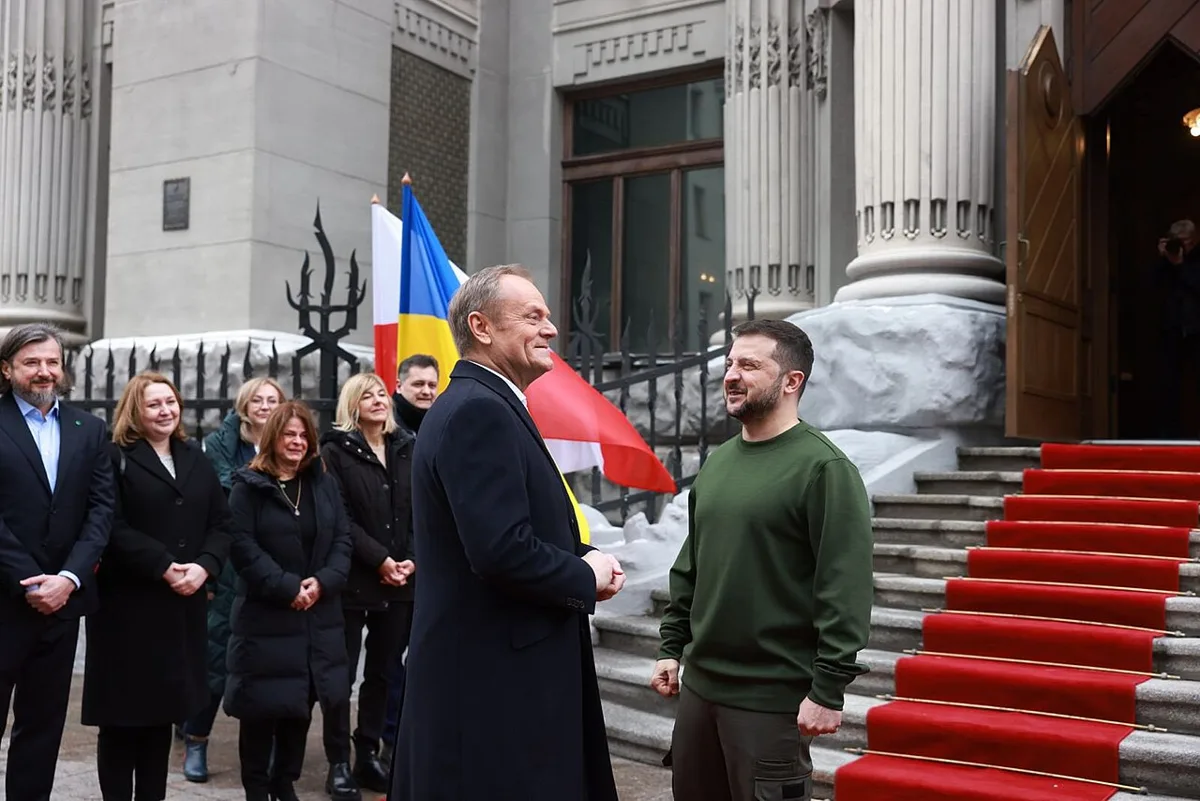
Volodymyr Zelenskyy, the wartime president of a country currently being bombed into rubble by Russia, spent part of his weekend physically mailing back a prestigious Polish state honor because two neighboring countries that desperately need each other decided right now was the perfect time to relitigate the 1940s. The Polish president stripped Zelenskyy of the Order of the White Eagle. Zelenskyy posted the postal receipt on X to prove he sent it back. This is, genuinely, where we are.
What Actually Happened Here
Start at the beginning. On May 26, Zelenskyy signed a decree naming a unit of Ukraine's Special Operations Forces after the Ukrainian Insurgent Army, known by its Ukrainian acronym UPA. The UPA fought against both Nazi Germany and Soviet forces during the 1940s and 1950s, which makes it a symbol of Ukrainian independence to many Ukrainians. To Poland, it is something considerably darker.
As CBS News reports, Poland's parliament formally recognized UPA crimes as genocide back in 2016. The organization has been accused of massacring tens of thousands of Polish civilians, mostly in the Nazi-occupied regions of Volhynia and Eastern Galicia. For most Poles, naming a military unit after the UPA is roughly equivalent to, say, naming one after a formation that specifically targeted your grandparents.
Zelenskyy's decree framed the naming as a restoration of military tradition and recognition of the unit's battlefield performance. That framing did not land particularly well in Warsaw.
Enter the Polish President, With Bad Timing and Worse Instincts
Polish President Karol Nawrocki responded by revoking the Order of the White Eagle, Poland's highest state honor, which former President Andrzej Duda had awarded Zelenskyy in 2023 for services to security, resilience, and the defense of human rights. Nawrocki delivered a 13-minute social media address explaining the decision, which is the diplomatic equivalent of turning a minor fender-bender into a 45-minute screaming match in a parking lot.
Here is the thing about Nawrocki that CBS News buries but absolutely should not: he is a nationalist politician who has actively exploited anti-Ukrainian sentiment for electoral gain. Poland has hosted millions of Ukrainian refugees. Ukrainians have contributed significantly to the Polish economy. And Nawrocki has spent time fanning resentment toward them anyway, because that is the kind of politician he is. So when he reaches for a symbolic punishment aimed at Ukrainians during a live war, the cynicism involved deserves a name.
Nawrocki said the honor revocation would not reduce Poland's military support for Ukraine. Which is nice. Though announcing you are humiliating an ally's wartime leader while insisting it changes nothing is the kind of thing that tends to change things.
Zelenskyy Sends It Back, With Documentation
Zelenskyy's response was theatrical in exactly the way you would expect from a man who has made his entire wartime presidency into a masterclass in symbolic communication. He posted photos of the Order of the White Eagle on X alongside a postal receipt showing it had been mailed back to the Polish presidential office. The message, as CBS News reports, read: "I believe the future will confirm the respect Ukrainians deserve."
Four Ukrainian officials followed suit, including Presidential Office chief Kyrylo Budanov, who called Nawrocki's move "an unfriendly act toward our people" and "a gift to the Moscow aggressor, which will certainly use it against both of our countries." That last part is not hyperbole. It is a fairly precise description of how Russian information operations work.
Not everyone in Ukraine celebrated the gesture. Former Prime Minister Arseniy Yatsenyuk wrote on X that one harmful and incorrect decision by the Polish president cannot be corrected by other incorrect decisions from Ukraine's side. Yatsenyuk is right. He is also, at this particular moment, the least viral person in this story.
The Grown-Up in the Room Says Stop It
Polish Prime Minister Donald Tusk, who is a political rival of Nawrocki and apparently the only person in this situation with a functioning sense of proportion, posted a pretty clear message on social media Friday night. "The front line runs elsewhere," Tusk wrote, adding that the dispute between Poland and Ukraine "delights Putin and shocks our allies."
That is not a complicated analysis. It is also one that both Nawrocki and Zelenskyy apparently needed to hear. Poland is set to host a major conference on Ukraine's postwar reconstruction next week, which Zelenskyy was expected to attend. The two countries had been making real, documented progress on the historically painful question of exhumations of Polish victims. A December meeting in Warsaw between the two presidents had been considered a genuine breakthrough on reconciliation.
All of that is now sitting next to a postal receipt on X, waiting to see what happens next.
The History Is Real, But the Timing Is Suspicious
None of this means the underlying history is fake or trivial. The massacres in Volhynia and Eastern Galicia were real. Tens of thousands of Polish civilians were killed. Poland's grief over those events is legitimate, and Ukraine naming a military unit after an organization associated with those killings was, at minimum, an unforced error in the middle of a war that depends heavily on allied solidarity.
But the UPA also fought against Nazi Germany and Soviet occupation forces, which is why it holds a complicated place in Ukrainian historical memory. As CBS News notes, Ukrainians point out that armed formations on both sides, including Polish underground forces, were involved in attacks and reprisals that produced mass civilian casualties among both Poles and Ukrainians. The history is ugly in multiple directions, which is exactly why serious diplomatic progress on it is so hard and so fragile.
Nawrocki chose to blow up that fragile progress with a 13-minute video address during an active European land war. The UPA naming decree was a provocation. What he did with it was a choice.
The Dingo Take
Let's be precise about what just happened. A nationalist Polish politician who has made a habit of stirring up resentment against Ukrainian refugees decided to strip a wartime leader of a ceremonial honor, at the single worst possible moment for European unity, over a naming dispute that could have been handled through the diplomatic back channels that both countries had literally just started using. And then Zelenskyy, instead of absorbing the hit and moving on, mailed the order back with a photo receipt because he, too, could not resist the symbolism. Putin did not need to do a single thing this weekend. Two neighboring countries handled it for him.
Tusk is right that the front line runs elsewhere. But Tusk does not control Nawrocki, because Poland's president and prime minister come from rival parties and the country is deep in its own political dysfunction. Nawrocki ran partly on skepticism toward Ukraine. The honor revocation was not really about the UPA. It was about domestic politics wearing the costume of historical grievance, which is one of the oldest tricks in the nationalist playbook and one of the most destructive.
Ukraine is going into next week's reconstruction conference with a diplomatic bruise and a pile of returned medals. Poland is going in with a president who just publicly embarrassed a wartime ally for electoral reasons he can barely disguise. And somewhere, someone in Moscow is having a genuinely great Saturday. That is the actual score here.


Comments