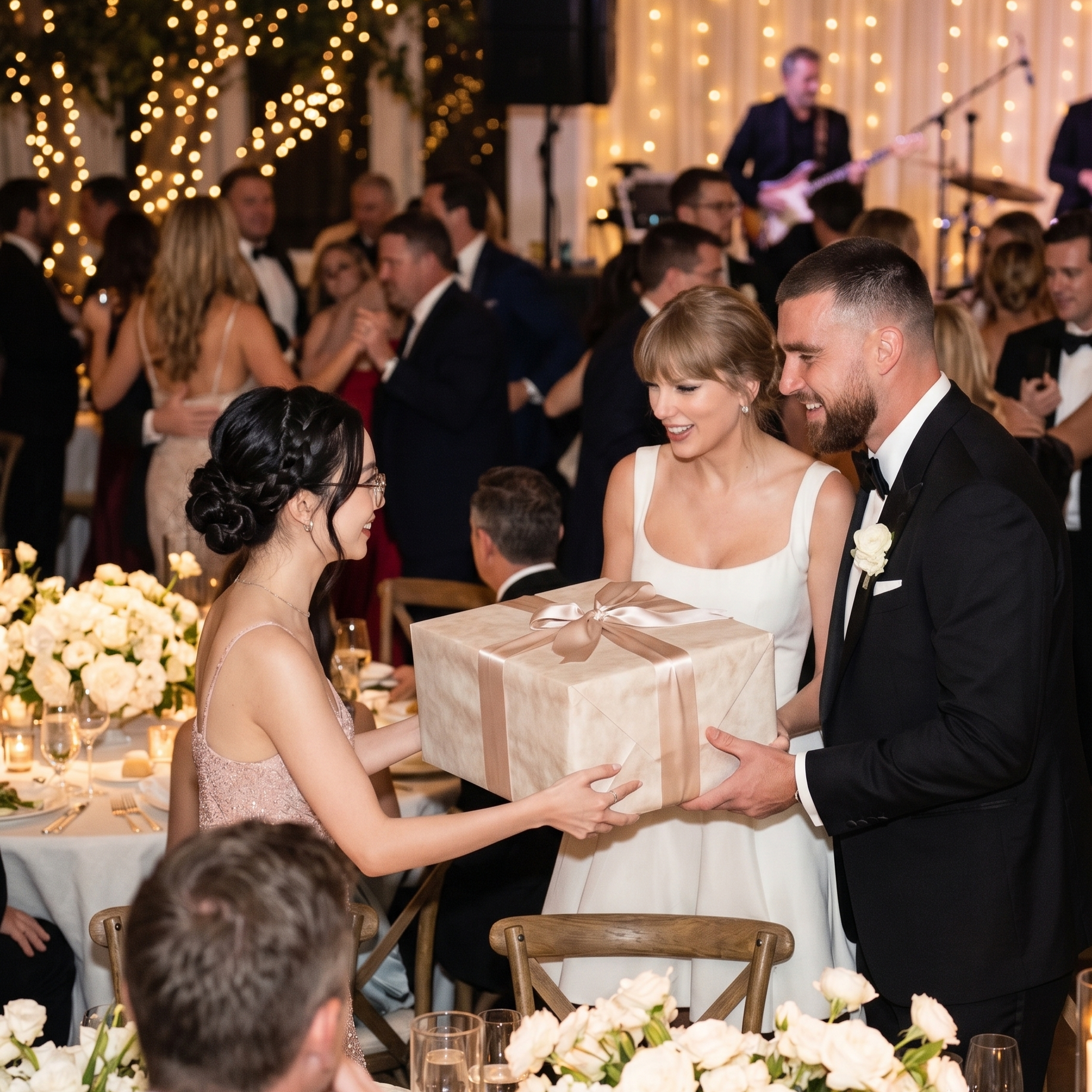
The invitation arrived on stationery so thick it felt like a mortgage payment. It wasn't a wedding invite; it was a subpoena to witness the apotheosis of the American brand. Taylor Swift and Travis Kelce, the poet laureate of heartbreak and the tight end who caught freedom, were tying the knot on the 4th of July. In New York. Naturally.
As I rode the L train into the city—my metallic tube of shared, sweaty destiny—I found myself contemplating the nature of ownership. The dress I was wearing? I didn't own it; I was merely renting it from a future credit card statement. The seat I was standing on? Owned by the MTA, which is, in turn, owned by a concept called "the public," which is a polite way of saying "nobody and everybody, so shut up and pay your fare."
But I was headed to a place where ownership was not a question. It was a decree.
The venue was a decommissioned aircraft carrier moored in the Hudson, festooned with 100,000 white roses flown in from a country that pays its farmers in hopes and prayers. The dress code was "Capitol Casual"—think seersucker suits woven from $100 bills and cowboy boots made of the leather of a single, perfectly sad calf.
Taylor descended from a helicopter that was presumably idling just to keep the champagne chilled. Her dress was a liquid sculpture of hand-sewn crystals, a galaxy of labor. I tried to calculate the man-hours. The seamstresses, the beaders, the underpaid interns who sourced the thread. The dress winked at me, and I knew, with the certainty of a woman who has checked her bank balance after brunch, that it contained more collective human effort than I would produce in my entire lifetime. We clapped because we were supposed to. It was the closest to a standing ovation a private jet could get.
Travis, resplendent in a white tuxedo that seemed to be made of the very clouds he had personally defeated, raised a football-shaped goblet. "Let's make this union official," he bellowed. "More official than a touchdown in the end zone of love!"
They exchanged rings forged from melted-down Super Bowl trophies and platinum records. The officiant—a hologram of the Statue of Liberty, because why have a person when you can have a projection?—pronounced them the King and Queen of the Content Kingdom.
Then came the food. A 15-course tasting menu that was essentially a eulogy for the concept of scarcity. Each dish was a small, exquisite crime against nature. A single, perfect oyster perched on a spoon made of ice that melted exactly as you raised it to your lips, as if to say, This is the moment. It is already gone. Just like your rent money.
I looked around the table at my fellow guests. They were all "influencers," a profession that baffled me because it implies they are influencing towards something, though what that is, I can never quite grasp. They were filming the meal for their "stories," creating a secondhand memory of a first-class experience. They weren't eating the food; they were archiving it. The transaction was no longer between the diner and the dish, but between the diner and their 10 million followers. The food itself was merely the raw material for the advertisement.
Between the 8th and 9th courses, the real spectacle began. A giant screen descended and displayed a "live" feed of the "working class" fireworks being set off over the East River. We oohed and aahed from our glass-and-steel prison, watching the explosions of color that we had paid for through our taxes, the ones Taylor and Travis would later declare as a charitable donation to the city's morale.
And it was in that moment, as I watched a holographic eagle shit sparkles onto the DJ booth, that I had my second epiphany of the night. The first was that the butter was shaped like a tiny football helmet. The second was that I was not a guest. I was a prop. We all were. We were the human confetti, the filler in the frame, the audience that makes the stage a stage.
The bride and groom were not in love with each other; they were in love with the idea of being in love with the tangible, physical embodiment of the American Dream. He was the brawn, she was the brain, and together they formed a perfect, impenetrable corporation. Their vows weren't "I do." They were "We merge."
As the night wound down and the VIPs were whisked away to an after-party on a private island I cannot legally name, I found myself walking the bridge back to Brooklyn. Below me, the East River churned, dark and indifferent to all the human drama happening above its surface. The fireworks were over. The confetti had been swept into the harbor. The labor of thousands had been consumed in a single, glorious, empty act.
And I found myself wondering... if a wedding happens in the most expensive city in the world, and everyone is too busy posting about it to actually see it, does it even happen at all? Or is it just another contract, signed in the ink of our collective attention, a deed to a house we are all paying for but will never be allowed to enter?
The bridge groaned beneath my feet. I looked down at the water and saw the reflection of the city lights, which is, I suppose, the only way any of us ever get to touch the sky.
And I couldn't help but wonder... if all the world is a stage, and all the men and women merely players, what happens to the rest of us who are just building the sets?
About the Author
Mary Chainsaw is a Manhattan-based essayist, professional over-thinker, and part-time anthropologist of the city's more regrettable hookup decisions. She has been ghosted by a venture capitalist, breadcrumbed by a drummer, and, as chronicled in her breakout piece, used as a human canvas by a man whose sole possessions included a 32-inch LED and a mattress that definitely violated the Geneva Convention.
When she is not typing furiously from her rent-stabilized walk-up—which boasts two televisions, a couch that doesn't double as a crime scene, and a thriving snake plant named "Kevin"—Mary can be found sipping overpriced cosmos, swiping left on anyone who lists "minimalist" as a personality trait, and wondering if chivalry died, or if it simply moved to Brooklyn and forgot to text back.
She remains cautiously optimistic that the next man she brings home will own a bookshelf. She does not accept fist bumps.
Comments