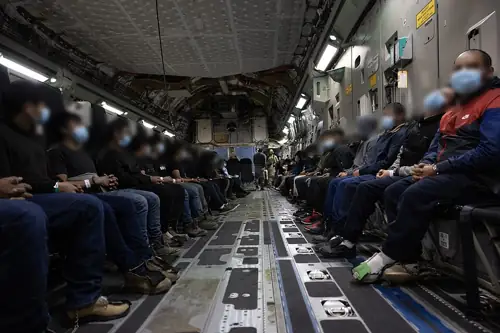
Last summer, ICE agents in masks and body armor fanned out across Los Angeles and started making people disappear. One year later, the families left behind are still sorting through the rubble, and the stories coming out of that wreckage are exactly as bad as you'd imagine, and then somehow worse.
People Vanished. That Was Just the Beginning.
According to The Guardian, immigration agents swept through Los Angeles last summer pulling people off street corners, out of workplaces, from parking lots and department stores. Carwash workers. Coffee shop regulars. Grandparents. Gone.
The raids were loud and chaotic and covered extensively in real time. What hasn't been covered as thoroughly is what comes after. The administrative nightmare. The family calendars that no longer make sense. The six-year green card backlogs. The kindergarten graduation ceremonies a father can't attend because he's in a village in Mexico, calling his kids every morning just to tell them it's time for school.
He Signed Away His Rights Because He Didn't Have His Glasses
Jesús had worked at the Westchester Hand Wash for ten years. He was married to his high school sweetheart, Noémi. They had four kids, all US citizens. As The Guardian reports, as the husband and father of American citizens, he had a legal pathway to residency. He could have fought it.
He didn't get the chance. When agents detained him, they pressured him to sign a document. He didn't have his glasses. He signed away his right to remain in the United States without fully understanding what he was putting his name to. Read that again slowly. A man lost his family, his home, and thirty years of his life in America because immigration agents rushed him through paperwork he literally could not read.
Now Jesús is in Kiní, Mexico, the town he left in 1992. He calls Noémi every morning. He calls the kids. He tells them it's time for school. And Noémi, who has been with this man since she was sixteen years old, is trying to explain to their six-year-old why daddy couldn't make it to kindergarten graduation.
"I have waited my entire life for that day," little Gabriel told her. The Guardian reports that Noémi wiped her tears and burst into laughter. Sometimes that's all you've got.
Six Years. Maybe Longer. No One Actually Knows.
The family has filed a petition for a green card. As The Guardian found, applications are currently backlogged and could take six years or longer to process. Six years, minimum, before Jesús might legally be able to come home. Dhelainy, who is sixteen, will be in her twenties. Esther, fifteen, same. Angel will be seventeen. Gabriel will be twelve, and he will have spent the majority of his conscious life without his father in the house.
Noémi told The Guardian she wishes someone could just give her a number. Two years. Three years. Something she could hold onto. Instead there's nothing. Just a blank where the future used to be.
Her daughter Dhelainy is studying law and political science. She walked the family dogs alone and told her dad about it over the phone, and she told The Guardian she is thinking about becoming an immigration lawyer. She is sixteen years old and ICE turned her into an activist. The youngest kids are still figuring out how to explain why dad isn't home. The older ones already know exactly what happened and who let it happen.
Then There's the Story About the Man With a Disability, Taken Alone
Jesús's story is devastating. Daniel's story is something else entirely. As The Guardian reports, Daniel has significant mental and intellectual disability and very limited speech. He had been under the conservatorship of his siblings for decades. He understands Spanish but not much English. He can't handle loud noises or disruptions to routine.
Last June, Daniel was doing what he usually did, walking around his east Los Angeles neighborhood, collecting recyclables, greeting neighbors and their dogs. An unmarked vehicle pulled up. Immigration agents cornered him. Neighbors watched and immediately called his family. Daniel had no idea what was happening or what to do. His nephew Christopher, who was at work at an ad agency, got the call and had to figure out in real time what you do when the government takes a man who cannot advocate for himself and has no idea why strangers are putting him in a vehicle.
Christopher told The Guardian that a year ago he knew almost nothing about immigration policy. Then his uncle disappeared and he basically had to learn. That sentence should haunt every elected official in America.
The City Moved On. The Families Couldn't.
Los Angeles has a short attention span and a long list of crises competing for space. The raids dominated the news cycle last summer and then, as these things do, faded into the background noise of a country with a new outrage every forty-eight hours. The families don't get that luxury.
They are still filing paperwork. Still suppressing flashbacks, as The Guardian describes it, to the chaos they witnessed. Still working out school pickups and dog walks and lunch hours without the person who used to be there for all of it. The administrative aftermath of a mass deportation operation doesn't end when the news cameras leave. It stretches out across years, across backlogs, across childhood milestones that a deported parent misses while waiting for a government that doesn't particularly want to let him back in.
The Dingo Take
Here is the thing about the "they're just enforcing the law" argument that gets trotted out every time someone wants to feel better about what ICE is doing in American cities. The law, as currently applied, allowed agents to pressure a near-sighted man into signing away his legal rights without his glasses. The law allowed them to corner a man with intellectual disabilities who was collecting recyclables on his own block. The law is producing six-year green card backlogs for the US citizen children of deported parents. If your defense of all this is "well technically it's legal," you should probably sit with that for a while.
What The Guardian documented here is not a glitch in the system. It is the system working exactly as the people running it want it to work. Rapid detention, maximum pressure to sign, minimal opportunity to contact a lawyer, and then gone before anyone can slow things down. The families left behind aren't collateral damage in some abstract policy debate. They're a sixteen-year-old girl walking her dogs alone and calling her dad to tell him about her day. They're a six-year-old boy who wants to know why his mom keeps crying.
The kids in these families are American citizens. Full stop. Their government deported their parents anyway, pressured one of them into signing away his rights without being able to read what he was signing, and then handed the family a six-to-ten year wait as a consolation prize. Dhelainy is going to become an immigration lawyer. Gabriel is going to grow up. And the people who designed this system are going to keep telling us it's about the rule of law, right up until someone they love is the one standing in a parking lot without their glasses.



Comments