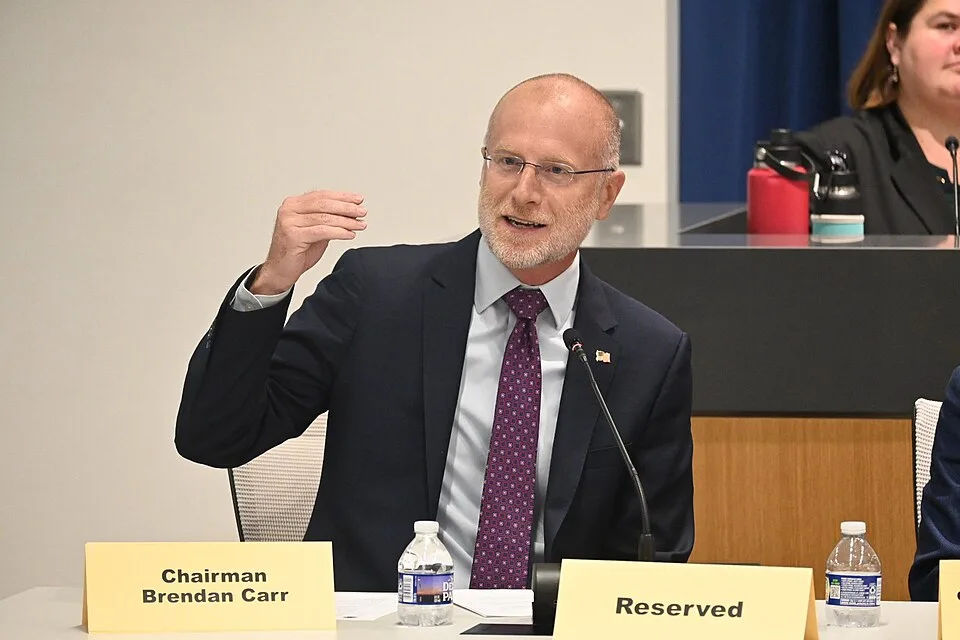
The FCC is reviewing whether to gut or eliminate E-Rate, the federally mandated program that has connected nearly every school and library in America to the internet since 1996. The stated reason, according to FCC Chairman Brendan Carr, is that kids are spending too much time on screens. The unstated reason, which Carr literally helped write down in a Heritage Foundation document, is Project 2025.
Thirty Years of Near-Universal School Internet, Meet Your Executioner
E-Rate is not a controversial program. That is the first thing you need to understand. When Congress created it in 1996 via the Telecommunications Act, only 14% of schools and libraries had internet access. Today that number is close to 100%. The FCC has administered it through both Republican and Democratic administrations without much drama for three decades. As NPR reports, by the agency's own data and its own measurement, the program is, in the words of one California technology director, simply "healthy."
So when the FCC announced a full review of E-Rate in late June and then approved a notice of proposed rulemaking calling to "limit screen time" as a justification for that review, the question a reasonable person might ask is: what the hell does screen time have to do with whether schools can afford to pay their internet bills? Great question. Glad you asked.
The Screen Time Argument Is as Thin as Dial-Up
FCC Chairman Brendan Carr's prepared statement at the commission's June hearing leaned heavily on the dangers of screen time for children and the growing body of research around it, according to NPR. And look, the screen time conversation is legitimate. States including Alabama, Tennessee, Utah and Virginia have passed legislation reevaluating technology in classrooms. The LA Unified School District, the second-largest in the country, approved a policy limiting student screen time. This is a real debate happening in real places.
But here is the thing: cutting the program that pays school internet bills does not reduce screen time. It just means schools cannot afford the internet. Those are not the same outcome, and anyone who has been inside a school building in the last ten years knows it. Schools use internet-based systems to track attendance, monitor bus routes, and administer state-mandated exams. According to the National Center for Education Statistics, 48 states now require some kind of online component in their standardized tests. You cannot opt out of the internet and still function as a public school in 2026.
Even advocates who genuinely want to reduce kids' screen time are not buying the FCC's logic. Josh Grolin, executive director at Fairplay, a nonprofit focused on digital safety for children, told NPR directly: "We believe there are ways of strengthening school policies to promote more limited and privacy-protecting use of EdTech without taking away critical E-Rate funding." When the people who actually want less screen time are telling you this isn't the way to do it, maybe listen.
The Project 2025 Connection Carr Would Prefer You Not Think About
Here is where the screen time argument collapses entirely under the weight of its own bad faith. NPR reports that the Project 2025 blueprint, compiled by the conservative Heritage Foundation to guide the second Trump administration, specifically singled out federal broadband policy as a target for cutting agency spending. Brendan Carr, the current FCC Chairman, helped write that chapter of the document.
So the man who put "cut broadband subsidies" into a transition planning document before he took the job is now running an agency review of the broadband subsidy program. And the reason he is giving publicly is screen time. This is not complicated. This is a predetermined conclusion in search of a justification, dressed up in the language of child safety because "we wrote this in Project 2025" does not poll as well.
Rural America Gets Hit the Hardest, Again
The fantasy underlying any push to kill E-Rate is that market competition will handle internet access if the government steps back. Bob Bocher, a senior fellow with the American Library Association who helped work on the original 1996 law, told NPR that this was the assumption at the time: competition would evolve and drive down prices. In cities, he says, there is something to that. Everywhere else, not so much.
Take Patrick Mayer, superintendent of the remote Alaska Gateway School District, which serves fewer than 400 students in an area where some kids take planes to school in the winter months. As NPR reports, his district spends more than half a million dollars per year on internet access for its six schools. "In rural Alaska, we don't have numerous options," Mayer told NPR. "We have one provider." One provider means no competition, which means no market pressure on price, which means E-Rate is not a nice-to-have supplement. It is the difference between schools that function and schools that don't.
In California's San Bernardino County, technology director David Thurston oversees internet access for 33 school districts spread across more than 20,000 square miles of mountains, desert, and urban sprawl. The infrastructure is already built. But internet bills are not one-time expenses. "Those are ongoing, essentially, utility costs," Thurston told NPR. "That's what E-Rate pays for." Lose E-Rate, and districts are looking at tens of thousands of dollars a month in new costs they do not have.
Can They Actually Kill It? Technically No. Practically, Maybe.
There is a legal floor here. Bocher told NPR that because E-Rate is written into the Telecommunications Act of 1996, the FCC almost certainly cannot eliminate the program outright. The Supreme Court also ruled last year that the Universal Service Fund, which is the money pool schools and libraries draw on to discount their internet costs, is constitutional.
But the FCC does not need to eliminate E-Rate to effectively destroy it. The agency could bury the program in compliance requirements so burdensome that schools and libraries give up trying to access the funding. Bocher has a phrase for this approach: "death by a thousand cuts. Death by a thousand rules and regulations." That is not a conspiracy theory. That is a documented strategy used by administrations on both sides to hollow out programs they cannot legally abolish. Make it painful enough, and participation drops. Program withers. Mission accomplished without ever having to hold a vote.
The Dingo Take
Let's be honest about what is happening here. A man who wrote in a transition document that federal broadband subsidies should be cut is now, in his capacity as FCC Chairman, initiating a review of the federal broadband subsidy program. The cover story is screen time. The actual story is Project 2025 executing on schedule, one program at a time, with whatever rationale happens to be available that week.
The screen time concern would be more convincing if the FCC were proposing, say, usage guidelines or EdTech transparency rules. Instead they are targeting the funding mechanism for internet access itself. That is not a screen time policy. That is a school defunding policy with a child wellness press release stapled to the front of it. The kids in rural Alaska taking planes to school are not going to benefit from Brendan Carr's concerns about too much TikTok.
Thirty years ago, Congress made a decision that connecting every school and library in America to the internet was worth doing as a matter of public policy. It worked. By every available metric, it worked. Now an FCC Chairman who pre-committed to gutting broadband policy before he took office is reviewing whether the thing that worked should continue working. If this program dies, it will not be because screen time data demanded it. It will be because the Heritage Foundation put it on a list and someone decided to follow the list.





Comments