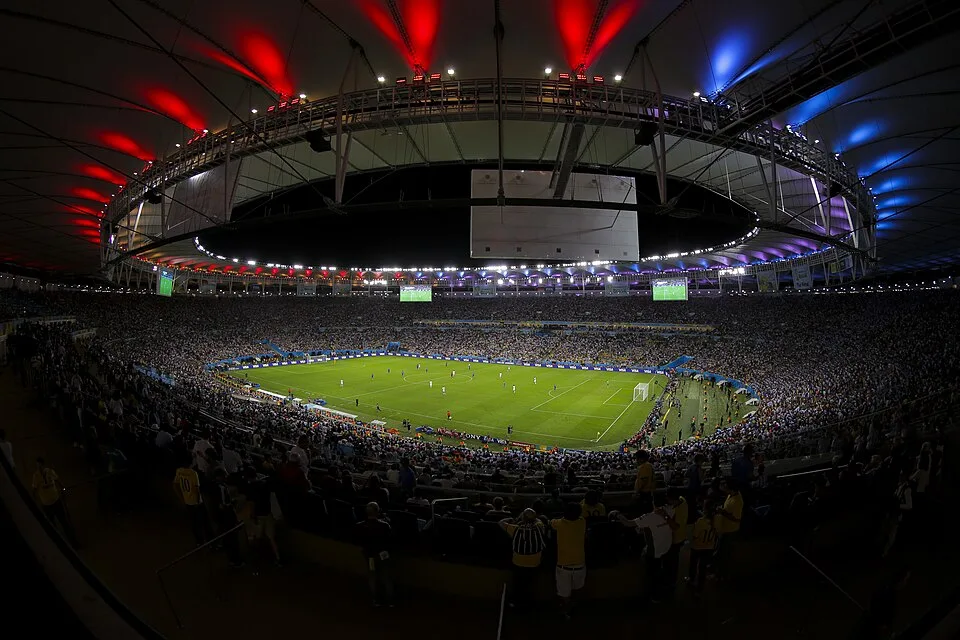
England is in the World Cup semifinals. Jude Bellingham has six tournament goals. And one of those goals almost certainly should not have stood, because the ball hit a camera cable dangling above the pitch and nobody with a whistle did a damn thing about it. Welcome to the beautiful game.
A Goal That Fell From the Sky. Literally.
Here is what happened just before halftime at Hard Rock Stadium in Miami Gardens on Saturday. Norway had a free kick. The ball went up, struck a sky camera cable suspended above the pitch, and dropped back down into a spot so perfectly convenient for England that if you wrote it in a screenplay, the producer would tell you to cut it because nobody would believe it.
From there, England built the play that ended with Jude Bellingham equalizing at 1-1. The New York Post reports that under FIFA rules, when a ball strikes overhead equipment, a drop ball should be called. The officials missed it. The video assistant referee also missed it, or chose not to act. Former Premier League referee Mark Clattenburg, watching on the Fox broadcast, was not confused about what should have happened. "It should have been picked up by the VAR," he said flatly.
FIFA later issued a claim that sensors inside the ball showed no spike in the ball's trajectory, meaning the camera contact supposedly did not alter the ball's path. Norway's manager, Stale Solbakken, was seen gesturing furiously at referee Clement Turpin during the halftime break. You get the sense Solbakken was not gesturing in admiration.
Turpin's Greatest Hits
The name Clement Turpin is not a new one in the annals of controversial officiating. The New York Post dug up a 2023 post-match press conference in which England manager Thomas Tuchel, then coaching Bayern Munich against Manchester City, had some thoughts about Turpin's performance. "I'd give him a 1/10," Tuchel told reporters. "He was absolutely terrible. It's unbelievable at this level."
Tuchel called him a "Grade E" referee. Tuchel is now England's manager. Turpin was Saturday's referee. The World Cup is held every four years, and somehow the universe arranged this specific combination of people in Miami on July 11, 2026. You cannot make this up. You could not make this up if you tried.
Turpin also waved away what Harry Kane believed was a foul on him earlier in the first half, moments before Norway scored their opening goal. So by the time Bellingham's ball-off-cable equalizer stood, Norway had some legitimate grievances stacking up.
The Part Where England Wins Anyway
Beyond the officiating chaos, this was a genuinely good, genuinely brutal football match played in conditions that NPR described as a heat index of 108 degrees in South Florida. Both teams looked like they were running through wet cement by the second half. The passes were short. The sprints were shorter.
Norway had taken the lead in the 36th minute through a blistering left-footed Andreas Schjelderup strike past England keeper Jordan Pickford. It was the fifth time Norway had scored first at this tournament. Norway then had what looked like a second-half go-ahead goal disallowed when video review caught Erling Haaland shoving an England player before a corner kick. In a match full of VAR drama, the one time it definitively intervened, it went against Norway.
After 90 minutes of 1-1, extra time began. Three minutes in, England keeper Jordan Pickford parried a long-range shot and Bellingham was right there to slot the rebound home. His sixth goal of the tournament. England 2, Norway 1. That was that.
Haaland and Norway Leave Miami Empty-Handed
Erling Haaland, possibly the most physically dominant striker on the planet, had a first half header that energized the crowd and then watched his potential go-ahead goal in the second half get wiped from the scoreboard by VAR. It was not his afternoon. It was not Norway's tournament.
This was Norway's deepest-ever run at a World Cup, according to NPR. They beat expectations to reach the quarterfinals. They scored first five times in the tournament. They deserved better than to go home with a legitimate grievance about a camera cable dangling above a Miami stadium and an official who, charitably, had a complicated afternoon.
For England, it is a different story. They advance to face the winner of Argentina versus Switzerland in the semifinal on Wednesday in Atlanta. England last won the World Cup in 1966. They are four wins from ending that particular national trauma.
What the Rules Actually Say
This deserves a clear-eyed look, because FIFA's post-match sensor explanation was doing a lot of heavy lifting. The rule is not ambiguous. The New York Post reports the rule plainly: if the ball strikes overhead camera equipment, a drop ball is the correct call. The question of whether the ball's trajectory changed is separate from whether the protocol was followed. It wasn't.
Clattenburg was specific on the Fox broadcast about why VAR should have caught it. An attacking phase of play leading to a goal qualifies as a reviewable incident. The camera contact was part of that phase. The VAR had both the mandate and the footage to intervene. It did not. England scored. The goal stood. And FIFA's sensors said everything was fine.
Somebody is going to write a very long Wikipedia footnote about this match.
The Dingo Take
Look, England might actually win this World Cup. Bellingham is playing like a man possessed, Kane is still a constant threat, and the team has that particular quality that champions tend to have, which is the ability to win ugly when the game stops going their way. All of that is real and worth acknowledging.
But the camera cable thing matters. Not because Norway definitely would have won, and not because one goal determines a whole match. It matters because FIFA runs the most-watched sporting event on earth, and when a ball visibly strikes a piece of their own equipment and the officials miss it, and the VAR misses it, and the correction mechanism that exists specifically for situations like this fails to function, the organization owes a better explanation than "our ball's heartbeat was fine." That is not a serious answer to a serious question.
Tuchel, the England manager who once called Turpin an absolute embarrassment, watched his team benefit from Turpin's inaction on Saturday and said nothing publicly. The irony is so thick you could slice it and serve it at a press conference. England are through. Norway are home. And somewhere above Hard Rock Stadium, a camera cable is just hanging there, completely unbothered.




Comments