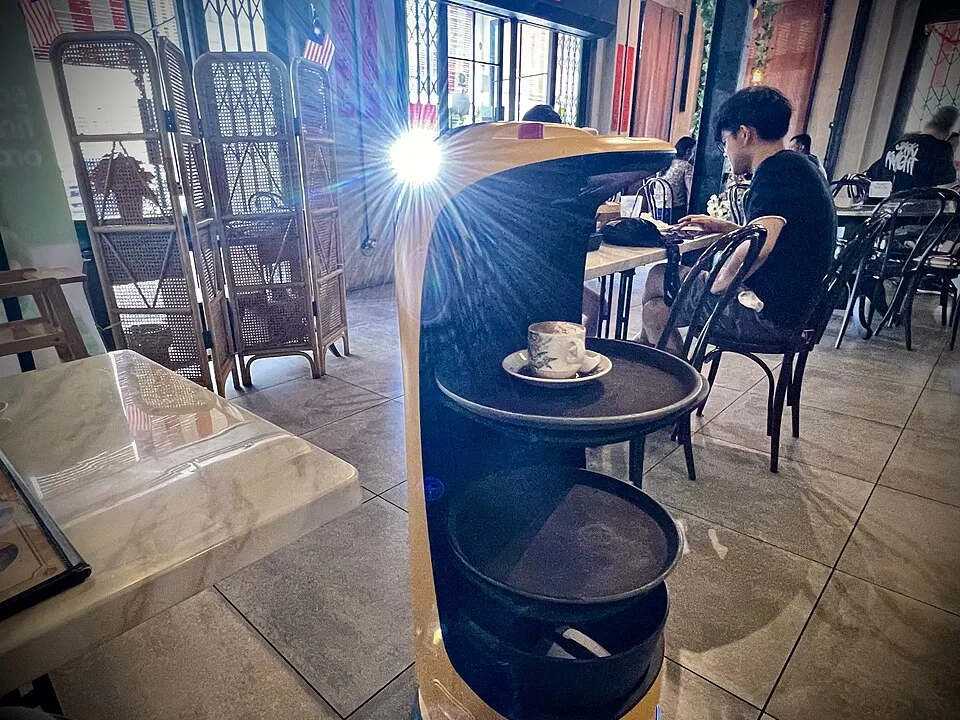
There is a cafe in Tokyo where robots bring you your food, and before you spiral into a Black Mirror episode, stop. Every single one of those robots is being operated in real time by a disabled person sitting at home, earning a paycheck, and talking to you through a little green-eyed machine. It is genuinely one of the most interesting things happening in technology right now, and almost nobody in the U.S. is talking about it.
The Setup Sounds Weird. It Is Not Weird.
Dawn Avatar Robot Cafe opened in Tokyo in 2021, and according to Good Good Good, it now employs roughly 100 workers called "pilots." These are people living with ALS, spinal cord injuries, severe heart conditions, and other disabilities that keep them homebound. They log into their home computers, take control of a small tabletop robot called an OriHime, and run a full cafe shift. Taking orders. Chatting with customers. Tilting the robot's head. All of it.
The robots have glowing green eyes and move around the tables with enough presence that diners reportedly form genuine connections with them. Tech influencer Evie Parker visited the cafe and shared in a recent vlog that she made a friend named Maya, who was piloting her robot. "We talked the whole time while I had lunch," Parker said. A person in a cafe made a friend. That's it. That's the whole story, except the friend was physically in a different building running a small robot body.
This is not AI. There is no algorithm deciding what to say to you. A human being is watching through the robot's camera, thinking of something funny to say, and saying it. The warmth is real because the person is real.
Where This Came From
The person behind all of this is Ory Yoshifuji, and his origin story is the kind of thing that would feel too on-the-nose in a movie. As a child, Yoshifuji spent three and a half years quarantined at home due to illness, cut off from school and friends. As Good Good Good reports, he found himself wondering, "Why couldn't I have a second body?" He went on to study robotics, founded Ory Laboratory, and eventually built the OriHime robot to answer that question.
After some pop-up cafe experiments, he made it permanent. "We've managed to create a situation where people, even if they can't physically move around much, can still participate as members of society and as productive members of the workforce," Yoshifuji told the Australian Broadcasting Corporation. He is not being grandiose. That is literally what he built.
Ory Laboratory has since expanded the concept beyond the cafe. Tourists in Tokyo can now take a mobile OriHime robot with them as a personal guide, with a pilot on the other end offering commentary, recommendations, and apparently some giggles along the way. Canadian tourist Dave Schultz told the ABC, "You can hear the warmth through their voice." A remote worker. In a robot. On your shoulder. Giving you a city tour. The future is profoundly strange and occasionally wonderful.
What This Actually Means for People
Meet Naoki. He has severe heart failure and is waiting for a transplant. Doctors told him to stop working. Good Good Good reports that he described what came next plainly: "I retreated into my shell." Then he found the Dawn Cafe pilot program.
"My first impression was that I am able to return to society," Naoki said in a video about his experience. "Now that I work like this, the joy of it is more prominent. I enjoy my days together with the customers. The way I feel has changed completely. It's like my feelings have been transplanted." A man waiting for a heart transplant describing his emotional state as having already been transplanted. That is not a line a copywriter came up with. That is a person telling you what it means to have something to do, somewhere to be, and someone to talk to.
This is not about productivity as a measure of human worth. People who cannot or choose not to work are not worth less. But for people who want to engage with the working world and have been locked out of it by their bodies, Yoshifuji built a door. That is a specific and meaningful thing.
Meanwhile, Back in the AI Panic
Right now, the dominant conversation about robots and automation is about replacement. How many jobs will AI eat. How fast. Which ones are safe. It is a legitimate conversation and the concerns are real. But the Dawn Cafe is a useful piece of evidence that the question "what do we do with this technology" is not already answered.
Parker, the tech influencer, put it well in her vlog: "The truth is, robots aren't the scary part. The real question is, what will we build them for?" She is correct, and it is a question that most of the companies currently racing to automate everything are not spending a lot of time on. Yoshifuji spent his entire life on it, starting when he was a sick kid alone in his room wishing he could be in two places at once.
The Dingo Take
Here is the thing about this story. It should not feel remarkable that someone figured out how to use technology to give disabled people access to work and social connection. That should be a baseline expectation. The fact that one guy in Tokyo had to invent it himself, from a childhood illness, through a robotics degree, through years of pop-up experiments, is an indictment of every tech billionaire who spent the same period of time building faster ways to serve ads to people.
We are living through a moment where the loudest voices in technology are very excited to tell you that AI is going to change everything, disrupt everything, replace everything. And some of them are right, and most of them are primarily excited about it because disruption is good for their portfolios. Yoshifuji built something that costs jobs absolutely nowhere and creates them for people who had none. There is no venture capital talking point in that. There is just a guy with a green-eyed robot asking if you want more coffee, and somewhere across Tokyo, a person with a damaged heart laughing at something you just said.
The Dawn Avatar Robot Cafe has about 100 pilots. That is 100 people who have a shift to show up to, a reason to put on something other than pajamas (metaphorically, they're at home, wear whatever), and a stranger to make laugh over lunch. In the middle of an era when technology is being wielded to hollow out the workforce and concentrate wealth in fewer and fewer hands, Tokyo built the opposite of that. It would be nice if someone noticed.




Comments