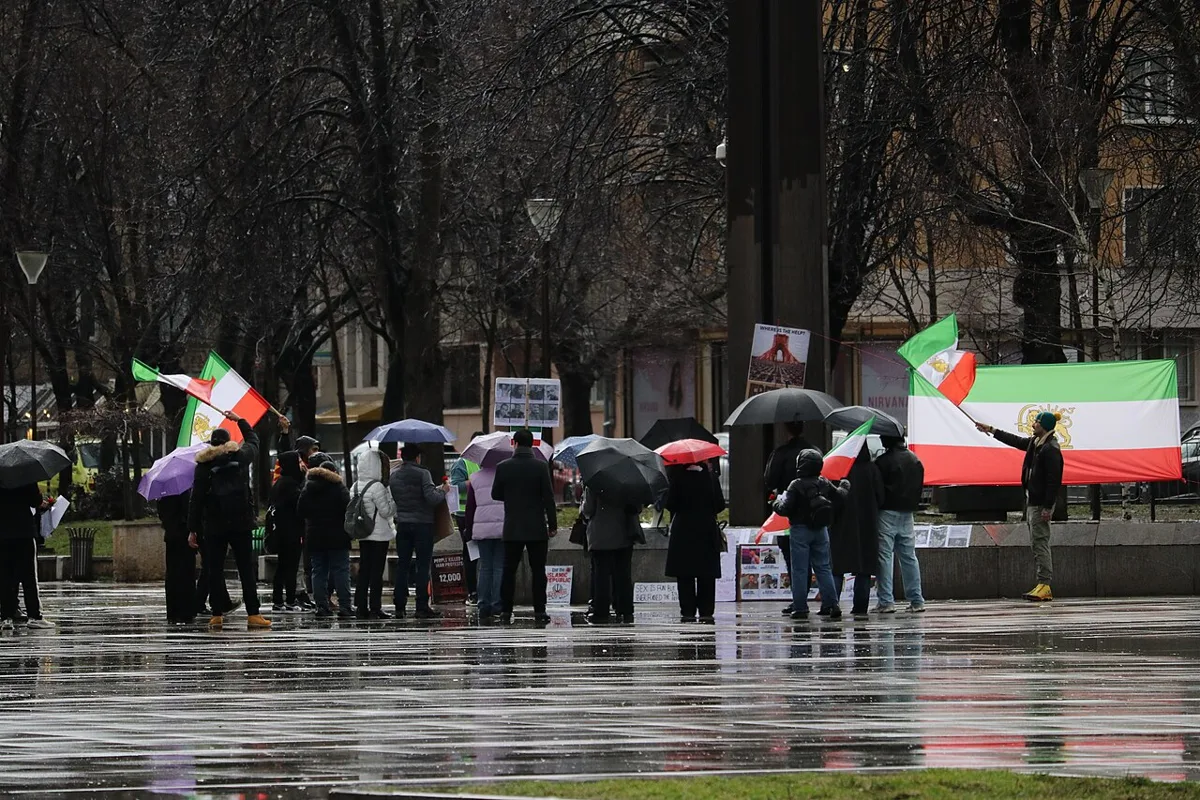
Mourners at a dead supreme leader's funeral waved signs calling for the sitting U.S. president to be killed, and the sitting U.S. president responded by going on social media at some ungodly hour to threaten to obliterate an entire civilization. This is the state of American diplomacy in July 2026. The interim deal that was supposed to stop a shooting war between the United States and Iran is now held together with the diplomatic equivalent of wet tissue paper.
What Trump Actually Wrote, In Case You Thought We Were Exaggerating
According to AP News, Trump posted on his website that a thousand "missiles are Locked and Loaded and aimed at the Islamic Republic of Iran, with thousands more to immediately follow" if Iran acts on its threats against him. He said he was responding to the kill-Trump banners that appeared at Ayatollah Ali Khamenei's funeral this week. Khamenei, 86, was buried after dying when the war began on February 28.
That alone would be a full news cycle anywhere in a normal political era. But Trump kept going. He added that the U.S. military would "completely decimate and destroy all areas of Iran — PRAISE BE TO ALLAH!" AP News reports this is part of a pattern: Trump has repeatedly invoked the name of God in Arabic while threatening to destroy Iranian civilization, something the Council on American-Islamic Relations has called "deranged mocking of Islam."
To be very clear about the sequence of events here: a foreign leader died, his mourners expressed rage at a funeral, and the U.S. president responded with overnight social media posts threatening to reduce a country of 90 million people to rubble, signed off with a religious phrase from their own faith used as a taunt. That happened. That is the record.
The New Supreme Leader Has Opinions
Iran's new Supreme Leader Mojtaba Khamenei, the late ayatollah's son, made his position clear on Saturday. Avenging his father's death "is the will of our nation and must certainly be carried out," he said in remarks carried by Iranian state television, as AP News reports. He has not appeared publicly since the war started, which makes this vow slightly more theatrical and slightly less immediately terrifying, but vow he did.
Iran's foreign minister, Abbas Araghchi, meanwhile flew to Oman on Saturday for more talks. He also accused the United States of violating the interim deal by canceling oil sale waivers that allowed Iran to sell crude on international markets in U.S. dollars. Washington pulled those waivers after Iran attacked ships in the Strait of Hormuz. "Reality check: There can only be mutual compliance," Araghchi posted on X, which is a remarkably calm tweet for a man whose country is currently being bombed.
Turkish Foreign Minister Hakan Fidan told state broadcaster TRT that he believed "a solution can be reached" this weekend. Bless his optimism.
The Strait of Hormuz Is the Whole Problem
Here is the core dispute grinding everything into rubble. The United States and the world consider the Strait of Hormuz an international waterway, which it has been for decades. Iran, since the war began, has insisted the strait is under its sole control and that ships must pay Tehran fees to pass through it. AP News notes that roughly a fifth of all globally traded oil and natural gas moved through that strait before the fighting started.
The Biden-to-Trump handoff left all of this unresolved, and now the U.S. is urging ships to take a southern route through Oman's territorial waters to avoid Iranian interference. Iran's UN diplomat said Friday that any activity in the strait, including opening it or clearing mines, "rests exclusively with Iran." Senior U.S. officials are demanding Iran make a public statement confirming the strait is open and ships are safe. Iran is not doing that. So here we are.
Oil prices, for what it's worth, have dropped sharply from wartime highs of $120 a barrel, according to AP News. That's something. Not enough, but something.
Someone Is Bombing Iran and Nobody Is Claiming It
After the U.S. wrapped up its latest round of strikes on Thursday, more explosions reportedly hit Iran. Nobody claimed them. AP News reports that Israel didn't take credit, which points toward Gulf Arab states as the likely culprit, probably trying to deter Iran after Tehran retaliated for U.S. strikes by targeting Bahrain, Jordan, Kuwait, and Qatar. Iran fired on four countries in one day. Four. That is not a ceasefire. That is not even close to a ceasefire.
The U.S. strikes over two days killed at least 17 people and wounded 115 others, according to Iranian Health Ministry spokesperson Hossein Kermanpour. U.S. officials, speaking anonymously to AP News, blamed the resumption of strikes on what they described as a rogue faction of Iranian hard-liners trying to sabotage the deal from within. Iran says its government is unified and there are no rogue factions. Both things can't be true, and figuring out which one is correct matters enormously for whether any negotiated outcome is even possible.
The Nuclear Question Hanging Over All of This
Underneath the immediate war, the broader nuclear standoff is getting sharper. AP News reports that U.S. officials told journalists the United States will never reach a nuclear deal with Iran unless Tehran first stops attacking ships. And any deal on the nuclear program, the officials said, would require Iran to physically hand over its stockpile of highly enriched uranium. That uranium is believed to be sitting at nuclear sites the U.S. already bombed in 2025.
Iran has repeatedly refused to surrender that material. The International Atomic Energy Agency has noted Iran is the only country on Earth enriching uranium to near-weapons-grade levels while claiming its program is purely peaceful. U.S. officials said without a deal, they have military options to ensure the enriched uranium stays buried underground permanently. They did not spell out what those options are. They did not need to.
So the framework being demanded is: stop controlling the strait, give up your uranium stockpile, and publicly back down from threats. Iran's counter-position is: the strait is ours, keep your sanctions off our oil, and our new supreme leader just vowed vengeance on television. Talks are ongoing.
The Dingo Take
Let's just sit with the absurdity for one moment. The ceasefire is functionally dead. The new Iranian supreme leader is vowing revenge from an undisclosed location. Multiple countries in the Middle East got hit with Iranian missiles this week. Somebody is bombing Iran and won't say who. And the American president spent part of his night writing capitalized threats on his personal website and signing them off with "PRAISE BE TO ALLAH" as a joke. This is the diplomatic situation. This is what's being managed.
The scariest part of this particular mess isn't Trump's posting or even the ongoing strikes. It's the uranium. If there is no deal and Iran still has enriched uranium at near-weapons-grade levels buried in sites that have already been bombed once, the pressure to bomb them again, and again, until the program is dead, does not go away. It builds. The U.S. officials quoted by AP News weren't being subtle about that. The military option they refused to describe has been the implied threat for years. The question is whether anyone with authority on either side actually wants to prevent the moment it stops being implied.
Mediation is happening. Oman is hosting talks. Turkey is optimistic. Qatar was just in Tehran. The machinery of diplomacy is grinding away while missiles are locked and loaded and a new supreme leader is vowing revenge on state television. Someone needs to get a grip here. The list of candidates for who that might be is not as long as you'd hope.




Comments