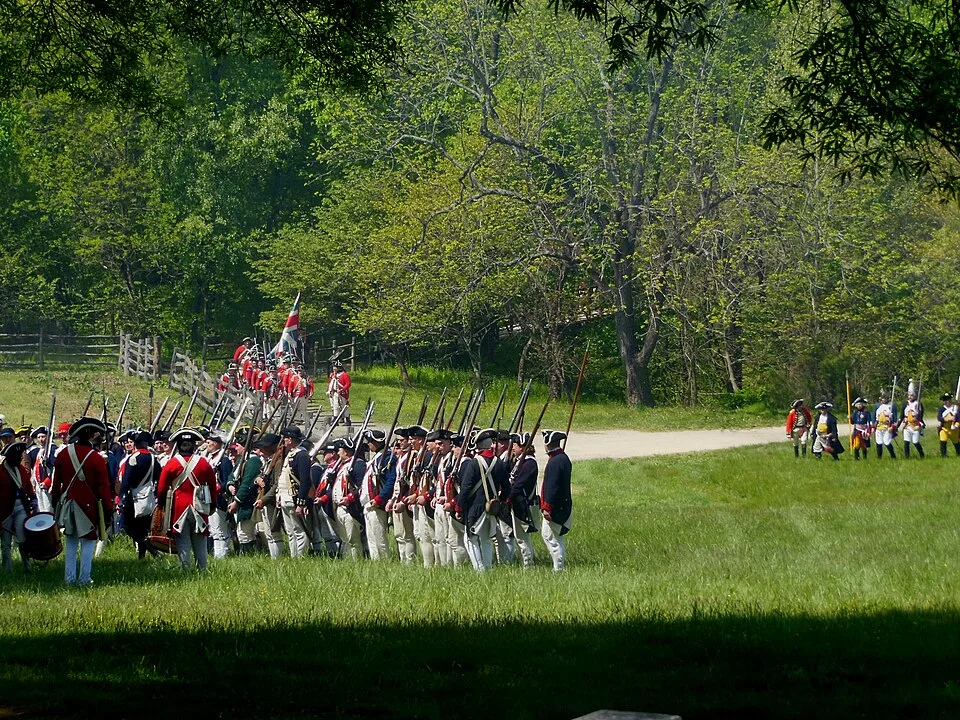
Georgia had a complicated relationship with the American Revolution. Like, genuinely weird and contradictory in ways that your high school history class absolutely did not cover. A new podcast is using the state's 2,000 roadside historical markers as a guide to untangle the whole messy story.
The State That Wasn't Sure Which Side It Was On
Here's the thing about Georgia and the Revolution: it was not a clean, patriotic, everyone-sang-Yankee-Doodle situation. The state was deeply divided between Loyalists and Patriots, saw some of the most brutal civil-war-style fighting of the entire Revolutionary period, and at one point was essentially back under British control. That is not the version of events that tends to make it onto the commemorative plaque at a rest stop.
But those plaques, all 2,000 of them scattered across the state, are exactly where NPR's Don Gonyea went looking for answers. In a conversation aired on All Things Considered, Gonyea spoke with Andrew Iden, the Executive Producer of Marked!: The Podcast, a show that uses Georgia's roadside historical markers as a framework for exploring what the state actually went through during America's founding years.
Two Thousand Signs and Counting
Two thousand roadside markers is a lot. That is more historical markers than most people will read in a lifetime of road trips and gas station stops. Georgia has been quietly installing these things for decades, and the cumulative result is something close to an open-air archive of the state's entire history, Revolution included.
Iden's podcast takes that archive seriously. Rather than treating the markers as quaint background scenery for a selfie, Marked! digs into what each sign is actually saying, what it might be leaving out, and why any of it matters in 2026. According to NPR, the project uses these physical touchpoints as jumping-off points for a much deeper conversation about Georgia's place in the Revolutionary story, one that most national histories have either glossed over or ignored entirely.
Why Georgia's Revolution Hits Different
Most popular tellings of the American Revolution are set in Massachusetts, Pennsylvania, and Virginia. Lexington, Concord, Valley Forge, Yorktown. Georgia barely gets a mention, which is genuinely strange when you look at what actually happened there.
The state was the site of significant military campaigns, complex political loyalties, and violence between neighbors that looked less like a glorious uprising and more like the kind of grinding civil conflict historians usually reserve for the 1860s. Savannah fell to the British in 1778 and wasn't retaken until 1782, meaning Georgia spent a large chunk of the war under enemy occupation. That is the kind of detail that reframes the whole narrative, and it's exactly the kind of thing a bronze sign on a state highway might quietly point you toward if you stopped long enough to read it.
Podcasts Doing the Work History Class Skipped
Marked!: The Podcast is part of a broader wave of regional history projects that are pushing back against the flattened, greatest-hits version of American history that most people grow up with. The approach is smart: take something physical and local, something people drive past every single day without thinking about it, and use it to crack open a story that's been sitting there the whole time.
It's a format that respects the audience. You don't need a PhD to stand next to a roadside marker. You just need someone willing to explain why the thing on the sign matters, and how it connects to everything else. According to NPR's reporting, that's precisely what Iden set out to build.
The Dingo Take
Look, history in America has a bad habit of getting simplified into a clean morality play: brave colonists, villainous British, triumphant independence. Georgia's actual Revolutionary War experience is a direct rebuke to that story. It was messy, it was brutal, and the loyalties involved were nowhere near as obvious as the mythology suggests. The fact that you can drive past 2,000 historical markers in a single state and still not know any of this says something uncomfortable about how selectively we choose to remember things.
What's interesting about the Marked! project, beyond just the history itself, is the medium. Road signs are democratic in a way that museums and documentaries aren't. They're just there, on the side of the road, available to anyone who happens to slow down. Using them as the spine of a podcast is a genuinely clever way to make local and regional history feel accessible instead of academic.
The American Revolution is having a bit of a cultural moment right now, caught between people who want to lionize the founders without complication and people who want to burn the whole mythology down. Georgia's story suggests a third option: just tell the truth about what actually happened, in all its contradictory, uncomfortable detail. The signs have been pointing the way this whole time.



Comments