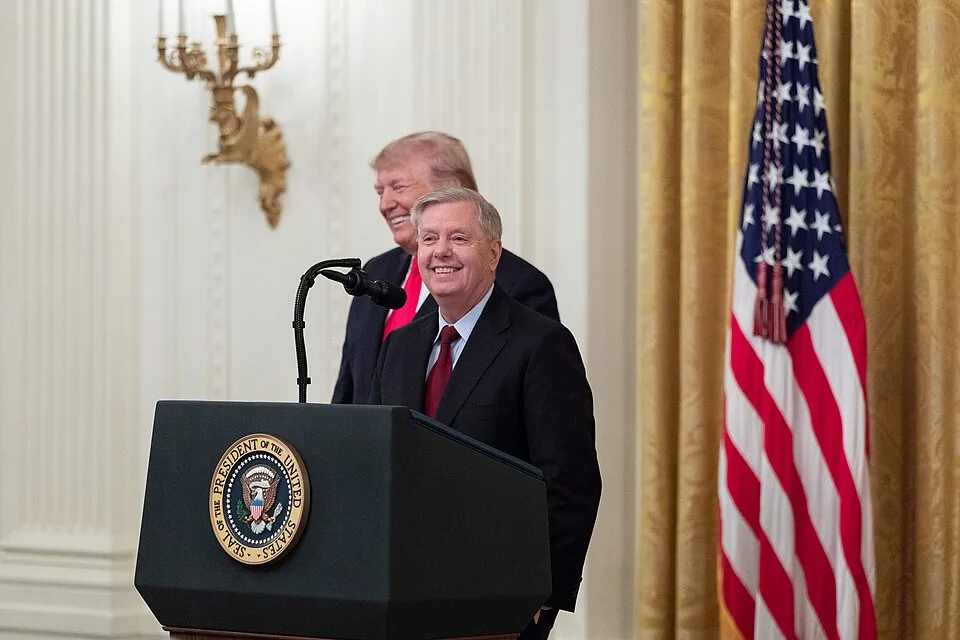
Lindsey Graham spent Friday on the phone from Kyiv, buzzing with excitement because the Trump White House had finally given him the go-ahead on his Russia sanctions bill. He was dead by Saturday. Whatever you thought of the man, that timing is brutal.
He Was In the Middle of Something Big
According to CBS News, Graham had just completed his tenth trip to Ukraine when he died. Ten. The man kept going back to a war zone, at 69 years old, while most of his Senate colleagues were busy figuring out how to avoid saying anything on camera that might upset the base.
He spoke twice by phone with CBS News anchor Margaret Brennan on Friday while he was still in Kyiv. He told her it was a big day. He was excited. He had news. The Trump White House had finally cleared him to move forward with legislation that would hit buyers of Russian oil with serious financial penalties, a bill Graham had been trying to get across the finish line for years.
That call happened Friday. He was gone Saturday. There is no dark punchline here. That is simply what happened.
What the Bill Actually Does
The legislation Graham had been pushing would impose significant financial penalties on countries that purchase Russian oil, the kind of secondary sanctions designed to make doing business with the Kremlin genuinely painful. The primary targets: China and India, which CBS News notes are the two biggest buyers of Russian fuel and have been essentially keeping Putin's war economy on life support while the West congratulated itself for its own sanctions regime.
Graham told Brennan he believed the bill would get overwhelming Republican support, pointing out that past versions had attracted 85 Senate signatories. That is not a fringe position. That is close to a supermajority of the chamber agreeing that squeezing Russia's oil revenue is a good idea.
He also made a point of crediting his Democratic partner on the bill, Connecticut Senator Richard Blumenthal, and urged Brennan twice to call Blumenthal and put him on the record too. In 2026, a Republican senator in a war zone repeatedly insisting that a Democrat get his fair share of credit for bipartisan legislation is, genuinely, a notable thing to witness.
A Year of Pushing, Finally Moving
This was not a new crusade. CBS News reports that almost exactly one year before Graham's death, he and Blumenthal had appeared together on Face the Nation to push the same basic effort. Graham said at the time he wanted to hand Trump "a sledgehammer to go after Putin's economy, and all those countries who prop up the Putin war machine." That quote aged into something more poignant than anyone intended.
The two senators had also traveled through Europe together, lobbying European governments to mirror the sanctions and cut off their own purchases of Russian fuel. This was coalition-building. Actual legislative diplomacy, the kind of thing Washington used to do before it became a performance art installation.
Blumenthal told CBS News on Friday that he and Graham had the votes to pass the bill. Then Graham died. Now it falls to Republican Senate and House leadership to decide whether to pick it up and carry it.
What Changed Trump's Mind
Graham told Brennan that Putin's relentless attacks on Ukraine had made it undeniable that the Russian president was, in his words, "saying one thing and doing another." That is a diplomatic way of describing what the rest of the world has been watching for four-plus years.
He had just met with Ukrainian President Volodymyr Zelenskyy before those phone calls, and he told Brennan he believed Trump now sees Zelenskyy as "more of a winner." Read into that what you will. The implication is that Trump's support for Ukraine, and his willingness to let Graham run with this sanctions bill, is at least partially contingent on Zelenskyy's image rather than the underlying facts of an illegal invasion of a sovereign country. But Graham was not going to say that out loud. He was working with what he had.
The Other Unfinished File
The Russia sanctions bill is not the only thing Graham left hanging. CBS News reports he had also been working to turn the ongoing Iran conflict into a window for normalizing relations between Saudi Arabia and Israel, a goal he had originally been pursuing with the Biden administration before October 7, 2023 blew that entire framework apart.
Three weeks before his death, Graham had appeared on Face the Nation pushing that effort. He had told Brennan on Friday that he wanted to come back on the show with Blumenthal again once they got the sanctions bill moving. That appearance is not going to happen.
Two massive foreign policy efforts, both mid-stream, both now dependent on whether anyone in the Senate actually wants to pick up where he left off. History is not encouraging on that front.
The Dingo Take
Here is the uncomfortable thing about Lindsey Graham: he was a genuinely complicated figure in a political era that does not do complicated well. He was a shameless Trump enabler on domestic politics, a man who spent years contorting himself into positions that would have horrified his former best friend John McCain. On that ledger, the criticism was earned and it was extensive.
But on Ukraine, Graham was consistent in a way that very few Republican senators managed to be. He kept going back. He kept pushing. He was on the phone from Kyiv, excited about a sanctions bill, hours before he died. Whatever else you want to say about the man, that is not nothing. The bipartisan work with Blumenthal, the European lobbying trips, the decade-long effort to give the executive branch real financial leverage over Russia: this was the work of someone who actually believed in what he was doing.
Now Senate Republican leadership has to decide whether to take up a bill that 85 of their colleagues had already supported, that would punish the buyers of Russian oil, that a just-deceased member of their own party spent years of his life fighting for. They will be watched. They will be tested. The smart money, in this Congress, is on them finding a reason to quietly let it die. Prove us wrong.




Comments