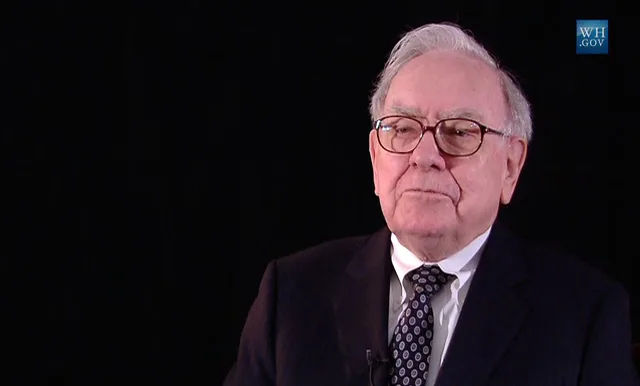
Warren Buffett, the man who spent seven decades quietly compounding wealth while everyone else chased the next hot thing, has finally said out loud what a lot of people have been thinking: America has turned into one giant casino and nobody's particularly worried about it. The Oracle of Omaha sat down with CNBC and delivered a verdict on modern American finance that should probably be printed on the wall of every brokerage app currently offering zero-commission options trading to college sophomores. He's retired. He's 95. He still can't help himself.
What Buffett Actually Said
According to Axios, Buffett used his CNBC interview to make a fairly damning observation about where American financial culture has ended up. "It's tough to find values when everybody is preferring gambling," he said. That's a sentence worth sitting with for a moment.
He went further. "Since humans love to gamble so much, there's more money in actually cultivating gamblers than there are cultivating investors." Read that twice. The most successful long-term investor in the history of American capitalism is telling you, plainly, that the financial industry has figured out it's more profitable to feed addiction than to build wealth. That is not a subtle critique. That is an indictment.
This Isn't Just an Old Man Yelling at Clouds
It would be very easy to dismiss this as generational grumpiness. Some crusty billionaire who doesn't understand meme stocks, crypto, and prediction markets telling kids to get off his lawn. Except Buffett's whole career has been built on being right about exactly this kind of thing while everyone else was busy being wrong in the most entertaining ways possible.
He watched the dot-com bubble inflate and pop. He watched the mortgage-backed securities disaster unfold in slow motion. He has seen this movie. The specific technology changes. The human behavior underneath it does not. When he says the financial industry has shifted from cultivating investors to cultivating gamblers, he is describing a business model, not a vibe.
And the business model is working beautifully, by the way. For the people running the casino. Less so for everyone playing in it.
The Infrastructure of the Bet
Look at what has actually been built over the last decade. Robinhood gamified stock trading with confetti animations and made options accessible to people who had no business trading options. Crypto exchanges ran Super Bowl ads promising financial liberation and then collapsed, taking customer funds with them in several memorable cases. Sports betting went from legal in one state to legal in most of them in about five years, and the apps followed people into their living rooms, their bathrooms, their 3am moments of poor judgment.
And then there's the prediction markets. Platforms like Kalshi, which Axios specifically connected to this story, have been pushing to expand what you can legally bet on into territory that would have seemed insane ten years ago. Election outcomes. Economic indicators. Pretty much anything with a binary result and enough public interest to generate volume. The line between "financial instrument" and "bet" has not so much blurred as it has been professionally erased by lawyers and lobbyists.
Buffett is not wrong that there is a lot of money in building this stuff. He is also not wrong that it is not the same thing as helping people build wealth.
The Part Where We Note He's Still Rich
To be completely fair to the critics of Buffett's position, the man is worth well north of a hundred billion dollars. His concern about gambling culture is not exactly coming from the perspective of someone who has ever had to choose between a risky investment and paying rent. There is something a little convenient about the world's most successful traditional investor showing up to say that the alternatives to traditional investing are bad, actually.
And some people would argue that prediction markets and speculative instruments serve real price-discovery functions, that they aggregate information efficiently, that not every financial product needs to be a thirty-year index fund. Those are not crazy arguments. Economists make them in good faith.
But there is a difference between a financial instrument that happens to resemble a bet and an entire industry whose core revenue model depends on keeping people engaged, emotionally activated, and coming back for more. Buffett's point isn't really about the instruments. It's about the incentive structure of the people offering them.
Why Anyone Under 40 Should Care About This
Here is the uncomfortable part. The people most aggressively targeted by gambling-adjacent financial products are younger Americans, specifically the ones who came of age during a period when wages stagnated, housing became a generational joke, and traditional wealth-building felt like a game rigged in favor of people who already had money. The appeal of a big swing makes complete psychological sense when the slow-and-steady path seems closed.
The platforms understand this. The marketing understands this. "You could be up $10,000 by Friday" lands very differently on someone drowning in student debt than it does on someone with a pension and a paid-off house. Buffett's critique of the gambling culture doesn't fully reckon with why the gambling culture is so appealing right now, which is a real gap in his analysis. But it doesn't make the underlying observation wrong.
The Dingo Take
Warren Buffett spent most of his career being boring in the most profitable way possible and the entire financial media complex spent decades alternately mocking him and genuflecting at him. Now he's retired, he has nothing to sell, and he's sitting down with CNBC to tell you that the industry has fundamentally changed in a direction he finds alarming. That is worth taking seriously.
The thing about "there's more money in cultivating gamblers than cultivating investors" is that it is descriptively accurate and also a little horrifying. It means the incentives are pointed in exactly the wrong direction. The platforms, the apps, the exchanges, the prediction markets: they all make more money when you trade more, when you stay engaged, when you feel the rush. They do not make more money when you put a thousand dollars into an index fund and check it in twenty years. One of those behaviors builds wealth. The financial technology industry has correctly identified which one it prefers you to do.
Buffett won't be around to watch the consequences of all this fully play out. A lot of the people currently getting "cultivated" by these platforms will be. That's the part that should probably be keeping someone up at night, and based on this interview, it's at least keeping a 95-year-old in Omaha mildly annoyed.



Comments