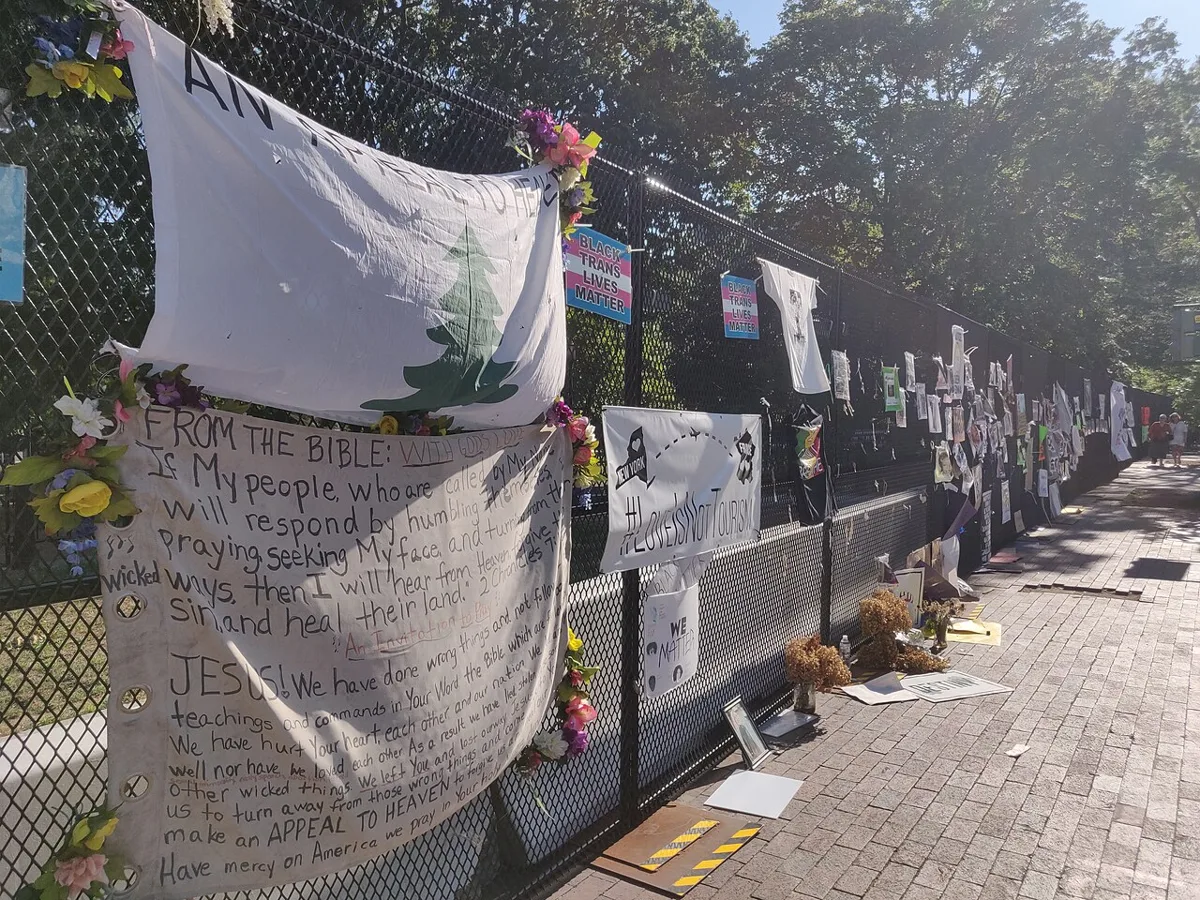
The Trump administration has formally proposed installing permanent 8-to-9-foot fencing around Lafayette Park, the seven-acre plot directly north of the White House that has served as America's most prominent protest ground since suffragettes were dragged off it in 1917. The park has already been sealed behind temporary chain-link since January, well past the July 4th deadline officials cited as justification. Now they want to make it forever.
Here's What They're Actually Proposing
According to NPR, the United States Secret Service and the Executive Office of the President, working with the Department of the Interior, submitted a 79-page proposal to the Commission of Fine Arts last week. The plan calls for permanent fencing that can be locked down during what the document calls "heightened conditions." In plain English: when people want to protest.
The proposal also wants to repave the park's walkways in granite, replacing the current bricks. The stated reason, lifted directly from the document, is that loose bricks could pose "tripping hazards" and be used as projectiles during protests. So the administration's official position is that the park's current pavers are a protest weapon. They wrote that in a federal document. Seventy-nine pages of it.
The Commission of Fine Arts is one of two federal bodies that has to review this kind of project before it moves forward. The administration says it anticipates "phased implementation beginning in 2027, sequenced according to funding availability." Which is bureaucratic for: we want this done but we're not telling you what it costs or who pays for it.
The Money Question Nobody Will Answer
NPR asked the White House directly how much this project will cost, who will fund it, and what happens to accessibility. The White House did not answer any of those questions. Instead, it issued a statement that read, in its entirety: "There are always discussions ongoing about how to make the White House Complex as safe as possible. However, nothing is confirmed at this time."
What we do know is that Trump posted on Truth Social in April claiming he had already made a "multimillion contribution" to beautification efforts at the park. So the president is personally funding renovation of federal public land, and nobody in his administration will say how much, from where, or on what terms. That's a completely normal thing that definitely shouldn't raise any questions.
Lafayette Park is public land. It is maintained by the National Park Service. It belongs to the taxpaying public, which is exactly the group being locked out of it.
The Park Has Been Closed Since January Already
The National Park Service announced in January that large portions of Lafayette Park would be closed through May for landscaping and repairs ahead of the nation's 250th birthday celebrations. NPR reports that as of mid-July, with workers mowing the lawns inside, the fences were still up and pedestrians were still kept off the grass.
Marty Pearl, 83, told NPR he has brought his "Hate Won't Make America Great" sign to the area approximately 1,200 times over the past eight years. He put it simply: "Unless your calendar is way out of date, July 4th is gone, and this is still sealed off."
The administration used a holiday as the justification for a temporary closure. The holiday passed. The fences stayed. Then they filed 79 pages asking to make the fences permanent. If you're keeping score at home, this is not how temporary works.
The People Who Show Up Anyway
On Tuesday morning, NPR found protesters gathered just outside the park in the heat, rallying against ICE following two deadly shootings in less than a week. Donna Powell, 67, told NPR she and her husband come to the area several times a week, rotating through a collection of nearly 80 handmade signs they keep at home. That day's selection included a Trump cutout holding a sign reading "I'm stealing from YOU!"
Powell said a permanent fence wouldn't stop her. But she was clear about what she thinks it means: "It's mind-boggling that he is so fearful of peaceful protesters that he feels like he has to put up multiple layers of fencing so that we can't get in there."
Pearl offered a darker read. He told NPR that more fencing would paradoxically funnel tourists into a smaller area, making it easier to get his message seen. But that wasn't comfort. "What this fencing represents, to me, is the worst of what the new attitude toward politics represents," he said. "And that is imperialism, fascism, dictatorship. Because what dictators do is isolate themselves from the people they rule."
Why Lafayette Park Specifically Matters
Lafayette Park isn't just any green space. It sits directly north of the White House, making it the closest a regular person on foot can legally get to the building. As NPR notes, the White House itself is already surrounded by a 13-foot steel fence. Lafayette Park was the sliver of public ground that remained between the public and that barrier.
The park has hosted protests continuously for more than a century. Hundreds of suffragettes were arrested outside the White House in 1917, with some serving jail time. The park has seen anti-war rallies, civil rights demonstrations, and the 2020 protest that the prior Trump administration infamously cleared with tear gas and mounted police so Trump could walk to a nearby church for a photo op.
That history is precisely the point. This is not a random piece of federal lawn. It is the place Americans have walked to, stood at, and screamed from when they needed the president to hear something he didn't want to hear. Fencing it off permanently is not a landscaping decision. It is a statement about who the White House belongs to.
The Dingo Take
Let's be clear about what is actually happening. The Trump administration is proposing to permanently fence off the most symbolically important public protest site in the United States, on the stated grounds of security and the genuinely stated grounds that bricks might be thrown. The park has already been closed for seven months past its stated reopening date. The president claimed on Truth Social that he personally paid for renovation work there. Nobody will say how much. Nobody will say from whose accounts. Nobody in the White House would answer a single one of NPR's questions on the record.
This is the part where someone usually says, well, every president has increased White House security, which is true. But no previous administration filed a 79-page federal proposal to permanently fence the closest public viewing area to the White House, while simultaneously claiming it's not confirmed yet, while simultaneously saying it starts in 2027, while simultaneously refusing to discuss cost or funding. That's not a security upgrade. That's a paper trail for something they've already decided.
Marty Pearl, 83 years old, 1,200 visits, still showing up with his sign. Donna Powell, three days a week, 80 handmade posters in a rotation. These are the people the administration wants to put on the other side of a nine-foot fence. And the most damning part is that the administration's own proposal basically admits what this is about: the fence gets locked during "heightened conditions," which in practice means whenever enough people show up to make the president uncomfortable. That's not a security policy. That's a definition of what a protest is, and a plan to stop it.



Comments