
A professional investigative journalist with nearly a decade of experience just scored 25% on a quiz designed to tell real photos from AI fakes. That's worse than random chance. And according to the company that built the quiz, she's completely, devastatingly normal.
The Quiz That Should Terrify You
Veriff, an online identity verification company, recently surveyed Americans on their ability to distinguish real images from AI-generated deepfakes. The results, as CBS News reports, landed right around 50/50. A coin flip. You could close your eyes, point at the screen, and statistically do just as well as your average American trying to figure out what's real.
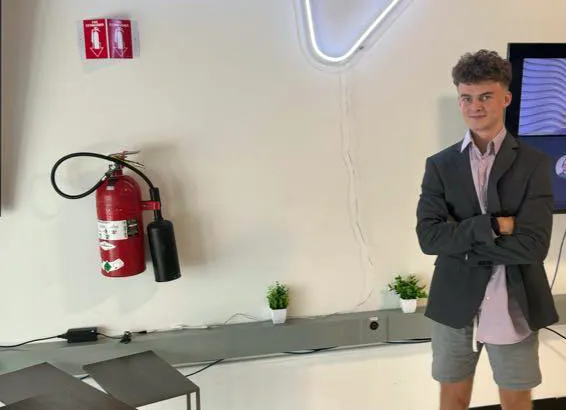
CBS LA Consumer Investigator Kristine Lazar took Veriff's side-by-side image and video detection quiz and scored three out of twelve. That's 25%. She felt confident going in. She was not. "I thought he was the fakest-looking one there," she said after learning the person she flagged as AI-generated was, in fact, a real human being walking around on Earth.
This is not a story about one journalist having a bad day. This is a story about all of us being completely unprepared for the information environment we're already living inside.
The Tells We Used to Rely On Are Gone
Remember when AI images were easy to spot? The nightmare hands with seventeen fingers. The eyes that looked like they were generated by someone who had only heard eyes described secondhand. The background that melted into abstract chaos if you looked too long. Those days are over.
Raul Liive, Veriff's product director, told CBS News plainly: "The AI has improved over the last few years heavily. It used to be pretty simple because, as you said, fingers were missing, or eyes were weird, but right now, the quality is so good." He's not boasting. He's warning us. And when Lazar asked whether people are essentially guessing, Liive said, "It's kind of a guess for you and me."
That "you and me" includes Liive himself. He told CBS News he cannot score 100% on his own company's quiz. The guy who built the test to detect fakes cannot reliably pass it. Sit with that for a second.
What You're Actually Supposed to Look For Now
Liive walked Lazar through what the new generation of detection actually requires: subtle inconsistencies in facial texture, unnatural pattern transitions, slight asymmetries in features that your brain would normally smooth over. After the tutorial, Lazar retook the quiz and jumped from three correct answers to eight out of twelve. The difference was slowing down and looking for things like mismatched earrings, one slightly larger than the other, on an otherwise convincing AI-generated face.
For videos, according to CBS News, the red flags are things like limited or robotic blinking, movement speeds that feel slightly off, and clothing or background patterns that blur together in ways real camera footage wouldn't produce. These are not things a casual scroll is going to catch. You have to be actively hunting for them, which is not how any of us consume media.
Experts quoted by CBS News recommend leaning on AI-powered detection tools and specialized verification apps rather than trusting your own eyes. Which is a perfectly reasonable suggestion and also a completely insane sentence to have to write in the year 2026.
Why This Is a Five-Alarm Problem Right Now
This isn't an abstract tech curiosity. We are in an era of manufactured political imagery, fake crisis videos, AI-generated "evidence" of things that never happened, and social media ecosystems optimized to spread whatever gets the most reaction before anyone has time to verify it. And we just established that the average American's ability to filter any of that is statistically identical to guessing.
Lazar's conclusion after the whole experience was blunt: "Seeing is no longer believing." That phrase used to be reserved for philosophy seminars. Now it's the takeaway from a quiz you can take on your phone during lunch. The infrastructure of shared reality, the idea that a photograph of something means that something happened, is collapsing in real time. We have not built anything adequate to replace it.
The Dingo Take
Here's what makes this genuinely maddening. We spent years arguing about "fake news" as though the problem was biased framing or partisan spin. Those are real issues. But this is something structurally different. This is the wholesale erosion of the evidentiary baseline. A photo used to mean something happened. A video used to be harder to fake than fabricate. We organized courts, journalism, and democratic accountability around the assumption that visual documentation carried some inherent weight. That assumption is now functionally dead, and we have approximately no institutions ready for what comes next.
The fact that a CBS investigative journalist scored 25% on a deepfake quiz before getting coaching is not a story about one person's media literacy. It's a diagnostic result for the whole country. And the prescribed treatment, "use AI tools to detect AI fakes," is the kind of solution that sounds reassuring until you think about who controls those tools, who has access to them, and what happens when the fake-generation technology outpaces the fake-detection technology, which, historically speaking, it tends to do.
Veriff built the quiz. Veriff also sells identity verification services. That's not a conspiracy, it's just worth knowing when you're absorbing their survey results. The underlying data is still damning regardless of who commissioned it. We are a country that cannot reliably tell real from fake, at a moment when the people with the most to gain from that confusion have never had better tools to exploit it. Good luck out there.


Comments