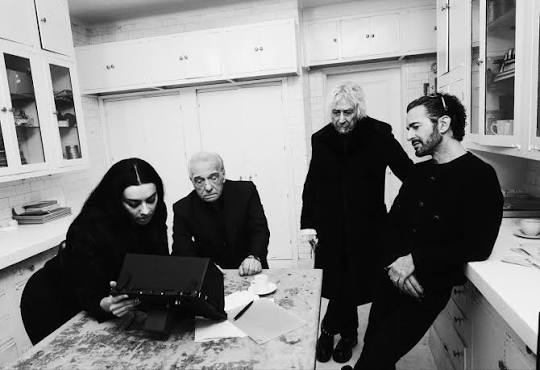
Charli xcx was the party for two years. "Brat summer" was a full-blown media event—a lime-green fever that took over political campaigns, group chats, and awards ceremonies, and left Charli standing at the exact center of pop culture's attention economy. So, it’s a genuinely strange thing to watch the same artist spend her follow-up album, Music, Fashion, Film, trying to talk her way out of the room she just filled.
Across eleven songs and barely thirty minutes, Charli trades the gleaming maximalism of Brat for guitar crunch, deadpan humor, and—according to early reviews—a self-conscious skepticism about fame itself. Critics have already reached for the same word from different directions. Rolling Stone calls the record a study of "the machinery of fame," while The Fader hears "deadpan indie sleaze" replacing the sparkle. It's a genre strategy, and it maps almost too neatly onto a concept media scholars have been sharpening for exactly this kind of moment… the "anticelebrity."
What an anticelebrity actually is
In a 2021 Celebrity Studies article, media historian Betto van Waarden argues that celebrity culture inevitably produces its own antithesis. Where the celebrity politician (his case study is politics, but the logic travels) courts the spotlight, cultivates charisma, and performs relatability for the cameras, the anticelebrity is defined by absence: little charisma, a studied lack of media savvy, a modest persona built on apparently avoiding exactly the behaviors that make someone famous in the first place. Van Waarden crucially insists this figure only makes sense in relation to a celebrity counterpart—a contemporary or a predecessor against whom the anticelebrity's plainness reads as authenticity. Angela Merkel needed Gerhard Schröder's showmanship to make her own dowdiness look like integrity. Clement Attlee needed Winston Churchill's wartime stardom to make his blandness look like substance.
And, here's the twist that makes the concept worth borrowing for pop music: van Waarden is careful to note that the anticelebrity's authenticity is itself almost always a managed performance. Politicians who play the unassuming outsider are frequently, on closer inspection, working just as hard on their image as the celebrities they're contrasted against—sometimes harder. Being anti-celebrity, as he puts it, is still a kind of celebrity.
Charli's contrast object is herself
What makes Music, Fashion, Film an unusually clean test case for this idea is that Charli doesn't need a rival to play off. She's playing off her own recent past. Where van Waarden's examples are pairs of separate public figures—Disraeli and Gladstone, Kruger and Wilhelm II—Charli has constructed something closer to a solo act of contrast: 2026 Charli, guitar-scarred and wary of the spotlight, versus 2024 Charli, the party-girl avatar of an internet-wide meme. The lead single "Rock Music" makes the pivot explicit, with Charli musing that the club scene she helped define now feels finished to her—a claim reviewers have treated less as sincere aesthetic theory than as a bit of theater, "an act of bear-baiting," as Resident Advisor's review puts it, aimed at anyone still expecting Brat 2.0.
That's the reactionary-anticelebrity move van Waarden describes almost exactly: a backlash produced by, and dependent on, an oversaturated celebrity moment. His framework distinguishes this reactionary type—a deliberate response to an excess of celebrity culture—from the natural anticelebrity, someone who is simply, structurally shielded from stardom's pull. Charli is unambiguously the former. Nothing about a Grammy-winning, tour-headlining, meme-generating pop star deciding to sound rougher and sparser is natural; it's a calculated repositioning, and the reviews know it. Variety frames the whole rollout—including her mockumentary film The Moment, in which she plays a fictionalized version of herself buckling under overexposure—as a "fascinating, if sometimes inside-baseball" commentary on the exhausting churn of contemporary stardom.
The costume of authenticity
Van Waarden's warning about mediated authenticity becomes the most interesting lens on the record on this very subject. Music, Fashion, Film announces its anticelebrity posture through texture as much as lyric: unpolished guitar tones, shorter songs, a self-described stripping away of the "branded" gloss that made Brat feel, in one critic's phrase, like a "product." Not an accident of casual friendship, the album was still produced entirely by A. G. Cook and Finn Keane, the same collaborators behind the meticulously engineered Brat—and its cover photograph poses Charli alongside John Cale, Marc Jacobs, and Martin Scorsese, three legacy figures Rolling Stone UK described as embodying music, fashion, and film respectively. That's It's a deliberate borrowing of older, harder-won cultural legitimacy to underwrite a raw image being built, once again, with A-list resources and a full press rollout. The rough edges are real, but they are also, unmistakably, produced.
The album's handling of backlash sharpens the point further. On "SS26," Charli alludes to being hacked and having her words twisted out of context—a near-perfect illustration of what van Waarden calls the anticelebrity's exposure to hostile media once they're seen to be dodging scrutiny rather than courting it (his example is baseball's Barry Bonds, vilified precisely for declining to play the media's game). Charli's actual, real-world version of this played out weeks before release, when singer Sky Ferreira publicly accused her of uncredited sampling on the Wuthering Heights soundtrack—a controversy her management handled with a carefully worded statement rather than a media blitz, itself a small performance of anticelebrity restraint.
Does it work?
Van Waarden's closing argument is that anticelebrity and celebrity need each other: one offers spectacle, the other offers relief from spectacle, and the swing between them is what keeps an "attention economy" interesting. Judged by that standard, Music, Fashion, Film is less a rejection of Charli's Brat-era fame than a second act that depends entirely on it. The record only reads as raw, sincere, or unvarnished because Brat was so polished and so everywhere. Strip away the meme-summer she's supposedly retreating from, and the guitar noise, the shrunken runtimes, and the diaristic bluntness would just be another pop record—not a statement.
That doesn't make the gesture cynical, exactly. Van Waarden's own case studies suggest that even the most self-aware anti-celebrities—Washington guarding his correspondence, Merkel managing her unmanaged image—genuinely believe in the persona they're curating, even as they curate it. Charli seems to know precisely what she's doing, and says as much through the very meta-commentary (a mockumentary about her own overexposure) that accompanies the album. Whether that self-awareness makes the anticelebrity act more convincing or less is an open question—and, appropriately, one the album itself never quite resolves. If anything, that unresolved tension between performing authenticity and confessing to the performance is the most honest thing about Music, Fashion, Film: it doesn't ask you to believe Charli has left fame behind. Instead, it asks you to watch her negotiate with fame in real time.
References
- Rolling Stone (2026). "Review: Charli XCX Celebrates Her Moment With 'Music, Fashion, Film.'" Rolling Stone.
- Variety (2026). "Charli xcx Cranks Up the Guitars and Launches Her Post-'Brat' Era With the Razor-Sharp 'Music, Fashion, Film': Album Review." Variety.
- The Fader (2026). "On Music, Fashion, Film, Charli xcx stands equal to her idols." The Fader.
- Resident Advisor (2026). "Charli xcx – Music, Fashion, Film · Album Review." RA.
- Beats Per Minute (2026). "Album Review: Charli xcx – Music, Fashion, Film." Beats Per Minute.
- Wikipedia contributors. "Music, Fashion, Film." Wikipedia, The Free Encyclopedia.
- van Waarden, B. (2023). The concept of an 'anticelebrity': a new type of antihero of the media age and its impact on modern politics. Celebrity Studies, 14(3), 313–332. https://doi.org/10.1080/19392397.2021.1968918
About the Author
Michael (William Pratama) Wenas is an Indonesian web developer, musician, and independent researcher based in Bali, whose work spans technology, quantitative finance, experimental music, and esoteric/mystical themes.
He earned a bachelor's degree (S.Kom) in Information Systems from STIKOM Bali between September 2019 and March 2024. He is currently pursuing a Master of Science in Financial Engineering at WorldQuant University, a program he began in October 2025 and expects to complete in October 2027. He also completed a Green Digital Certification through INCO Academy in 2025.
He has also worked as a web developer for two social-progress organizations: the Coalition for Sexual and Bodily Rights in Muslim Societies (CSBR), starting May 2024, and GAYa Nusantara, starting January 2024, building accessible digital platforms for these groups. His internship history includes a data scientist role with Home Credit Indonesia via Rakamin Academy (Sep–Oct 2025), a software engineer internship at Wells Fargo (Aug–Sep 2025), and a cybersecurity analyst internship at Deloitte Australia (Jul–Aug 2025).
Comments