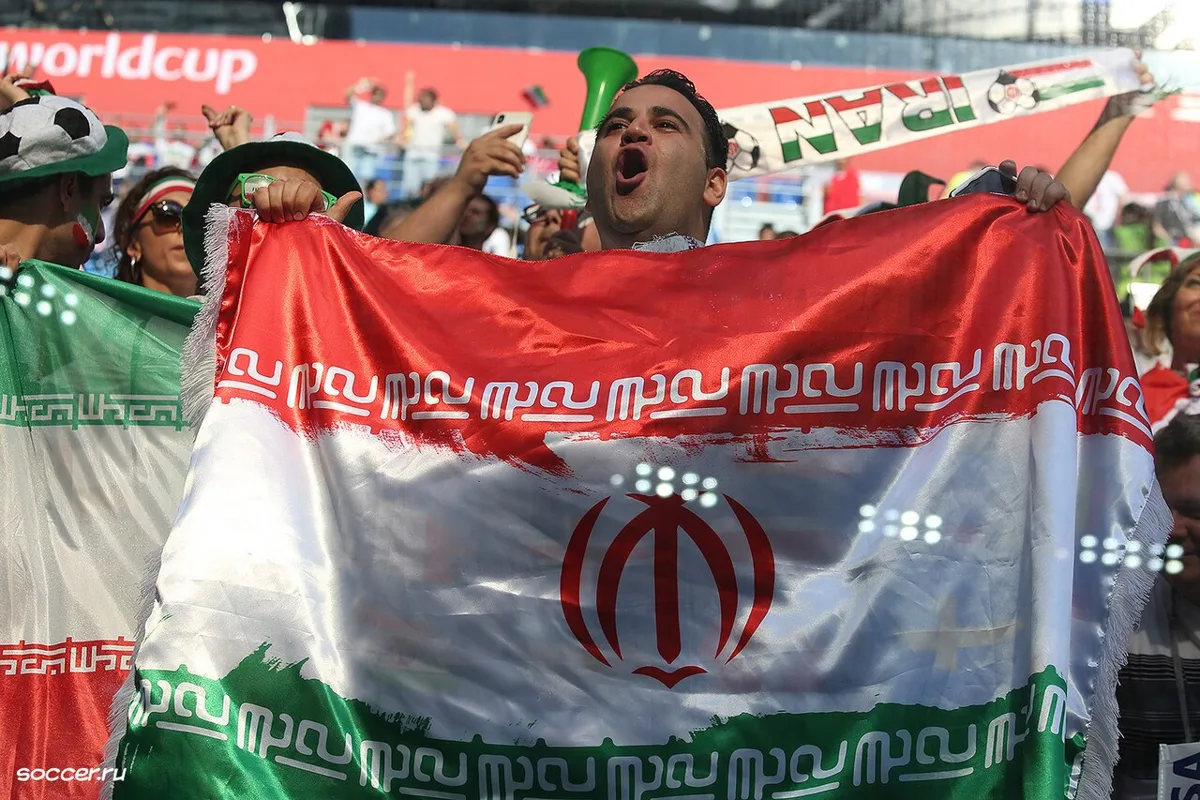
Iran's national soccer team landed at Los Angeles International Airport on Sunday afternoon to play a World Cup group stage match, which would be a perfectly normal sentence if the United States and Iran were not currently at war with each other. They are. The team touched down at 4:11 p.m. ET, flew in from Tijuana, and headed to a hotel ringed with police and concertina wire, because this is the world we live in now.
A Brief History of Unprecedented Things
Reuters is reporting that this is the first World Cup since the tournament began in 1930 in which a host nation has received a team from a country it is actively at war with. Nearly a century of World Cups. Two world wars. Countless regional conflicts. And we saved this particular milestone for 2026, in Los Angeles, on a sunny Sunday afternoon.
Iran moved their base camp from Arizona to Tijuana, Mexico late last month after the U.S. and Israel conducted joint strikes on Iran beginning in late February. So the team has been staging out of Mexico, flying across the border to play matches in American stadiums, and then flying back. As you do. As anyone would do in this situation, which, again, has never existed before in the history of organized international soccer.
The A320 carrying the squad made two attempts before landing on runway 25L. Whether the first missed approach was weather, optics, or just the universe hesitating for a second to consider what it was allowing to happen, Reuters does not specify.
Concertina Wire and a Press Conference
The team headed to their Los Angeles hotel, where Reuters reports police had already set up a security presence before the squad arrived. Sidewalks were being blocked off. Concertina wire was being stretched along sections of the hotel's front entrance. It looked, in other words, exactly like what it was: a wartime security operation wrapped around a soccer trip.
Coach Amir Ghalenoei and striker Mehdi Taremi were scheduled to meet the press at Los Angeles Stadium at 6:45 p.m. ET. What you say at a press conference under those circumstances is genuinely unclear. "We are excited to be here" has never carried more subtext.
Iran's Group G opener against New Zealand is Monday. New Zealand, for the record, is not at war with anyone, and is probably very confused about how they ended up in the middle of all this.
Outside the Stadium, a Different Kind of Crowd
While the squad made its way from the airport, a group of protesters rallied near Los Angeles Stadium. Reuters reports they were Iranian Americans calling for democracy and regime change, holding signs reading "No Shah - No Mullah in Iran - Regime Change by Iranians" and lining the street with photos of athletes they say died after being arrested by the Iranian government.
Mojgan Ramezani, 56, told Reuters she was particularly outraged by the January crackdown on protests in Iran, which rights groups and activists say killed thousands, and possibly tens of thousands of people. "They're holding hostage their own people," she said. Hassan Haddadi, 70, put it plainly: "We're hoping to bring awareness to the western world, to somehow do something beyond just condemning, to bring an end to this regime."
Los Angeles is home to the largest Iranian community outside Iran itself. "Tehrangeles" is a real place, a real community, and right now it is caught between cheering for their national team and protesting the government that sent them.
Meanwhile, in Tijuana, They Sang in Spanish
Before the flight, Reuters reports, supporters lined up five-deep on the sidewalk outside Iran's hotel in Tijuana to send the team off. They chanted "Team Melli," the Persian nickname for the national team. Players waved and smiled. Someone held a sign reading "Iran, you will never walk alone. Mexico stands with you." At one point, the crowd broke into Spanish to sing, "Iran, brother, you are Mexican now."
A young boy sitting on someone's shoulders held the official Panini FIFA World Cup 2026 sticker album, open to the Iran squad page. Iranian soccer federation President Mehdi Taj stood outside watching it all as the bus pulled away and supporters followed it down the street.
The Iranian community in Tijuana is tiny, Reuters notes, around 20 people. They showed up anyway. You have to respect that kind of commitment.
What This Match Actually Means
Iran versus New Zealand, Group G, Monday at Los Angeles Stadium. On paper it is a soccer match. In practice it is something with no real precedent and no clean category: a game being played inside a military and diplomatic crisis, in a city split between communities who see the same team in completely opposite ways.
Some Iranian Americans in Los Angeles will be cheering. Some will be protesting outside. Some will probably be doing both at different points in the afternoon, because it is entirely possible to love a national team and despise the government that controls it. That is not a contradiction. That is just what it looks like when sports and geopolitics get tangled up in ways that defy easy narratives.
FIFA, for its part, pressed on. The show goes on. It always goes on.
The Dingo Take
Here is the thing about the 2026 World Cup that nobody quite prepared for: the tournament was supposed to be a soft-power flex, a celebration of North American hospitality and the beautiful game, Canada and Mexico and the United States all holding hands and sharing a sporting moment. Instead the host nation is at war with one of the teams, that team is staging out of a Mexican border city, and a hotel in Los Angeles has concertina wire on its sidewalk because a soccer squad needed somewhere to sleep.
The protesters outside the stadium are not wrong. The fans in Tijuana singing in Spanish are not wrong either. Both things can be true. The Iranian government has blood on its hands from January's crackdown and from decades before that. The Iranian players walking to a bus while a little kid holds their sticker album are not the same thing as the Iranian government. Sports have always been used to paper over that distinction, and governments have always been happy to let it happen. Sorting it out is left, as usual, to the people in the streets.
What FIFA has produced here is not a World Cup moment. It is a stress test of every comfortable fiction we use to keep sports and reality in separate boxes. Iran plays New Zealand on Monday. The United States and Iran are at war. The concertina wire is out front. And somewhere in Los Angeles, a kid with a sticker album is just trying to watch some soccer.


Comments