
While Donald Trump was busy calling his White House meeting with Benjamin Netanyahu 'productive,' Iran launched a volley of missiles at U.S. forces somewhere in the Middle East. The U.S. intercepted all of them. Nobody, according to the experts, has any idea how to make any of this stop.
What Actually Happened Yesterday
According to U.S. Central Command, Iran launched missiles at American forces in the Middle East just before 6 p.m. ET on Monday. The U.S. intercepted all incoming missiles. U.S. and Saudi forces then responded with strikes on Iranian-backed militias in Iraq, which NPR notes was a rare show of force from Saudi Arabia in this particular conflict.
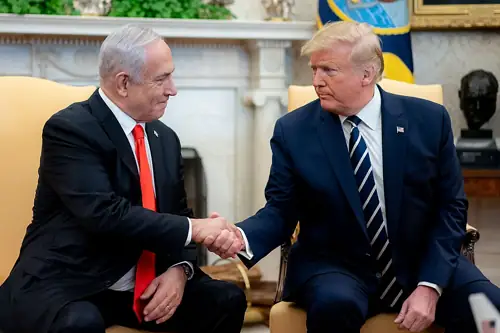
This all unfolded on the exact same day Trump was sitting across from Netanyahu and Ukrainian President Zelenskyy at the White House, describing things as going well. So to recap the Monday afternoon schedule: missiles fired at American troops, retaliatory strikes launched, and somewhere in Washington a press conference was happening where the word 'productive' was used with a straight face.
Five Months In, and Nobody Has a Map Out
Israel and the United States launched this war together five months ago. Since then, according to NPR's Franco Ordoñez, the two sides have quietly developed very different ideas about where it should go. Israel wants to keep fighting to neutralize ongoing security threats from Iran and Hezbollah in Lebanon. Israel also does not want Trump to sign any agreement that would constrain its ability to defend itself going forward.
Trump, for his part, wants the war to end quickly because it is unpopular, wants to reopen the Strait of Hormuz, and wants gas prices to come down. These are not the same goals. Michael O'Hanlon of the Brookings Institution told NPR that while Trump and Netanyahu maintain a cooperative relationship, the central problem is that neither side actually knows how to end this. That is a hell of a thing to admit five months in, but here we are.
So you have Israel pulling in one direction, Trump pulling in another, Iran launching missiles in the middle of a diplomatic photo op, and Saudi Arabia suddenly throwing punches. This is what 'productive talks' looks like in 2026.
Rand Paul and the 1,000-Page Fauci Diary Drama
Meanwhile, Dr. Anthony Fauci is set to testify today before a Senate committee as part of the ongoing investigation into COVID-19's origins. The scientific consensus remains that the virus spread naturally from an animal source to humans, but that hasn't stopped the hearing from happening.
Sen. Rand Paul, who has spent years treating Anthony Fauci like a personal nemesis in a superhero origin story, posted more than 1,000 pages of what he claims are Fauci's private diary entries over the weekend. He then took them down Monday, then reposted them Tuesday with redactions. Paul claims the entries reveal a disconnect between what Fauci said privately and what he told the public. Fauci's legal team, for their part, sent Paul a letter last month accusing him of waging a 'years-long public crusade' against Fauci. That is, objectively, an accurate description of what Rand Paul has been doing.
The Fed, Iowa's Water, and a Cancer Rate Nobody Is Talking About Enough
Federal Reserve policymakers are meeting today to discuss interest rates under new Fed Chairman Kevin Warsh, who took the job two months ago. In June, committee members signaled their next move would likely be a rate hike. But NPR reports that inflation eased somewhat last month, which may lead the committee to hold current rates steady for now. Warsh has made clear that bringing prices under control is the priority.
In Iowa, the stakes are more visceral. The state now has the second-highest cancer rate in the United States, according to the Iowa Cancer Registry, and rates are still climbing. NPR reports that Iowa's water quality is increasingly being tied to those cancer numbers, and the issue has become a live wire in the state's November gubernatorial race. Both Democrat Rob Sand and Republican Zach Lahn say more needs to be done. Both have focused largely on voluntary and incentivized measures. Farmers, who are not endorsing either candidate, have agreed to meet with both of them. Which is the kind of polite, collaborative, entirely-too-slow response you get when the second-highest cancer rate in America is being treated as a campaign talking point rather than an emergency.
The Dingo Take
Iran fires missiles at American troops and the official descriptor for that day's diplomacy is 'productive.' That is the sentence we are living inside right now. Five months into a war that neither the United States nor Israel knows how to end, with Saudi Arabia now in the mix throwing punches, the best assessment anyone can offer is that two leaders with conflicting goals had a cooperative meeting. The Strait of Hormuz is still closed. Gas prices are still climbing. Missiles were in the air.
The Fauci hearing is its own category of exhausting. Rand Paul has been doing this for years, and the routine is familiar by now: release documents dramatically, pull them down, repost them with redactions, call a press conference. It is political theater dressed up as oversight. The scientific consensus on COVID's origins has not changed. What has changed is that this is apparently still the hill Rand Paul wants to die on in the summer of 2026, while Iran is shooting at American soldiers.
And Iowa's cancer rate should be a national scandal. Second-highest in the country, tied to water quality that both political parties have been content to address through voluntary measures and polite stakeholder meetings. Voluntary measures. For the second-highest cancer rate in America. The farmers are willing to talk to the candidates. That is very nice. It is also nowhere near enough, and everyone in that room knows it.


Comments