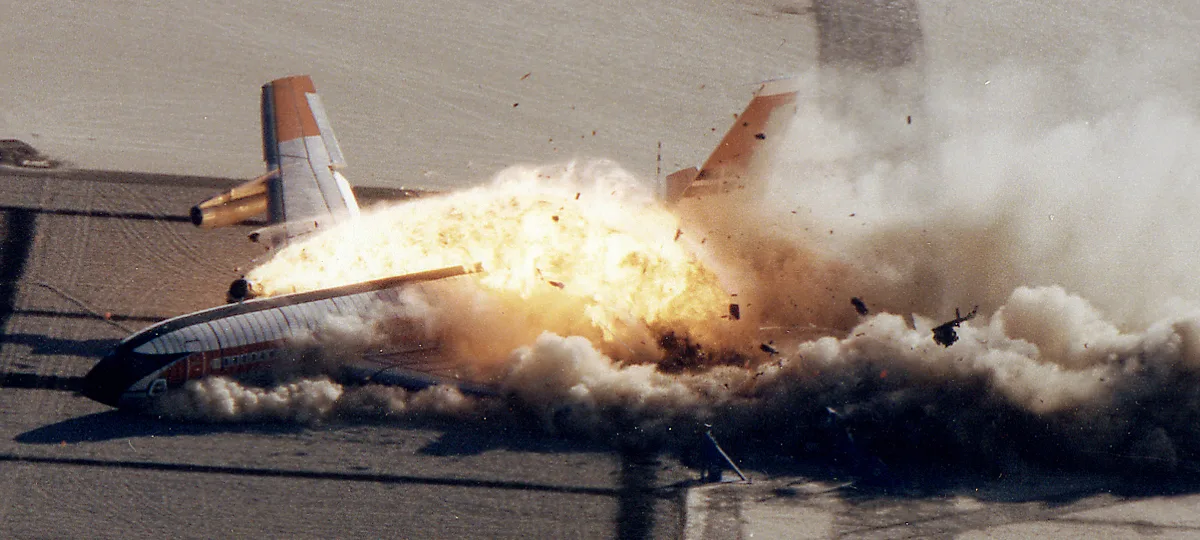
Twelve people boarded a plane Sunday in Butler, Missouri, and none of them came home. A aircraft supporting operations for Skydive Kansas City took off, turned, and nosedived into the ground approximately 300 yards from the runway, killing all 11 skydivers and the pilot on board. The skydiving community south of Kansas City is now trying to figure out how to breathe through something like this.
What We Know About the Crash
The crash happened around noon on Sunday, according to The Guardian, as the plane was taking off in support of Skydive Kansas City's operations. Dennis Jacobs, director of local county emergency management, told Missouri's KMBC news station that the aircraft carried nine experienced skydivers, two tandem jumpers, and a pilot. That last detail matters. Tandem jumpers are beginners. First-timers. People who signed up for a bucket list experience.
Jacobs told KMBC the plane had barely gotten off the ground before something went catastrophically wrong. It turned and went straight down, hitting earth less than a third of a mile from where it left. Bates County Sheriff Chad Anderson held a press conference Sunday and said plainly: "At this point, this appears to be an accident." That determination is still very much in progress.
Skydive Kansas City released a statement Monday confirming all 12 deaths and pledging cooperation with investigators. "This is a devastating loss for everyone connected to Skydive Kansas City and for the wider skydiving community," the company said, asking for privacy as they work through it. As of Monday morning, the names of the victims had not been released, with authorities still working to notify next of kin.
A Community That Knew These People
Here's what makes this story land differently than a raw fatality count. Charles Crinklaw, a skydiver with nearby Falcon Skydiving, told Missouri's KSHB 41 that he personally knew everyone on that plane. "Everybody on that plane was somebody that I know," he said. "I know four of them very, very well. They jumped with me on a regular basis."
He described one victim who had been working with the United States Parachute Association, training the next generation of skydiving instructors. "She was teaching new instructors how to be coaches," Crinklaw said. "It shocked everybody. We just were walking around here numb for a while." That line. Walking around numb. That's what grief in a small, tight-knit community actually looks like.
Skydiving circles are small. The people who do it seriously tend to know each other across dropzones, across state lines. The loss of nine experienced jumpers in a single accident is the kind of thing that ripples through that world for years.
The Investigation Just Getting Started
The National Transportation Safety Board is on the ground in Butler, and they told The Guardian exactly what they're looking at. "Investigators will begin the process of documenting the scene and examining the aircraft," the NTSB said in a statement. They're pulling radar data, weather information, maintenance records, and the pilot's medical records. The FAA is also involved.
The NTSB framed it the way they always do, methodically: "NTSB investigators will look at the human, machine and environment as the outline of the investigation." Translation: they want to know if it was mechanical failure, pilot error, weather, or some combination of all three. A plane that takes off, turns, and nosedives that quickly is a specific and ugly failure pattern, and the investigators will work to understand exactly what triggered it.
These investigations take time. Months, sometimes over a year. The families of 12 people will be waiting for answers that may not fully satisfy them regardless of what the NTSB eventually finds.
The Scope of Sunday's Loss
Twelve people dead in a single accident is not a number that should pass quietly. To put it in some context, the deadliest single aviation accident in the United States in recent years involved far larger aircraft. This was a skydiving jump plane, a small craft, and it took an entire community's worth of people with it in one morning.
Sheriff Anderson stood at a microphone Sunday and said what sheriffs say when there's nothing useful left to say. "There's nothing you can say to make it better. We just pray for their loved ones, their families and they can recover some sense of normalcy." He also extended that prayer to first responders, the people who arrived at that scene and had to process what they found 300 yards from a runway in rural Missouri.
Skydive Kansas City says its entire team is in shock. That is not PR language. That is just true.
The Dingo Take
There is no political villain in this story. No policy failure to blame, no bad-faith actor to expose. Sometimes the news is just a plane full of people who loved jumping out of the sky, and then they are gone, and a community walks around numb trying to figure out what to do with that.
What deserves attention now is the investigation. The NTSB has a strong track record of getting to the bottom of aviation accidents, and they should get the time and resources to do exactly that. Twelve families deserve real answers, not a PR statement six months from now that buries the technical cause in aviation jargon. If there was a maintenance failure, say so. If there was a mechanical defect with this type of aircraft, the public needs to know. Transparency in these investigations is not optional.
The skydiving community will grieve and eventually return to the sky, because that is what people who love something do. But the next time someone in Butler, Missouri looks up at a clear Sunday and watches a plane climb, they are going to think about this. That is the part that does not go away.




Comments