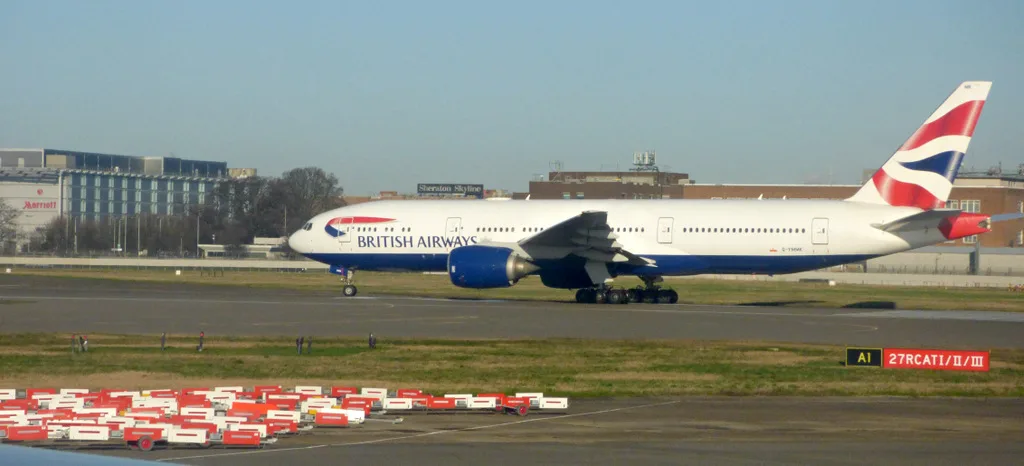
A cellphone caught fire on a British Airways flight from London to Las Vegas on Monday, and the pilot told air traffic control it had 'scorched the inside of the cabin.' The plane landed safely. The airline said it did not declare an emergency. Cool, cool, cool.
What Actually Happened at 30,000 Feet
British Airways Flight 271 was somewhere over the American Southwest, inbound to Harry Reid International Airport in Las Vegas, when a cellphone onboard decided to become a fire hazard. The FAA confirmed the crew reported the fire and that the aircraft landed safely, according to CBS News.
You can hear the pilot on air traffic control audio describing a mobile phone fire that scorched the cabin interior. That sentence should alarm you. It scorched the cabin. On an airplane. With hundreds of people in it.
The Las Vegas airport confirmed the pilot called an alert. British Airways, doing what airlines always do when something goes wrong, told CBS News the plane arrived as scheduled and that no emergency was formally declared. Nothing to see here. Just some light scorching at altitude.
The Part Where We Talk About Lithium Batteries (Again)
Here is the thing about the battery in your phone, your laptop, your portable charger, your wireless earbuds, and roughly forty other devices you are probably carrying right now. Lithium-ion batteries can short circuit. When they do, they do not smolder politely. They burn hot and fast and they are extraordinarily difficult to extinguish mid-flight.
That is why the FAA and airlines have regulations specifically prohibiting passengers from checking lithium batteries into the cargo hold. You have to keep them in the cabin, where a crew member can actually see a fire and respond to it. That policy is the reason this story ended with a safe landing instead of something much worse.
Almost 100 battery fire incidents occurred on aircraft in 2025, mostly involving battery packs and vape devices, according to FAA data CBS News cited. Nearly 100. In a single year. That is not a fluke statistic. That is a pattern.
The Industry Has Noticed, Sort Of
In April, American Airlines tightened its restrictions on portable chargers that passengers can bring aboard flights, as CBS News reported. That move came as part of a slow, grinding recognition across the aviation industry that the devices everyone carries everywhere are a genuine fire risk in an enclosed metal tube traveling at five hundred miles an hour.
The British Airways incident on Monday is the FAA's to investigate now. They said they will. What they will find, almost certainly, is that a lithium battery experienced thermal runaway, the technical term for what happens when the battery's internal temperature spirals out of control and it catches fire. The specific phone model has not been identified.
This is not a British Airways problem specifically. It is not a Las Vegas problem. It is a we-all-carry-small-fire-starters-in-our-pockets problem, and the aviation safety infrastructure has been quietly managing it for years while the rest of us board flights without thinking twice.
Everyone Was Fine, But Let's Be Honest About the Stakes
The passengers on Flight 271 landed safely. The crew handled it. The system worked, more or less, which deserves acknowledgment.
But scorched cabin interior is doing a lot of work in that sentence 'everything was fine.' A fire that chars the inside of an aircraft cabin is not a near-miss. It is a fire on an airplane. The gap between 'fire contained by crew' and 'catastrophic outcome' is narrower than any airline spokesperson would like to discuss in a press statement.
The FAA's investigation will determine the specifics. In the meantime, the incident joins a list of nearly one hundred others from last year alone, all of them filed, catalogued, and adding up to a trend that moves just a little faster every time someone boards a flight with a battery they bought off a discount website.
The Dingo Take
The airline said the plane arrived as scheduled. That framing is doing some genuinely heroic heavy lifting. Yes, technically, the flight landed at the correct airport at roughly the correct time. It also had a fire inside the passenger cabin. Both things are true. One of them is considerably more important than the other, and the fact that airlines reach for 'no emergency declared' as their primary reassurance tells you everything about how this industry communicates risk to the public.
Nearly a hundred battery fire incidents on planes in 2025. That number should be on a billboard. It should be read aloud before every safety demonstration. Instead it lives in an FAA database that most passengers will never look at, and the aviation industry continues treating each individual incident as an isolated curiosity rather than the predictable consequence of stuffing rechargeable incendiary devices into the overhead bins of every commercial flight on earth.
The rules that kept this from being worse, keeping lithium batteries in the cabin, training crews to respond, are genuinely good rules that genuinely work. Credit where it is due. But 'the rules are working' and 'we have the right number of rules' are two very different claims, and right now the industry is only comfortable making the first one.





Comments