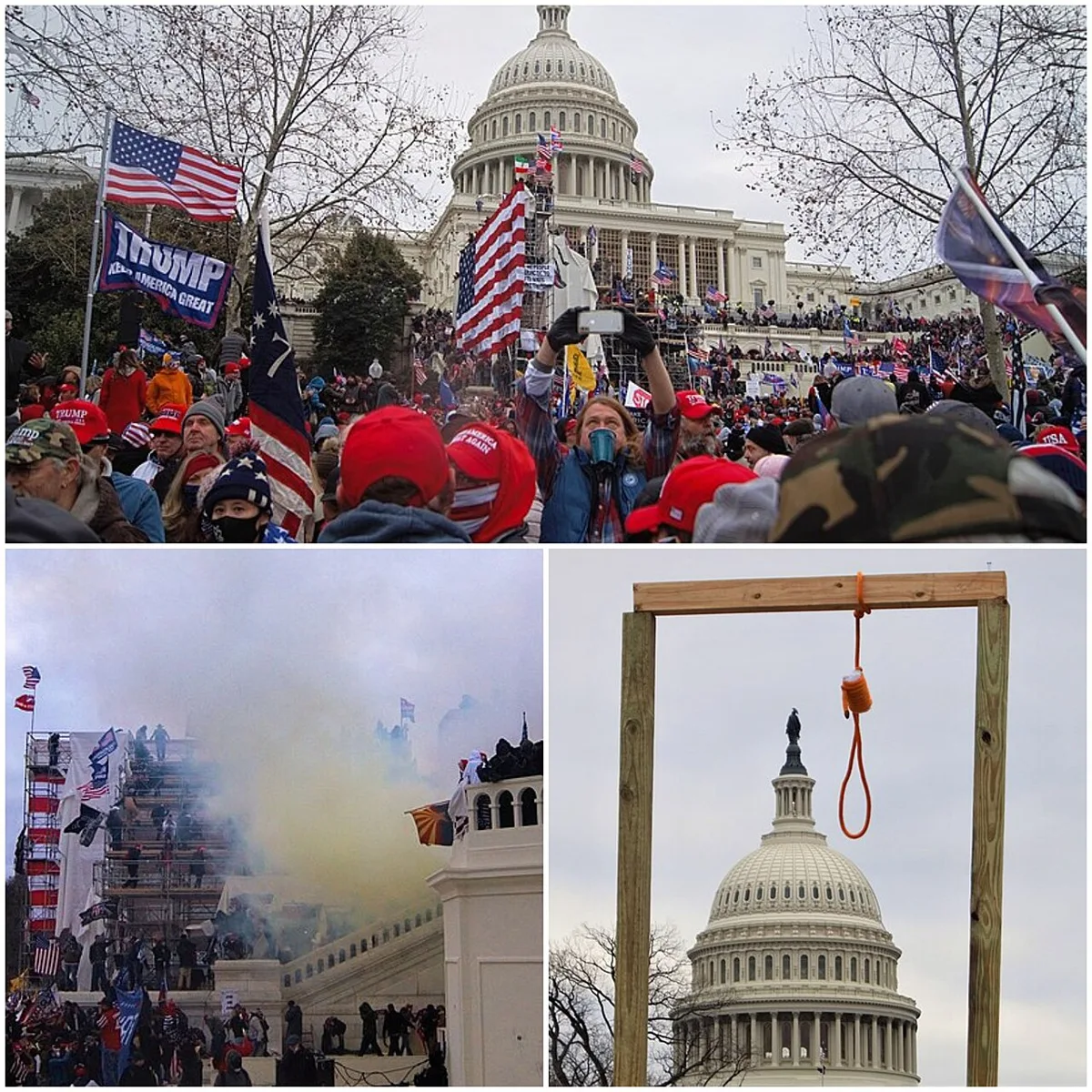
Sean Penn, a man who once called Donald Trump 'an enemy of mankind' and spent his Oscar night in Ukraine with Zelenskyy, is now writing and directing a fact-based drama about a police officer caught up in the January 6 Capitol insurrection. Bradley Cooper, who has been nominated for an Oscar twelve times and apparently cannot stop working, is in talks to star. This is going to be a whole thing.
What We Actually Know
According to Deadline, as reported by The Guardian, the film is an as-yet-untitled drama that Penn is developing as a "passion project." He'll write, direct, and presumably pour every ounce of his considerable intensity into the thing.
The story follows a police officer who gets caught up in the violent insurrection of January 6, 2021. Cooper is reportedly in talks to play the officer, whose real identity is being kept under wraps for now. The film is being made in direct collaboration with the actual person the story is based on, which suggests this isn't going to be some loose, fictionalized reimagining. Penn does not do loose.
The project has also been described, intriguingly, as an "unexpected story about friendship." Which is either going to be genuinely moving or extremely confusing, possibly both.
Penn Has Been Waiting to Make This Film for Years
This isn't some opportunistic cash grab from a director eyeing a hot news cycle. Penn attended a January 6 House committee hearing in 2022 as an observer, describing himself as "just another citizen" there to watch history unfold. He left that hearing and said, on record, "I think we all saw what happened on January 6, and now we're looking to see if justice comes on the other side of it."
Four years later, with justice having arrived for some participants and evaporated entirely for others, Penn is apparently done waiting for the political system to tell the story. He's going to tell it himself.
He's also not shy about where he stands. Penn has publicly called Trump "an enemy of mankind" and "a narcissist." So we can probably rule out a both-sides framing here.
Cooper Is the Right Call
Twelve Oscar nominations. Twelve. Bradley Cooper has been nominated for acting, directing, producing, and screenwriting, which is the kind of resume that makes you question your own life choices. He's not a guy who takes roles carelessly.
His most recent work was a comedy he also directed, Is This Thing On?, and before that he was racing through Paul Thomas Anderson's One Battle After Another alongside Penn, who just took home his second Oscar for that performance. These two know how to work together. More importantly, Cooper has shown repeatedly that he's willing to disappear into difficult, unglamorous material when he believes in it.
A cop who got swept up in one of the most chaotic and morally complicated days in recent American history is exactly the kind of role Cooper was built for.
Hollywood Is Coming for January 6, Whether Anyone Likes It or Not
The Penn and Cooper project isn't arriving in a vacuum. Aaron Sorkin has an upcoming Facebook sequel called The Social Reckoning, which The Guardian reports will examine social media's role in the events of January 6. So we're moving into a phase where Hollywood is actively building the cultural record of what happened that day.
This is how it always works. The political moment passes, the historians write the books, and then the filmmakers make the films that most people actually watch. The Watergate break-in happened in 1972. All the President's Men came out in 1976. The cultural processing of national trauma runs on its own clock.
The difference here is that the trauma isn't fully processed politically. The president those rioters were trying to help is back in the White House. Which gives this film a live-wire quality that most historical dramas don't have.
The Subject Is Someone Real, and That Matters
The detail that keeps jumping out is that Penn is making this film in collaboration with the actual officer at the center of the story, whose identity is being protected. That's not a standard creative choice. That's a filmmaker saying: this person's story deserves to be told carefully, and on their terms.
Police officers on January 6 were beaten with flagpoles, sprayed with bear mace, crushed in doorframes, and told afterward by some of the very politicians they protected that what happened wasn't really that bad. Officer Michael Fanone had a heart attack. Officer Brian Sicknick died. More than 100 officers were injured that day, according to reporting at the time.
Whatever angle Penn's specific story takes, it's coming from a place where the subject is still alive and still living with what happened. That's a different kind of responsibility than adapting a book. Penn clearly understands that, which is probably why he's been sitting on this for years before pulling the trigger.
The Dingo Take
Here's the thing about a Sean Penn January 6 movie: it was always going to happen. The man shows up to congressional hearings as a civilian observer and flies to active war zones on his days off. He is constitutionally incapable of looking away from something he thinks matters. January 6 matters to him. It has for years. The only surprise is that it took this long to become a film.
What's actually interesting about this project isn't the politics, obvious as those are. It's the focus. Not a senator. Not a rioter. A cop. Someone whose job that day was to hold a line that many of his colleagues in other departments had already abandoned or actively helped breach. Someone who probably didn't vote the way you'd assume, or maybe did, and either way found himself on the wrong end of a mob that was doing exactly what the president on television told them to do. That's a genuinely complicated human story, and Penn and Cooper are both smart enough to know it.
Will this film make anyone who stormed the Capitol reconsider their choices? Of course not. Will it drive a certain segment of the internet absolutely feral the moment a trailer drops? Absolutely. Will it probably be very good? Given the two people involved and the fact that Penn has been quietly building toward this for four years, yes. It will probably be very good. And some people are going to lose their minds about it, which, honestly, is fine. Art that doesn't make anyone uncomfortable isn't doing its job.




Comments