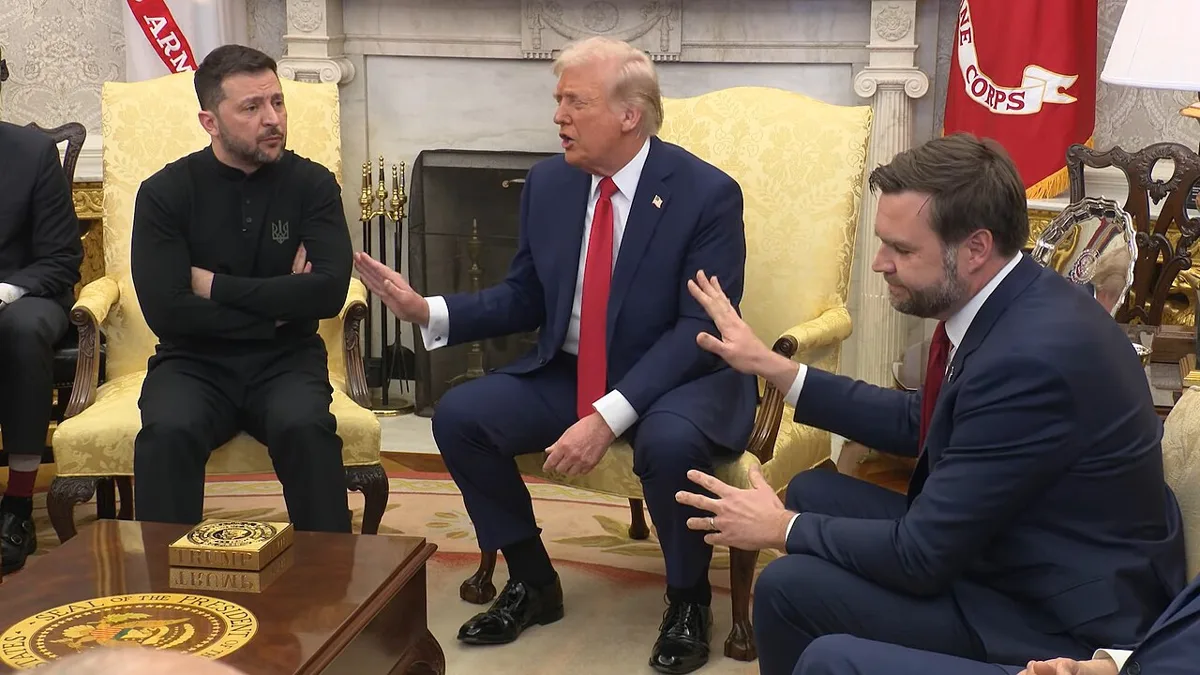
At a lakeside resort in the French Alps, Donald Trump just co-signed a document promising to flood Ukraine with air defense systems, long-range weapons, and tightened sanctions on Russian oil. His name appears in it three times. The man who spent the better part of two years calling Zelensky a salesman and questioning why America should care about eastern European border disputes just became a co-author of the most unified Western statement on Ukraine in years.
What the Declaration Actually Says
The joint G7 declaration, published just after midnight Wednesday at the summit in Evian-les-Bains, France, is not subtle. According to Politico, the leaders committed to "increase the delivery of air defence capacities, additional systems and interceptors, and long-range capabilities" to Ukraine, and to consider licensing arrangements that would let Ukraine ramp up its own military production domestically.
On the economic side, the G7 pledged to "increase the pressure on the Russian war economy" and to "strengthen our sanctions, including those on the oil and gas sectors." That last part matters. Trump himself had suspended U.S. sanctions on Russian oil until mid-June, and as recently as Tuesday, Politico was reporting that he was signaling he might reinstate them. Apparently he did more than signal.
The document also names Trump specifically in the context of the U.S.-Iran deal, crediting him with "reopening the Strait of Hormuz" and arguing that this created the political opening for additional economic pressure on Moscow. Whether that framing was designed to give Trump a win he could sell back home is a question worth sitting with for a moment.
Macron Called It a 'Strategic Wake-Up Call.' He Wasn't Wrong.
French President Emmanuel Macron posted a video after the leaders' dinner gala stressing that every G7 member, including the United States, backed the decisions in the declaration. According to Politico, he called the summit "a moment of strategic wake-up call." Coming from the man who once described NATO as "brain dead," that is either growth or extremely good PR.
The fact that Macron felt the need to explicitly call out U.S. participation tells you everything about how the last few years have gone. When your diplomatic achievement requires a press release clarifying that America was actually in the room and agreed to things, that is the bar we are clearing now. Low bar. Still cleared.
Last week, Politico reports, Macron's office had suggested that the sensitive geopolitical discussions on Ukraine and the Middle East would only be covered by a French presidency statement, not a full joint communique. The fact that it ended up as a unified declaration signed by all seven governments is, by any reasonable measure, a bigger outcome than expected going in.
The Iran Deal Connection Nobody Saw Coming
Here is where things get genuinely strange. The G7 declaration specifically argues that the U.S.-Iran deal, which reopened the Strait of Hormuz, created the conditions for tougher action against Russia. The logic, as Politico reports it, is that with the Strait open and oil flowing more freely from the Gulf, the world can absorb the shock of squeezing Russian energy exports harder.
That is actually a coherent strategic argument. Credit where it is due. The problem is that it requires trusting that Trump understood this connection going in, rather than stumbling into it and having the Europeans reverse-engineer a rationale that made him look like a chess player. Both possibilities exist. History will sort it out.
The declaration also backs an international naval mission, led by the UK and France, to protect shipping in the Strait of Hormuz. Canada gets a specific shoutout for its potential to boost global energy supply. Everybody goes home with something to show the folks back home.
The Rest of the Agenda, Which Everyone Will Ignore
The Evian summit also produced declarations on cancer research, Ebola response coordination, drug trafficking, migrant smuggling, and protections for children online. On Wednesday, Politico reports, leaders were expected to finalize agreements on critical minerals and child safety on digital platforms.
These are not unimportant things. Critical minerals alone are the kind of supply chain issue that will define the next thirty years of great power competition. But they will get approximately one-twentieth of the coverage the Ukraine declaration gets, because the Ukraine declaration involves missiles and Trump and the possibility that something significant just shifted, and the critical minerals agreement involves supply chains.
The G7 also took a position on China, opposing what Politico describes as "any unilateral attempts to change the status quo, in particular by force or coercion, in the East and South China Seas and across the Taiwan Strait." That language has been in every G7 statement for years. Beijing will note it, shrug, and keep doing what it is doing.
What Changed and Why It Matters
Eighteen months ago, the working assumption in European capitals was that Trump would gradually hollow out Western support for Ukraine, either through inaction, public skepticism, or outright hostility. That assumption was not unreasonable. It was based entirely on things Trump said out loud, repeatedly, on camera.
What happened in Evian is that Trump not only signed a document committing the United States to the opposite of that posture, he let his name appear in it three times as a justification for why the moment is right to go harder on Russia. That is not nothing. It is, in fact, pretty significant, whatever his actual motives.
Politico reported Tuesday that this summit was marked by "an unexpected convergence" between Trump and the other G7 members. Unexpected is doing a lot of work in that sentence. The more cynical read is that Trump got his Iran win, got his name in the document, got to play dealmaker on the world stage, and the Europeans got the Ukraine commitments they needed. Everyone performed their role. The question is whether the performance translates into actual military hardware arriving in Kyiv on a schedule that matters.
The Dingo Take
Let's be honest about what just happened and what it did not. Trump signing a G7 declaration is not the same as Trump following through on a G7 declaration. The United States has been promising Ukraine things for years, and the gap between the communique and the cargo plane has historically been wide enough to drive a Russian tank column through. Declarations are paper. Air defense interceptors are metal. We will find out which one shows up.
That said, the cynical read is not the only read. The Iran-Hormuz-Russia sanctions logic that the declaration articulates is genuinely coherent foreign policy thinking. If reopening the Strait actually does create the economic cover for tougher Russian oil sanctions, and if Trump actually reinstates those sanctions and keeps them in place, that is a material change in the war's economics. It won't end the war. But it costs Russia real money in real time.
The image of Trump sitting at a table in a French Alps resort town, signing his name to a document that promises more weapons to Ukraine and more pain for Russia, would have seemed like satire two years ago. It might still be satire. But it happened. The declaration exists. His name is on it three times. Whether that means anything at all depends entirely on what the administration does the moment the summit ends, the cameras turn off, and nobody is watching. So, you know. Watch.



Comments