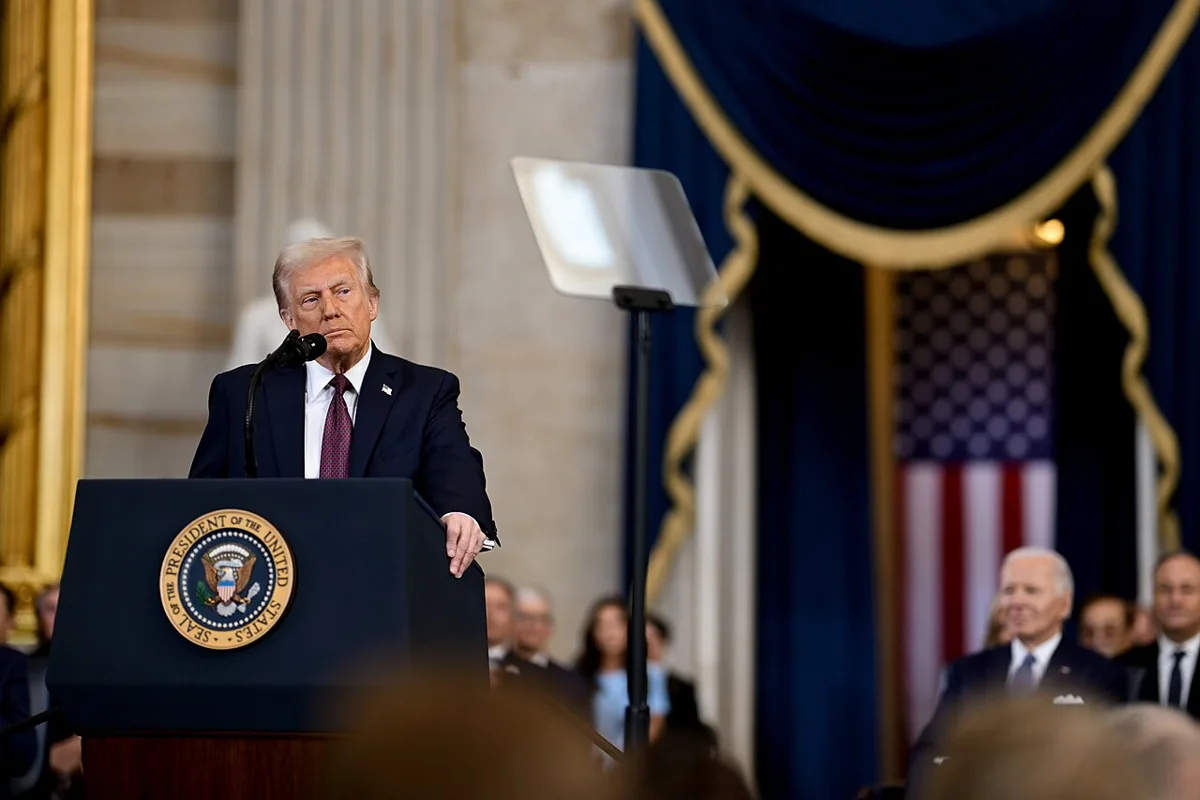
Donald Trump, a man who does not live in Washington DC, does not vote in Washington DC, and has spent considerable energy trying to hollow out Washington DC, has some thoughts about who should run Washington DC. Specifically, he'd like the city to know that if the wrong Democrat wins Tuesday's mayoral primary, he might just take the whole thing back. This is, somehow, a real sentence about real events happening in the real world.
Trump Crashes a Race He Has No Business Being In
A week before Tuesday's primary, Trump told reporters he wouldn't tolerate a Janeese Lewis George victory, and floated revoking DC home rule entirely. "Maybe we take back Washington and run it on the federal basis. We won't put up with it," he said. That's the President of the United States threatening to strip 700,000 American residents of their right to elect their own mayor because he doesn't like one of the candidates.
For context, DC home rule has existed since 1973. It is not a radical concept. It is the basic, minimal arrangement under which people who live in a city get to choose who runs it. Trump is threatening to end that arrangement because a democratic socialist councilmember might win a Democratic primary in a city that voted against him by about 90 points. The Guardian has full coverage of the race and the threat.
Who's Actually on the Ballot
The two frontrunners are DC councilmember Janeese Lewis George and former councilmember Kenyan McDuffie, both Democrats, both vying to replace Mayor Muriel Bowser, who is stepping down after more than a decade in office. Whoever wins the primary will almost certainly win November's general election. This is DC. A golden retriever wearing a DNC t-shirt would win the general election.
Lewis George is running as a democratic socialist on what she calls a "people-first platform," focused on lowering childcare costs, stabilizing rent, and utility relief. McDuffie, a former prosecutor, has locked up support from Washington's business community, including restaurants and realtors, and is running on public safety and economic diversification. The Guardian describes their pitches in detail, and on paper they're not wildly different. In practice, they've been tearing each other apart.
The Trump Money Fight, Which Got Messy Fast
At a recent televised debate on NBC4 Washington, Lewis George accused McDuffie of accepting "tens of thousands of dollars from Trump's supporters." That framing was, to put it charitably, a stretch. According to the Guardian, the actual number of donors who have given to both Trump and McDuffie is relatively small. McDuffie called it a "disinformation campaign that rivals Trump in spreading rumors and innuendo."
That's a brutal line to use in a Democratic primary. And to be fair, McDuffie says 99.9 percent of his donors are Democrats and independents. The whole episode is a reminder that when the Republican Party has collapsed to the point of irrelevance in a given city, Democrats will find ways to accuse each other of being secretly Republican. It's a rite of passage.
The $16,000 Fine That Landed at the Worst Possible Moment
Days before the election, the DC Office of Campaign Finance fined Lewis George's campaign $16,000 after investigating alleged improper coordination with unions that also manage an independent political action committee. The timing was, to say the least, conspicuous.
The campaign called the order "reckless" and "riddled with factual errors," announced it would appeal, and accused the OCF of following a "disturbing pattern" of conduct. Whether the fine is legitimate or an eleventh-hour hit job dressed up as regulatory enforcement is genuinely unclear. What is clear is that it landed in the middle of a tight race and will be the subject of litigation regardless of who wins Tuesday.
How Each Candidate Plans to Handle Trump
Both Lewis George and McDuffie told the Guardian they'd stand up to the administration, which is exactly what every candidate in every Democratic primary in every city in America has said since January 2025. The specifics matter more than the posture.
Lewis George said she'd rescind the executive order that currently directs Metropolitan Police Department officers to cooperate with federal immigration enforcement. "Our officers need to be focused on getting guns off our streets and solving crimes," she told the Guardian. She's also staking out DC statehood and immigrant community protections as non-negotiables, while leaving room for cooperation on things like the Union Station redevelopment. McDuffie took a different angle, promising to work with the attorney general to protect home rule and describing himself as a "fighter" for DC residents. He didn't say much about immigration enforcement specifically, leaning harder on affordability and public safety as his primary framing. It's a notable difference.
Bowser Exits Stage Left, Sort Of
Outgoing Mayor Muriel Bowser, who spent two Trump terms threading an increasingly impossible needle between protecting DC and not completely torching her relationship with the White House, offered what may be the most politician thing ever said at an Axios event on June 10. "I have always supported Kenyan McDuffie," she said, "but I'm not endorsing or making any endorsements for mayor because I'm stepping off the political stage."
That is a non-endorsement endorsement of historic precision. She named the guy. She said she supported him. Then she said she wasn't endorsing anyone. Muriel Bowser has spent a decade in this city's politics and she is leaving with her survival instincts fully intact.
The Dingo Take
Here's the part worth sitting with for a second. The sitting President of the United States threatened to dissolve the democratic self-governance of an American city because he might not like who wins a primary election. Not a foreign election. Not a state election he's trying to influence through surrogates. He looked at Washington DC, a city whose residents pay federal taxes and serve in the military and have no voting representation in Congress, and said: get the result wrong and we take the whole thing back. That is not a normal thing for an American president to say. It stopped being treated as abnormal about four years ago, but it isn't.
The race itself is a genuinely interesting fight about what Democratic governance looks like in a city under federal siege. Lewis George and McDuffie have real policy differences on immigration enforcement that will matter day one, whoever wins. The Trump donor attacks and the last-minute campaign finance fine are both worth scrutinizing. This is a real election with real stakes for real people who actually live there.
But do not lose the thread. A president is threatening to punish a city for voting in a way he disapproves of. He has no legal authority to revoke home rule unilaterally, but he has spent 18 months demonstrating that the gap between what he can legally do and what he will attempt to do is basically zero. DC residents are voting Tuesday knowing the outcome might be used as a pretext for something much uglier. That's the story. Everything else is context.



Comments