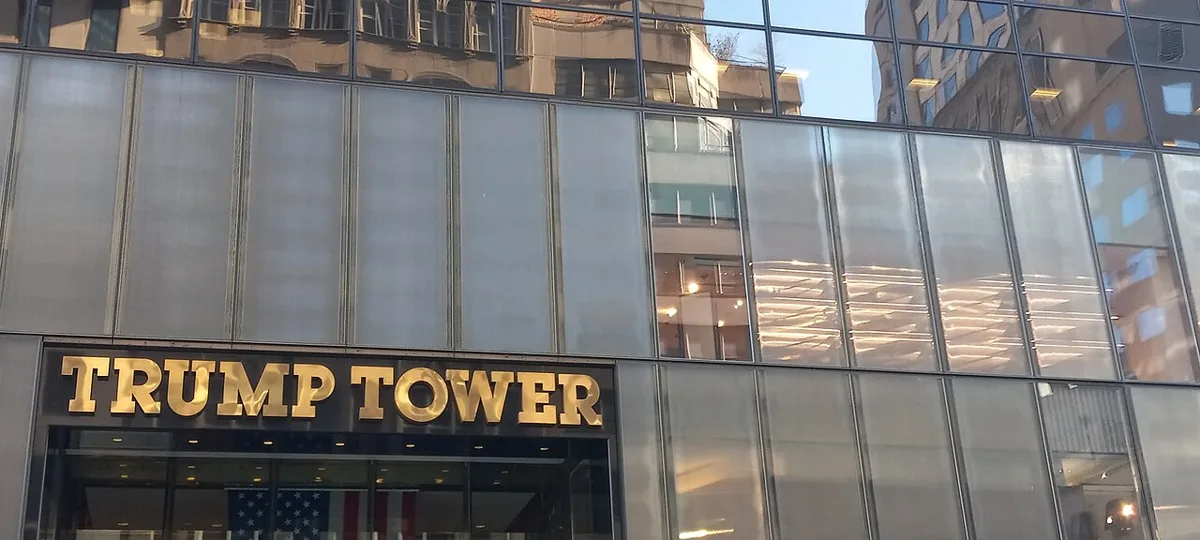
Buried inside the millions of documents the Trump administration released as the so-called Epstein Files is an FBI interview describing two men who patrolled the public atrium of Trump Tower in the early 1990s, recruiting women to have sex with Donald Trump. One of those women, the interviewee told agents, later killed herself. This is in the files Trump's own DOJ released.
What the FBI Interview Actually Says
Raw Story investigators found the interview tucked inside the document dump. A woman, whose name was redacted throughout, told FBI agents in 2021 that she was a student in her 20s working at a shoe boutique inside Trump Tower when she was approached during her lunch break.
Two men in their early 30s walked up to her in the public atrium. One asked if she knew who Donald Trump was, told her Trump was "meeting people that day," and said she "did not need to work so hard to go to school." Then he winked. The FBI report states flatly that the woman "felt that it was clear that sex was on the table, even though the man never mentioned sex."
The kicker: the party invitation the men offered her had Jeffrey Epstein's address on it. Not a Trump property. Epstein's address.
Threats, Teenagers, and a Tragedy
The woman declined both the meeting with Trump and the party. According to her FBI interview, that's when the threats started. The men told her they knew where she worked and could find her. She said she never went to the police because she didn't think they would believe her.
She kept watching the same two men work the atrium for the next six months. She told the FBI she saw them approach girls she estimated to be approximately 15 or 16 years old, walking them toward an escalator.
Then she told agents about a woman she knew whose daughter had been waiting to meet her at Trump Tower and was persuaded to go upstairs with the recruiters. The FBI report records her account this way: the mother later told her that "something horrible happened to her daughter that day." The daughter dropped out of school, got into drugs, and committed suicide.
That detail is sitting in a government document. Released by Trump's own Department of Justice.
How This Got Into the Epstein Files in the First Place
The woman didn't come forward immediately. She contacted a law firm years later, after Epstein's crimes became public and after watching a 60 Minutes report about Trump's relationship with Stormy Daniels, the adult film actress whose hush money payment eventually resulted in Trump's conviction on 34 felony counts. The law firm told her to contact the FBI.
Lying in an FBI interview is a federal crime. That doesn't prove her account is true, but it does mean she gave this statement under serious legal exposure. The interview was conducted in 2021 and appears to have sat in the files until Raw Story found it in this latest release.
The White House Response: He's Totally Exonerated (He Is Not)
Raw Story asked the White House about the specific allegations in the FBI interview. The White House did not address them. Instead, spokesperson Abigail Jackson issued a statement saying Trump "has been totally exonerated on anything relating to Epstein."
That is not a real thing that happened. Trump has not been criminally charged in connection with Epstein. He has also not been formally exonerated. Those are two very different legal statuses, and conflating them is either ignorant or cynical. Given that Jackson works for the Trump White House, you can take your pick.
The DOJ's own statement when the files were released tried to preemptively discredit parts of them, calling some claims "untrue and sensationalist" and arguing that if anything damning were credible, it "certainly would have been weaponized against President Trump already." That is not how evidence works. That is also not a denial of specific facts.
Trump, Epstein, and the Timeline
None of this exists in a vacuum. Through the 1990s and into the 2000s, Trump and Epstein moved in the same New York City and Palm Beach social circles. Trump famously told New York magazine in 2002 that Epstein was a "terrific guy" who enjoyed "beautiful women" and liked them "on the younger side."
Epstein was arrested in 2006, pleaded guilty to two prostitution charges under a deal that let him leave jail for 12 hours a day, and was arrested again in 2019 on federal sex trafficking charges. He was found dead in his cell that same year.
Trump has not been charged with any crime in connection with the Epstein files. He is mentioned thousands of times in those documents, which again, his administration released. Make of that what you will.
The Dingo Take
Here's what you should not let get lost in the noise. The Trump administration released these files. They made a big show of it, positioned it as a transparency moment, a reckoning with the deep state or the elites or whoever the enemy is this week. And buried inside their own document dump is an FBI interview describing a sexual recruitment operation running out of the lobby of Trump Tower, with a party invitation bearing Jeffrey Epstein's home address, and a story about a teenage girl who later took her own life.
The White House response to Raw Story's specific questions was to not answer them. Instead, they issued a blanket non-denial denial and claimed an exoneration that does not legally exist. If the story were simply false, the move would be to say so clearly and specifically. What they did instead was change the subject and hope you wouldn't notice.
Trump has not been charged. That matters. An FBI interview is not a conviction, and one woman's account is not proof of anything beyond the fact that she gave the account. But the DOJ's own framing, that a claim must be false because it wasn't "weaponized" sooner, is a wild standard to apply to anything. Sometimes allegations get buried. Sometimes files sit for years. Sometimes they end up in a document dump that the subject of the investigation personally authorized. The irony of that is almost too much to carry.


Comments