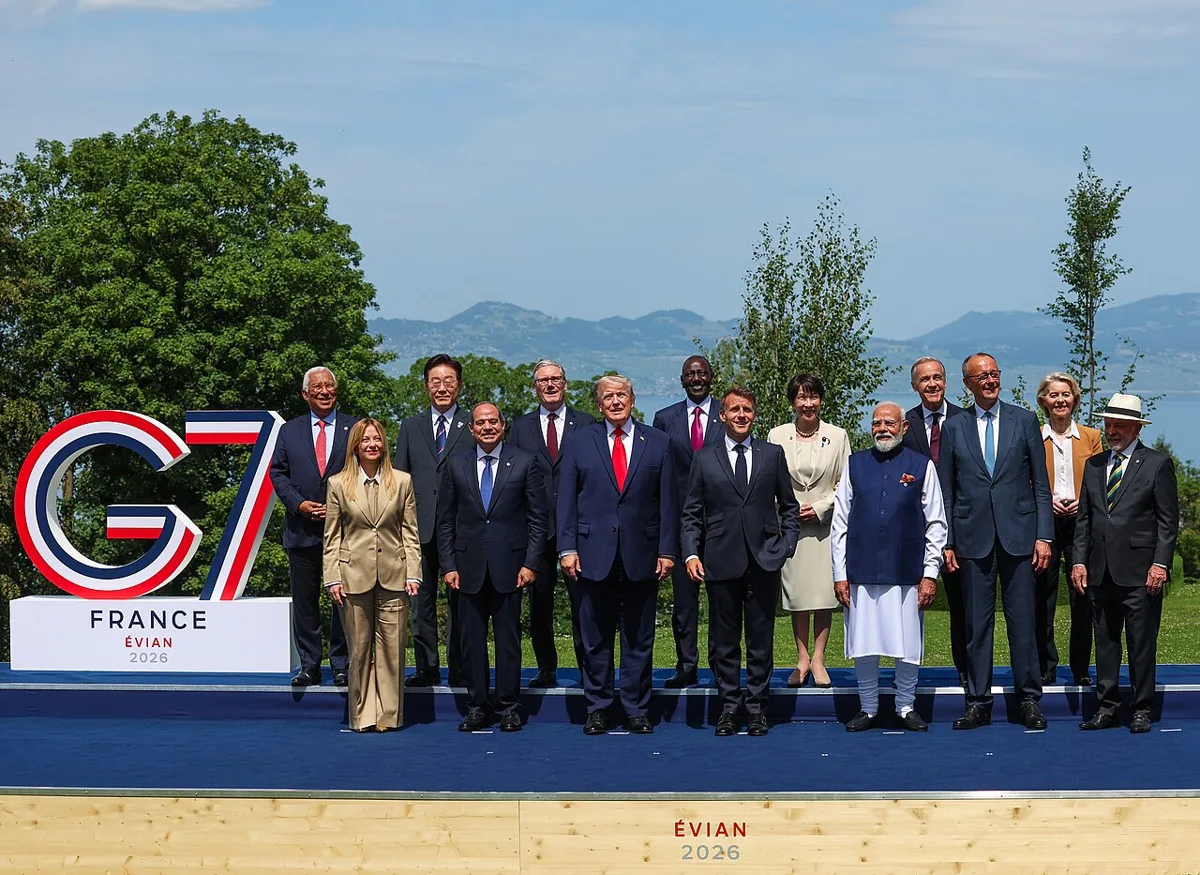
Someone set a Tesla on fire outside the G7 summit last week, and honestly, it might have been the most coherent political statement made by anyone in the vicinity. Inside the summit, Keir Starmer was wandering around asking whether there was a meeting he hadn't been invited to, Emmanuel Macron was reportedly spending his days terrified Trump would leave early, and Donald Trump was telling reporters, without irony, "I am the boss." The rules-based international order, ladies and gentlemen. She's doing great.
Twenty-Five Years of Protests, and the G7 Finally Did It to Itself
Back in 2001, 200,000 people descended on Genoa to protest the G8 summit. The argument, as Guardian columnist Zoe Williams recalls it from personal experience, was that eight rich nations had no business dictating terms to the rest of the planet. The Italian government was so rattled it turned Genoa into a no-fly zone, citing terrorism concerns. This was before September 11. The protesters looked like anti-capitalists, not people who could weaponize aircraft.
The movement was sprawling and serious. It had roots in the 1999 Seattle WTO protests. It had inside-outside coherence, with street activists and NGOs syncing their messaging to argue that a rules-based order needed a social conscience or it would hollow out and collapse. The G8 never once acknowledged that those protests changed anything.
Twenty-five years later, the G7 protest in Canada drew about 20,000 people, met with overnight kettling by police, which Williams describes bluntly as a mass arrest without the facilities. The target this time was simpler: grotesque, unsustainable wealth inequality. And someone set fire to a Tesla.
The Tesla Fire Was a Statement. Elon Musk's Net Worth Made It Unavoidable.
Burning a car outside a summit is not new. But this particular car, in this particular week, carries a specific weight. The Guardian reports that Elon Musk became the world's first trillionaire last Friday, and his wealth has already climbed to $1.4 trillion since then. To put that in perspective Williams offers: the person with one pound to their name is as close to the second-richest person on Earth as that second-richest person is to Musk.
Sit with that for a second.
National governments, including the ones that still wave social-democratic credentials around like they mean something, are paralyzed in the face of that concentration of private power. Their unified response at the G7? A whole agenda item dedicated to banning social media for under-16s. Not regulating the platforms. Not breaking up the monopolies. Policing teenagers. Williams calls this the clearest possible signal that governments will unite to do anything, as publicly as possible, to delay the moment when they actually have to confront concentrated private capital. Hard to argue with that read.
Trump at the G7: "I Am the Boss"
Germany's Friedrich Merz declared the summit a success because the group had, in his words, "found common language" on support for Ukraine. That is quite a bar. Finding words. Together.
The problem, as the Guardian notes, is that Donald Trump's relationship with Vladimir Putin remains opaque, his posture toward Zelenskyy looks less like allied support and more like coercive control, and he has not committed to any military aid for Ukraine since taking office. Trump's own commentary from the summit included the line "If they don't behave, we will go right back to dropping bombs right smack in the middle of their heads" about Iran. That was said out loud, by the leader of the free world, at a meeting of allied democracies.
You cannot have a rules-based order, Williams writes, when only most of the participants are following the rules. It's like watching a football game with a horse on the pitch. The horse is not going to start playing football. The horse is going to keep being a horse.
The Leaders Look Scared, and They Should
The body language around the summit table told a story that the press releases were desperately trying to contradict. Macron reportedly spent the week anxious that Trump would walk out early, as he did at last year's summit. Starmer was caught on a hot mic asking whether the other leaders were in a meeting he had not been invited to. The Guardian's Williams describes it as images of power unraveling that sit behind every trenchant official statement of success.
These are the most powerful heads of government in the democratic world. They look like middle managers who just heard the CEO is coming to visit and none of them know what mood he's in. The only thing they appear genuinely unified on, Williams writes, is their determination to pretend their unity has held.
What the Protesters Are Actually Fighting Now
Here is the shift that makes this G7 moment genuinely strange. The original Genoa protesters were fighting an institution that was strong, confident, and arrogant about its own power. The target was a fortress. Now, Williams argues, protesters are fighting something more like a facade: heads of state who are insecure, in denial, and apparently unable to confront the forces actually reshaping the world.
The crucial target at this G7 may not have been a government at all. It may have been the man whose car got torched in the parking lot. Musk is not an elected official. He holds no formal state power. He controls a communications platform used by billions, wields a fortune that dwarfs the GDP of most nations, and governments are treating him like weather: something to be endured and complained about privately, never confronted directly.
That is not a protest problem. That is a governance problem. And it is not going away because someone made a strongly worded joint statement about teenagers and TikTok.
The Dingo Take
The G7 used to be something worth being furious about. A bloc of rich nations writing global economic rules in their own favor, insulated from consequence, certain of their own righteousness. You had to fight to be heard outside the red zone. Now the red zone is a group of visibly nervous men hoping the American one doesn't throw a tantrum and leave before the group photo.
What replaced the fortress is not better. It's a vacuum, and vacuums get filled. Musk's $1.4 trillion fills a lot of vacuum. The protesters who lit that Tesla were pointing at something real: the actual seat of power at the G7 summit was not inside the building. It was wherever Musk happened to be that day, probably posting something unhinged to his own platform while governments debated the screen time of 15-year-olds.
Zoe Williams is right that the anti-globalization movement of 2001 understood something important about rules-based orders needing moral authority to function. What nobody fully modeled was what happens when the richest country elects someone who openly announces he is the boss of an allied summit, and everyone just kind of goes along with it. The G7 is not being dismantled by its critics. It is being quietly, publicly hollowed out by one of its own members while the rest watch and hope he doesn't notice them noticing.



Comments