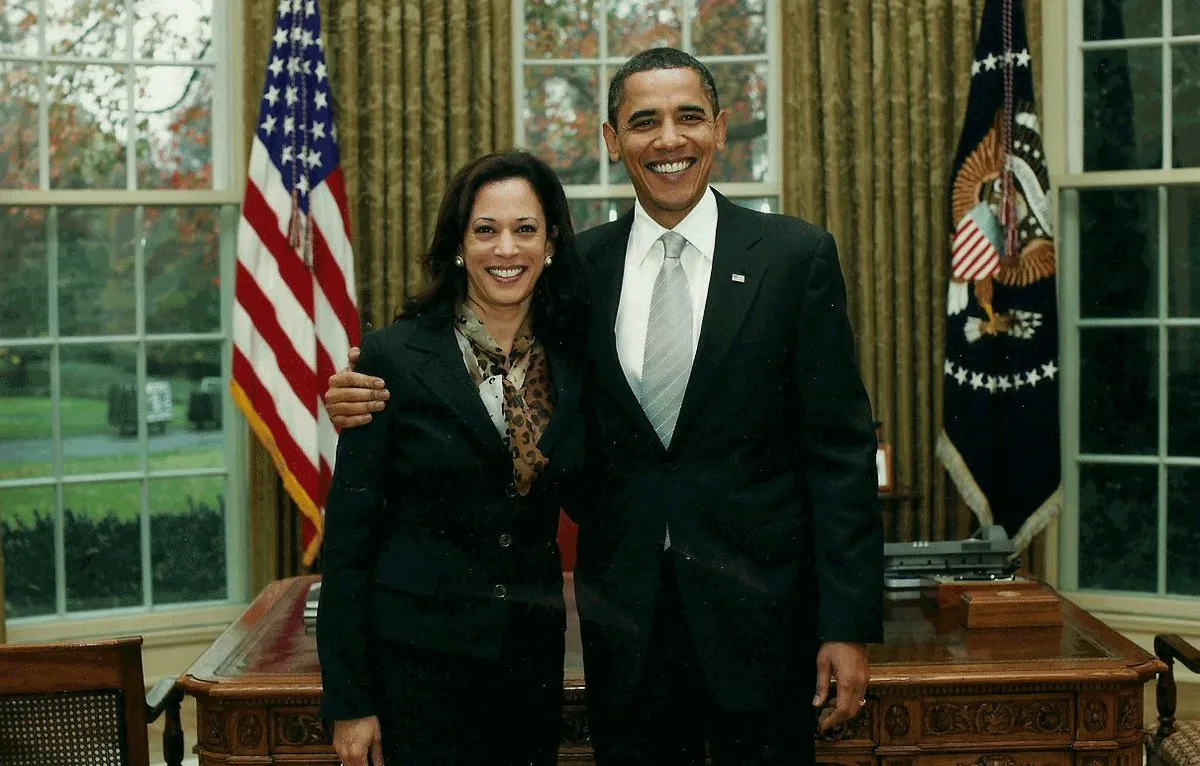
Kamala Harris flew to Vienna to attend Arnold Schwarzenegger's climate summit and used the occasion to predict that Donald Trump's Iran deal will collapse the same way Barack Obama's did. She's calling it a "War of Choice," she's calling Trump "self-indulgent," and she's calling the midterms for Democrats. Whether any of that lands is a separate question from whether she's right about the deal itself.
What She Actually Said
Harris made her remarks Tuesday at the Austrian World Summit in Vienna, the annual climate conference hosted by the Schwarzenegger Climate Initiative. Fox News reports she took direct aim at the Trump administration's memorandum of understanding with Iran, which has not yet been publicly released.
"This is a war the American people did not want. This is a War of Choice. This is a president who has proven himself to be entirely self-indulgent," Harris said. She then made the comparison that the White House is probably least thrilled about: "Whatever is being negotiated, this president is going to declare victory, and we'll end up where we were after the JCPOA and call that a victory, the JPOA that he withdrew from."
For those who need the acronym translation: the JCPOA was Obama's 2015 nuclear deal. Trump blew it up in 2018. Harris is saying Trump will reconstruct a version of the thing he destroyed, slap his name on it, and expect a parade. Given this administration's track record on branding over substance, it's not the most outlandish prediction anyone has ever made.
What the Deal Actually Is, As Far As Anyone Knows
Here's the tricky part: we still don't know the full terms of the agreement because the administration hasn't released the memorandum of understanding. What administration officials have said, according to Fox News, is that the deal would reopen the Strait of Hormuz and require Iran to halt nuclear weapons development and support for terrorism.
There is also a 60-day negotiating window built in, during which Iran is expected to demonstrate it has abandoned those programs. Retired Navy SEAL Mike Sarraille told Fox News the $300 billion in private sector funding attached to the deal functions as "economic handcuffs" rather than a payoff, providing leverage over Tehran during that period.
Let's be honest about what a 60-day window to verify Iran has abandoned its nuclear ambitions and terrorism support actually means. Iran has been pursuing both for decades. Sixty days is how long it takes to find a decent contractor in this country. The burden of proof being demanded here is either historic or aspirational, and right now there's no way to know which.
The Gas Price Argument Is the One That Matters Politically
Harris hit a more concrete target when she connected the conflict to household costs. "There is a direct correlation between this war of choice and what has happened in terms of gas prices. It is estimated the average American has spent, since the war started, $500 more because of this war," she said, per Fox News.
Fox News noted that oil prices fell Monday to their lowest point since early March after the preliminary U.S.-Iran agreement raised hopes about Strait of Hormuz traffic returning to normal. The Trump administration has been telling voters gas prices will drop this summer under the deal. Republicans heading into November midterms very much need that to be true.
This is where Harris's argument has the most teeth, regardless of how you feel about her as a messenger. Gas prices and grocery prices are the two things voters feel most viscerally. If they stay elevated, the midterm math gets ugly fast for a party that ran on making things cheaper.
The Messenger Problem
Here is where we have to be straight with you. Harris is not wrong about the structural risks of this deal. The JCPOA comparison is fair game, and the skepticism about Iran's willingness to actually change its behavior is shared by people well outside the Democratic Party.
But Harris is also a candidate who lost the 2024 presidential election and is now predicting midterm victories while posing for photos with Arnold Schwarzenegger in Vienna. The optics of delivering economic populism arguments from an international climate summit in Austria are, to put it gently, not ideal. Democrats have a long and distinguished history of being correct about something while being completely unable to make anyone care, and this has the early feel of that.
"I have no question or doubt that we will win the midterms," she said. That kind of confidence would mean more coming from someone who had won something recently.
The Deal Still Has to Survive the Next 60 Days
The agreement, such as it is, now enters its critical phase. Iran gets a 60-day window to show compliance. The Strait of Hormuz, through which a significant chunk of global oil flows, would reopen under the terms. And the Trump administration gets to run a "peace in the Middle East" victory lap heading into the midterms, assuming nothing goes sideways.
A lot can go sideways. Iran's government has already been spinning the deal domestically as a victory over the United States and Israel, according to Fox News. That is not the framing a fragile, preliminary agreement can easily survive on both sides simultaneously. When both governments claim they won, it usually means neither of them negotiated what they think they did.
The 60-day clock is now running. Watch it carefully.
The Dingo Take
Look, the honest answer here is that both things are true at the same time. Harris's critique of the deal's structure is substantively reasonable. The comparison to the JCPOA is fair. The concern that Trump will declare a win before the details are verified is rooted in observable history. She is not wrong.
She is also a politician who lost a presidential race less than two years ago, speaking at a celebrity climate conference in Europe, predicting electoral victories she cannot deliver herself. The substance of the argument gets swamped by the messenger and the setting. Democrats keep doing this. They are correct in rooms that don't count and absent from the rooms that do.
As for the deal itself: an Iran that has genuinely stopped pursuing nuclear weapons and stopped funding terrorism in exchange for economic relief would be an enormous development. If Trump can actually deliver that, fine, credit where it's due. But a 60-day window and an unreleased memorandum are not a deal. They are a vibe. And American foreign policy built on vibes has a catastrophic failure rate that both parties have spent decades contributing to.





Comments