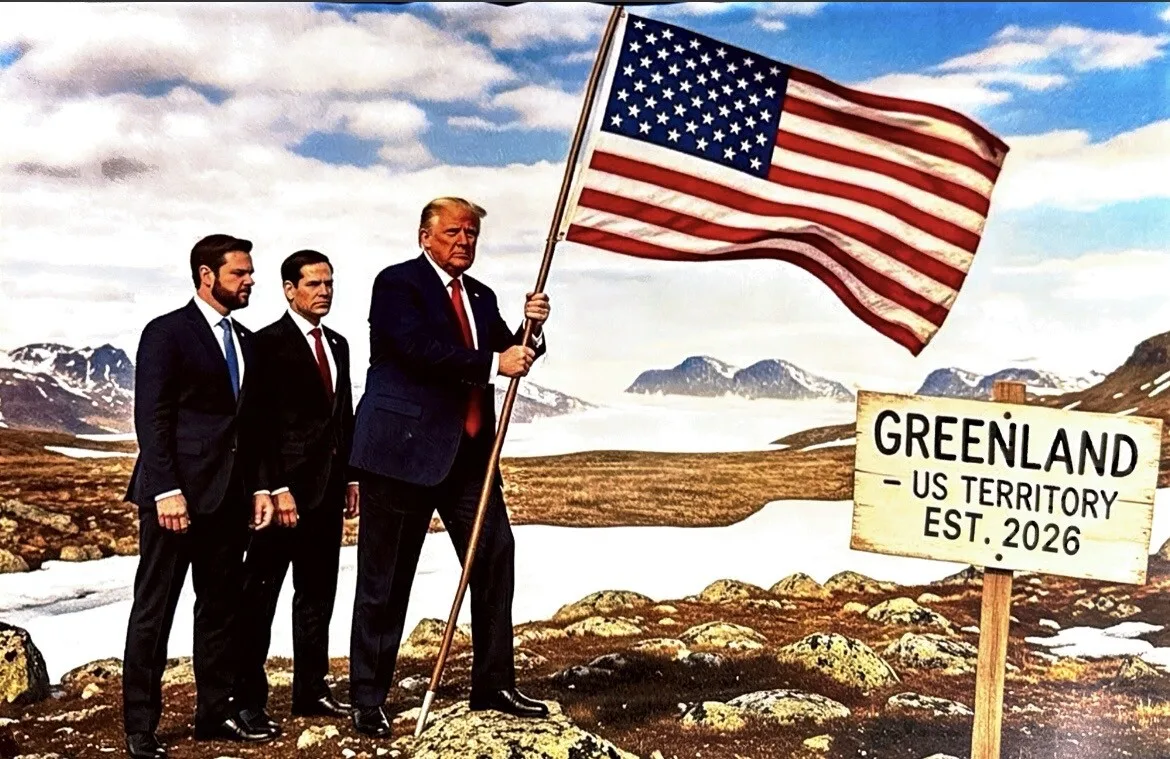
You thought the Greenland thing was over. You thought it was a bit, a distraction, one of those early-term Trump fever dreams that fades into the noise. According to a new investigation from The New Yorker, you thought wrong. The campaign to acquire a sovereign territory belonging to a NATO ally is still very much alive — it just stopped being loud enough to make the front page.
Still Happening. Still Weird. Still Real.
New Yorker writer Ben Taub spent serious time digging into Trump's efforts to acquire Greenland, and what he found, as he told NPR's Fresh Air this week, is that the story never actually ended. It just went quiet. The administration's push to bring Greenland under American control has continued behind the scenes, away from the cable news chyrons and the late-night jokes.
That is worth sitting with for a moment. The United States government has an active, ongoing campaign to acquire territory that belongs to Denmark, a country that has been one of our closest allies for decades, a fellow NATO member, a democracy that has done nothing to provoke this except exist in a geographically inconvenient location. And the reason most Americans stopped thinking about it is simply that the news cycle moved on.
This is how a lot of genuinely alarming things happen under this administration. The outrage cycle burns hot for two weeks, then some new catastrophe lands, and the old one quietly continues without the spotlight. The Greenland push is a case study in exactly that pattern.
What the Allies Actually Think
Here is where it gets less funny and more serious. Taub told NPR that Trump's ongoing pursuit of Greenland has broken trust with American allies in ways that are hard to repair. This isn't a matter of hurt feelings or diplomatic awkwardness at a summit dinner. Trust, in the context of military alliances, is structural. It is the whole foundation.
When a NATO member watches the United States spend months pressing aggressive territorial claims on another NATO member, the lesson they draw is not abstract. The lesson is: the Americans will come for what they want, and the alliance will not protect you from them. That is a genuinely destabilizing message to send to every country that has spent the better part of eighty years betting its national security on the American partnership.
Denmark has been a reliable U.S. ally through Cold War posturing, post-9/11 coalition building, and every iteration of the transatlantic relationship since World War II. The reward for that reliability, apparently, is having an American president publicly and repeatedly suggest that their autonomous territory should simply become part of the United States.
Why Greenland? The Actual Answer Is Depressing.
The strategic logic, such as it is, involves Arctic access, rare earth minerals, and the kind of great-power competition framing that defense hawks have been pushing for years. As the Arctic ice melts, the region becomes more navigable and more valuable, and Greenland sits in an extraordinarily useful position relative to both Russian and Chinese activity in the north. There are real strategic interests in play here. Nobody serious disputes that.
But there is an enormous difference between deepening military and economic partnerships with Greenland and its government and literally trying to purchase or absorb the territory. One is diplomacy. The other is what European capitals are increasingly calling something closer to coercion. The fact that the administration cannot seem to tell the difference, or does not care to, is precisely what's eroding the trust Taub describes.
Greenland's government, for what it is worth, has repeatedly and clearly said it is not for sale. The Greenlandic people have their own aspirations for self-determination, their own political identity, their own future they are trying to build. The Trump administration's response to all of that has essentially been to keep asking anyway.
The Quiet Campaigns Are the Dangerous Ones
What Taub's reporting for The New Yorker illustrates, and what his conversation with NPR underscores, is how much of this administration's most consequential foreign policy activity happens when nobody is paying attention. The loud stuff, the tariffs and the insults and the press conference provocations, absorbs the public's attention. The quiet stuff reshapes the world.
An ongoing, active campaign to acquire allied territory does not require daily headlines to do damage. Every diplomatic meeting where it comes up, every briefing where European officials have to factor it into their calculations, every alliance discussion where somebody wonders whether Washington can actually be trusted with collective security commitments, that is the campaign doing its work. Slowly. Steadily. Out of the news cycle.
The fact that this story has to be pulled back into focus by a magazine investigation and a radio interview, rather than sustained coverage commensurate with its actual seriousness, is its own kind of indictment. Not of any single outlet, but of the collective attention problem that this administration has learned to exploit with remarkable skill.
The Dingo Take
Let's be honest about what this is. A sitting American president has decided that a piece of another country looks useful and has set the machinery of the U.S. government to work acquiring it, over the repeated objections of the people who actually live there and the country that actually governs it. If any other government in the world were doing this, we would call it what it is without hesitation. We would lead the news with it every single night.
The allies who are watching this do not have the luxury of getting distracted by the next news cycle. They have to actually plan around it. They have to brief their parliaments, adjust their defense postures, and quietly recalculate how much of their national security they can afford to outsource to a Washington that has made clear it operates on appetite rather than principle. That calculation, once made, does not easily go back to where it started.
Ben Taub did the work. NPR aired the conversation. The question is whether enough people are listening, because the administration is certainly counting on them not to be.




Comments