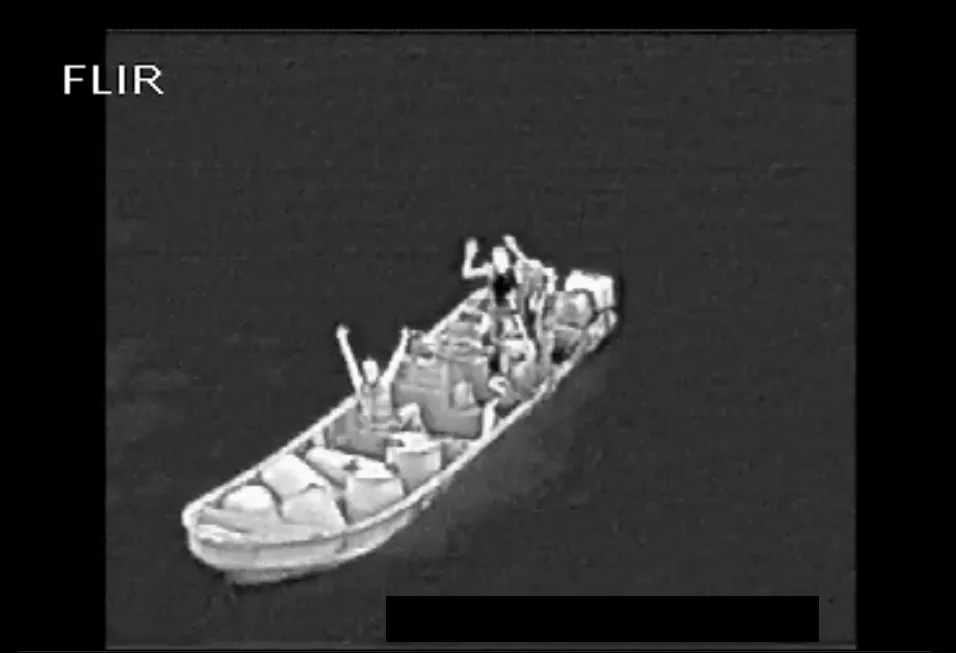
The U.S. military blew up another boat in the eastern Pacific on Tuesday, killing one person and leaving two survivors treading water while the Coast Guard scrambled to find them. It was, depending on how you're counting, a fairly routine Tuesday. At least 208 people have now been killed in American military strikes on alleged drug boats since September, and the administration still hasn't presented evidence that a single one of those vessels was actually carrying drugs.
What Actually Happened Out There
U.S. Southern Command confirmed the strike on a boat traveling in the eastern Pacific Ocean, saying it targeted alleged drug traffickers along known smuggling routes. One person was killed. Two survived. Southern Command said it "immediately notified U.S. Coast Guard to activate the Search and Rescue system for the survivors," which is a very official way of saying they blew up a boat and then called someone else to deal with the people still in the water.
A video posted on X showed the vessel moving normally across the ocean before being hit and erupting into flames. The military provided no evidence the boat was carrying drugs. This is not unusual. According to NPR, the military almost never provides that evidence. The pattern is: strike first, describe the target as a narcoterrorist vessel in a press release, move on.
208 People Dead, Zero Drug Shipments Stopped
Let's sit with that number for a moment. At least 208 people killed in military strikes since early September. That is not a special forces raid on a cartel compound. That is not a precision operation targeting a known kingpin. That is nine months of blowing up boats in international waters based on their location along "known smuggling routes," which is a phrase that apparently now substitutes for evidence in the Trump administration's war on drugs.
The Trump administration has justified all of this under the claim that the U.S. is in "armed conflict" with cartels in Latin America. Trump has said these strikes are necessary to stop the flow of drugs and prevent fatal overdoses. What he has not said, because his administration has not provided it, is any substantive proof that the people being killed were actually traffickers. NPR has noted that the administration has offered little evidence to support its claims of killing "narcoterrorists."
Here's the part that should really make your eye twitch. The fentanyl driving America's overdose crisis is typically trafficked overland from Mexico, where it's produced using chemicals imported from China and India. Blowing up boats in the Pacific Ocean is not, by any logical chain of causation, stopping fentanyl from crossing the southern land border. Critics have raised exactly this point, and the administration has responded by blowing up more boats.
The Strike That Killed Survivors, Explained
The September strike that started all of this remains the most legally alarming single incident in this campaign. According to CBS News, two men initially survived the first attack, which killed nine others. They were clinging to the wreckage of the destroyed vessel when the military struck it again, killing them both.
The White House confirmed the follow-up strike and said it was carried out "in self-defense" to ensure the boat was destroyed, and that it was done in accordance with the laws of armed conflict. Legal scholars said that was wrong on the face of it. Striking survivors clinging to wreckage is not a legal act of war under any reading of international law, armed conflict declaration or not. Some legal scholars told NPR the second strike would have been illegal under any circumstance.
The White House's response to that legal consensus was, more or less, to keep doing strikes.
The Pentagon's Inspector General Is On It (Sort Of)
In May, the Pentagon's watchdog announced it would look into whether the U.S. military followed an established targeting framework when carrying out the strikes. That sounds promising until you read the fine print. The inspector general's office clarified that the evaluation is focused specifically on what's known as the six-phase Joint Targeting Cycle, and not on the legality of the strikes themselves.
So to be clear: the official oversight review will check whether the military filled out the right paperwork before killing people in boats. It will not ask whether killing people in boats is legal. That question, apparently, is above the inspector general's pay grade or outside the scope of what anyone with actual authority wants answered right now.
Democratic lawmakers and military legal scholars have pushed for more scrutiny. The scrutiny they have received is a procedural audit that explicitly excludes the most important question.
The Evidence Problem Isn't Going Away
The administration keeps using the word "narcoterrorists." They use it confidently, repeatedly, in every press release. What they do not use is proof. According to NPR, the military did not provide evidence in the most recent strike that the targeted vessel was ferrying drugs. This is consistent with the pattern across the entire campaign.
Southern Command's standard justification is that boats were traveling along known smuggling routes. That's it. That's the whole case. Fishermen travel those routes. Civilians travel those routes. The ocean does not segregate itself into drug lanes and non-drug lanes. "Known smuggling route" is a geographic fact about where drug trafficking happens, not evidence about what any specific boat is carrying on any specific day.
The Dingo Take
There is a version of an aggressive anti-drug policy that could be debated on the merits. This is not that. This is the U.S. military executing people in international waters based on their location, with no presented evidence, no judicial oversight, no public accounting of who these 208 people actually were, and a legal framework built entirely on Trump declaring an "armed conflict" with a concept. If a foreign government was doing this to boats it suspected of carrying American contraband, we would call it state-sponsored murder and sanction them into the ground.
The follow-up strike on survivors is where this crosses from policy debate into something that should haunt everyone involved. Two men survived an attack. They were in the water, holding onto wreckage. The U.S. military hit the boat again and killed them. The White House called it self-defense. Legal experts called it a war crime. The inspector general is currently reviewing the paperwork. These are not equivalent responses.
At 208 dead and counting, with zero drug shipments demonstrably stopped, with fentanyl still flowing across the land border it has always crossed, someone in a position of actual authority needs to ask what this campaign is actually for. Because it is not stopping drugs. It is stopping people. And nobody in this administration seems to think that requires explanation.




Comments