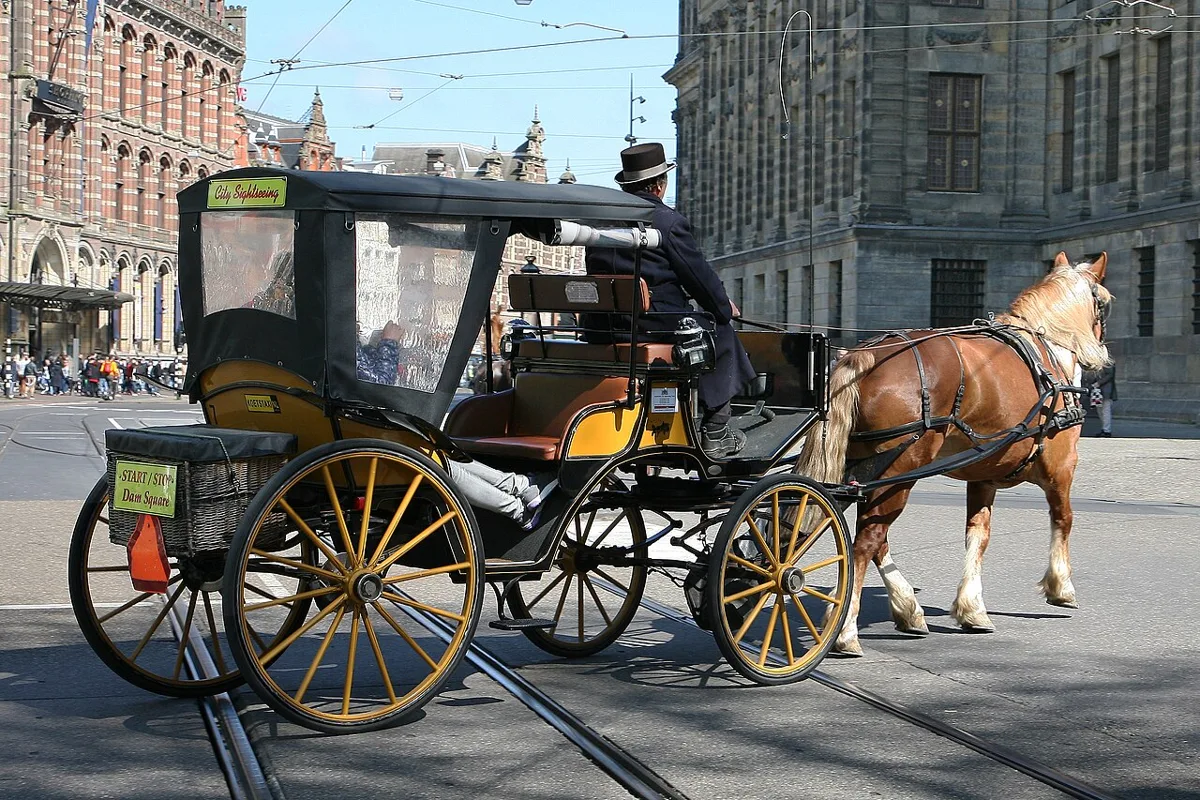
A driver got off his carriage to snap a photo of his passengers. The horse bolted. An 18-year-old tourist from India is dead. And an industry that has spent years arguing it's perfectly safe just ran out of arguments.
What Happened in the Park Wednesday
Just before 3pm on Wednesday, a horse-drawn carriage was moving through Central Park when the driver stepped away from his position to photograph the four passengers riding in the cab. According to the Guardian, the driver had dismounted, which the Transport Workers Union says drivers are explicitly not supposed to do. The horse bolted.
Video circulating online shows the animal sprinting through the park as two people appear to jump or get thrown from the carriage. A second clip captures the moment the cab clips the wheels of another carriage on the park's busy loop and topples over. At least two passengers were ejected. The 18-year-old, identified by BBC News as a tourist from India, was rushed to hospital in critical condition. He was later pronounced dead. The three other passengers declined medical treatment.
Alexander Kemp, the administrative vice-president of Transport Workers Union Local 100, was not in the mood to defend the driver. "It appears the driver was at least at arm's length from his horse," Kemp told local media, according to the BBC. "This is unacceptable. A driver is not supposed to leave the carriage to take photos, ever. We support a full investigation." That is a union rep throwing one of his own members directly under the carriage, and honestly, given that a teenager is dead, it's hard to argue the call.
The Horse Had Been on the Job Six Weeks
Here is a detail that should make you put down whatever you're drinking. According to the Guardian, the horse had only been working in Central Park for six weeks. Kemp confirmed this while calling for a full investigation. Central Park, one of the most densely visited public spaces in the United States, with millions of tourists passing through every year on foot, on bikes, on scooters, and in carriages. Six weeks of experience.
The Guardian reports that Central Park covers nearly 850 acres and attracts enormous crowds annually. The park's loop, where this happened, is shared by joggers, cyclists, delivery vehicles, e-bikes, pedicabs, and the carriages themselves. Dropping a green horse into that environment is, in retrospect, not a decision that needs much more commentary from us.
This Is the Second Horse Incident in Eight Days
Last week, a carriage horse named Deniz died in Central Park. The BBC reports that initial autopsy results suggest Deniz ate a toxic plant. Now, a week later, an 18-year-old is dead after a different horse lost control with a different carriage. Two incidents. Eight days. The industry would like you to believe this is a coincidence.
The Central Park Conservancy, the nonprofit that manages the park, is not buying it. The group came out in support of banning horse-drawn carriages last summer, and on Wednesday they issued a statement that left nothing to interpretation. "A young man came to enjoy our park and lost his life," they said, according to the Guardian. "That is not an acceptable cost of an antiquated industry operating in the middle of one of the most heavily used public spaces in America." When the organization that literally runs the park is calling for your industry to end, the writing is not on the wall so much as it has been painted across the entire wall in enormous letters.
The Political Machinery Is Already Moving
New York Mayor Zohran Mamdani has already said publicly that he supports removing the carriages from the park, according to the BBC. This is not a mayor hedging. That is a clear position from the person who runs the city.
City Council member Shahana Hanif was more direct, saying on X that the back-to-back incidents "are heartbreaking reminders that horse-drawn carriages are unsafe for both horses and people." Hanif called for the passage of Ryder's Law, a bill that would stop the city from issuing any new carriage licenses and phase out the industry entirely over two years. Council member Harvey Epstein called the accident "tragic" and said the city "can't continue to ignore these tragedies." The political momentum here is not subtle.
Ryder's Law has been sitting in the legislative pipeline for a while, in that particular way New York City legislation tends to sit around while people argue about jobs and tradition and tourism revenue. Wednesday's footage of a carriage toppling over on a park loop while passengers go flying is the kind of thing that tends to unstick bills.
The Industry's Defense Is Running Out of Road
The horse-drawn carriage trade in Central Park is 150 years old, as the Guardian points out, and its defenders have always leaned heavily on that history. Romantic. Quaint. A living piece of old New York. A source of hundreds of jobs for drivers and a second life for farm and racing horses. These are not nothing arguments, and for a long time they were enough to keep legislators from acting.
But the union itself, in its statement Wednesday, acknowledged that "safety in the park has been a growing concern" and called for improvements involving not just carriages but e-bikes, delivery vehicles, and pedicabs. That is a union conceding the problem exists. A driver broke a basic rule, a teenager died, and the industry's own representatives are now calling for investigations rather than defending the status quo. That is not the posture of an industry that feels confident about its future.
The Dingo Take
Let's be honest about what happened here. A worker violated a basic safety rule, a frightened animal did exactly what frightened animals do, and an 18-year-old who flew to New York City for what was probably the trip of a lifetime got thrown from a wooden cab at full gallop and never came home. That's not a freak accident. That's a predictable outcome of putting inexperienced horses and inattentive drivers in a chaotic, crowded public space and calling it a tourist attraction.
The carriage industry has spent years treating every safety incident as an outlier, a one-off, a reason to call for better training rather than a structural reckoning. They have a horse that died from a toxic plant last week and a teenager dead from a runaway carriage this week, and their union rep is out there noting that drivers shouldn't leave their carriages for photos as if this is a gentle process improvement opportunity. A kid is dead. The horse was six weeks into the job. The driver stepped away for a photo op. This is not a training problem. It's an industry that has overstayed its welcome in a city that has fundamentally changed around it.
Ryder's Law should pass. The mayor supports ending this. The organization that runs the park supports ending this. Two of the city council members quoted in coverage of this story support ending this. The only remaining question is whether New York City will wait for a third incident in two weeks before it decides that a 150-year tradition is not, in fact, worth more than the lives of the people who come to that park. The answer should be obvious. It usually is, after someone dies.




Comments