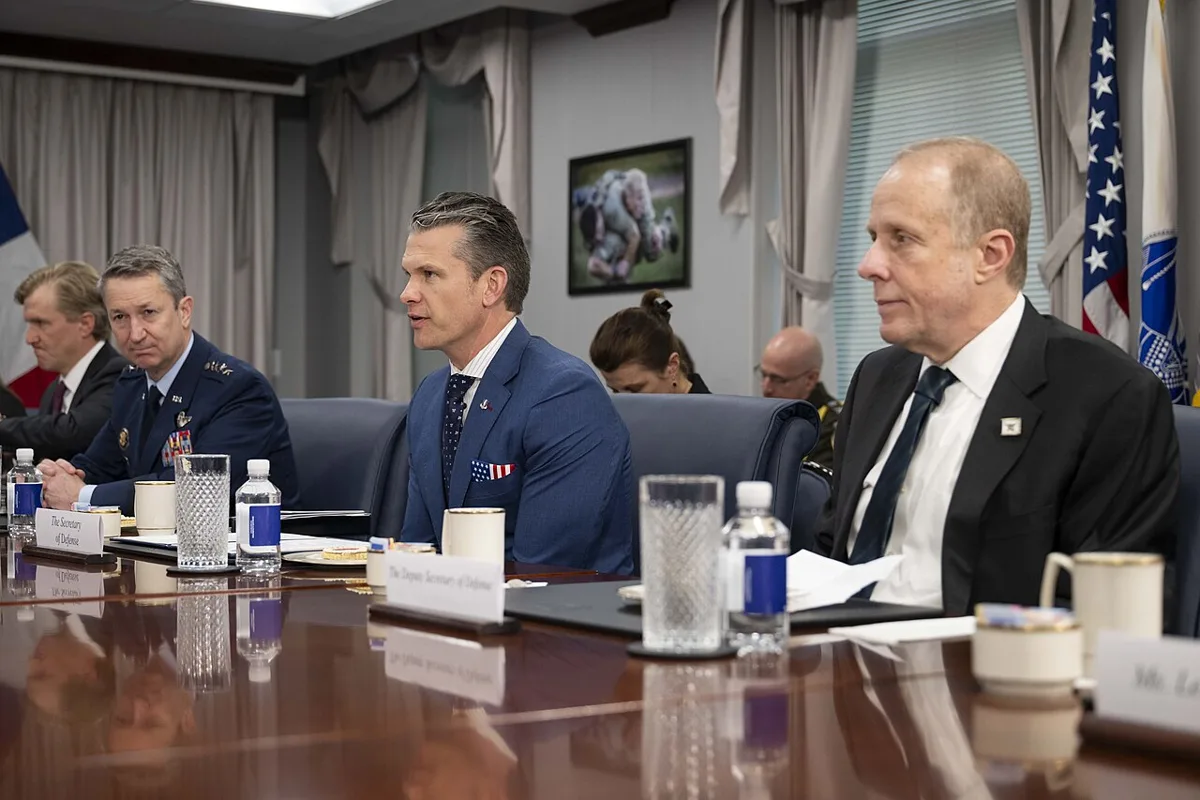
Pete Hegseth is out there doing push-ups with soldiers and screaming at journalists, and somehow he's not the most powerful person at the Department of Defense. That distinction belongs to Stephen Feinberg, a 66-year-old private equity billionaire who hasn't given a single interview, hasn't testified to a single congressional committee, and whose only known video presence in the last 15 months is a cartoon animation posted to X. He runs the most expensive military apparatus in human history. Nobody has seen his face.
Who Is This Guy, Exactly
Feinberg is the founder of Cerberus Capital Management, one of the largest private equity firms in America. He was confirmed as Deputy Undersecretary of Defense in March 2025, making him technically the number two civilian official at the Pentagon under Hegseth. In practice, according to The Guardian, which spoke to ten sources across Capitol Hill, the Pentagon, and the defense contracting world, he is the number one.
"Everything is centered around Feinberg," one veteran Pentagon bureaucrat told The Guardian. A financier familiar with his operations put it more bluntly: "I don't think there's anything that goes on that he doesn't have a stake in." His press spokesperson left the government months into his tenure. Nobody has replaced that person. There's no one to call. There's no face to put on a TV screen. There is just a cartoon man in a grey suit lighting a cigar.
For decades before this, Feinberg was legendarily reclusive in the private sector too. This is not a man who stumbled into secrecy by accident. This is a man who built a career on being invisible while controlling enormous amounts of money. The only difference now is that the money is yours.
The Arrangement With Hegseth Is Exactly What It Looks Like
Here is how the division of labor apparently works at the Trump Pentagon. Hegseth handles the ideological circus: removing women and Black service members from promotion lists, fighting culture wars with the Boy Scouts over transgender children, posting on social media, yelling at reporters. Feinberg handles the money, the contracts, the procurement system, and the industrial base of the entire military.
Defense analyst Winslow Wheeler, a former Government Accountability Office official, described it to The Guardian with the kind of clarity that makes your stomach drop: "He's perfectly happy to let Hegseth do that horseshit so long as Hegseth stays out of his hair and he can do what he wants."
What he wants, according to The Guardian's reporting, is to remake Pentagon procurement from the inside out. Both critics and supporters, the outlet reports, say Feinberg has essentially shredded the old rules of government weapons acquisition and turned the Department of Defense into its own private equity operation. Which is convenient, because that's what he spent 34 years doing in the private sector.
He Brought His Own People
Feinberg didn't walk into the Pentagon alone. The Guardian reports he has systematically seeded the department with current and former Cerberus executives. There's George Kollitides, a senior executive adviser who SEC filings show still holds a seat on an investment company's board of directors. There's Tomas Rakusan, a former CIA case officer who went to Cerberus and then followed Feinberg to the Pentagon. There's David Lorch, a Cerberus managing director now running a multibillion dollar office dedicated to investing in critical minerals and strategic industries.
A Pentagon official who worked with Feinberg gave The Guardian the assessment that explains all of this perfectly: "In his mind the most qualified people are the people who have been working for him for 10 years. Their whole thing is shaking up the way government works."
Shaking up the way government works. That phrase is doing a lot of work. At a normal agency, this kind of consolidated loyalty network would trigger immediate ethics reviews. At the Trump Pentagon, it's apparently just Tuesday.
About Those Conflicts of Interest
Feinberg said in early 2025 that he would fully divest his holdings in Cerberus and its affiliates upon joining the government. He certified in March 2025 that he had done so. A Cerberus spokesperson confirmed to The Guardian that he divested his stake and is not involved with the firm's operations in any way.
But here's the thing about spending 34 years building a company and then walking away: the company doesn't stop existing. Cerberus owns Stratolaunch, a hypersonic flight test company it purchased in 2019. That company announced a $90.8 million Pentagon contract in January. Hypersonics are, according to The Guardian, a top DOD spending priority right now. Cerberus also bought control of M1 Support Services, a federal contracting company that supplies training and logistics to the US military, months before Trump won the 2024 election.
Senator Elizabeth Warren wrote to Feinberg in April pointing out that Cerberus-linked companies have received contracts related to the Golden Dome missile defense system. "The award of contracts to Cerberus-linked companies raises serious conflicts of interest concerns," she wrote. Feinberg may not personally profit from these deals. But the firm he founded, staffed with people he trusted, pursuing priorities he spent decades cultivating, keeps winning government contracts from a department he now controls. You are allowed to find that alarming.
The Scandal That Briefly Made Him Visible
Feinberg almost became newsworthy this month for reasons unrelated to procurement policy. The Guardian reports that a CIA official named David Rush faced federal charges for allegedly lying about his background, with federal agents writing that Rush had stashed millions of dollars worth of gold in his house. Feinberg, officials said, had supported Rush in a phone call to the CIA before the scandal became public.
A Pentagon spokesperson told The Guardian that Rush and Feinberg didn't have a "close personal relationship of any kind." Then Feinberg went back to not giving interviews, not testifying, and not having a spokesperson available for follow-up questions. The cartoon man returned to his cartoon desk.
The Dingo Take
Let's be honest about what The Guardian's reporting actually describes. A billionaire private equity executive, with no electoral mandate and essentially no public accountability, has taken control of the largest procurement budget on the planet while his nominal boss performs for the cameras. This is not a bug. This is the entire design. Hegseth exists to generate outrage and media coverage and keep the base activated. Feinberg exists to actually run things. The culture war is the magic trick. Feinberg is what's in the other hand.
The divestment question almost doesn't matter at this point, though it matters plenty. Even if Feinberg has perfectly scrubbed his personal financial interest in Cerberus, he staffed the Pentagon with Cerberus alumni, he built a career entirely inside the defense contracting world those alumni understand, and the firms they all came from keep winning contracts in priority areas he now controls. You can call that legal. You can call it certified and above board. What you cannot call it is a system designed to serve the public interest.
The most revealing detail in all of The Guardian's reporting is the simplest one: the man has no press spokesperson. He disbanded that function and never rebuilt it. When a deputy secretary of defense at the most powerful military institution in world history decides that public communication is simply not something he needs to do, that tells you everything about what kind of accountability he expects to face. The answer, so far, has been almost none.




Comments