
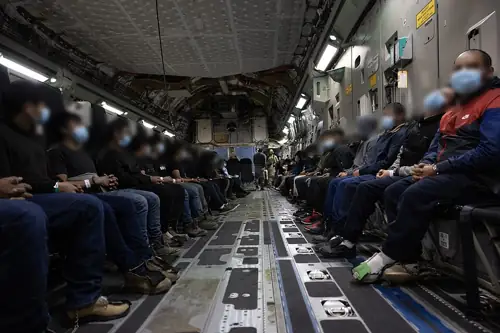
The Department of Justice filed a lawsuit against Virginia last week for passing laws that would require federal immigration agents to wear visible identification badges during operations. That's it. That's the outrage. The federal government is going to court to protect the right of armed agents to arrest people without saying who they are.
What Virginia Actually Did
Virginia's Democratic-controlled legislature passed two bills this session that the DOJ finds intolerable. The first requires federal law enforcement officers operating in the state to wear visible ID badges and bans them from covering their faces during operations. The second limits voluntary cooperation agreements between local sheriffs and ICE.
Both laws are set to take effect July 1. The Trump DOJ wants a federal judge to block them before they do. According to Fox News, DOJ Assistant Attorney General Brett Shumate confirmed the department is moving fast to get an injunction, because these laws, in his words, 'have criminal penalties that put federal agents at risk.'
The criminal penalties in question would apply to unidentified, masked agents grabbing people off the street. Which, depending on your read of the situation, sounds less like a threat to law enforcement and more like a basic accountability mechanism. But we'll get to that.
The 'Next California' Warning
Shumate told Fox News Digital, with apparent alarm, that the DOJ is 'suing Virginia to prevent Virginia from becoming the next sanctuary jurisdiction, just like California.' The comparison is doing a lot of heavy lifting there. California passed laws requiring ICE agents to show identification. Virginia passed laws requiring ICE agents to show identification. The DOJ sued California. A federal appeals court sided with the DOJ in April, blocking California's ID requirement.
So now the DOJ is running the same play against Virginia, armed with that precedent. Shumate was explicit about it: 'We brought a nearly identical lawsuit against California earlier this year, and we won that case.' The legal theory centers on the Supremacy Clause, the constitutional principle that federal law overrides state law. The DOJ's argument is that states have no authority to regulate how federal agents conduct federal operations.
Virginia was a reliably red state for decades before shifting left over the past twenty years. Fox News was sure to mention this. The implication being, presumably, that Virginia should know better.
The Masking Debate No One Wanted to Have
ICE has defended the practice of agents wearing masks and concealing their identities during operations. The agency argued last summer, as anti-ICE protests intensified, that inflammatory rhetoric had caused a spike in threats and assaults against agents and their families. That's a real concern and worth taking seriously.
But here is the other side of that coin, which the DOJ did not address in Shumate's comments to Fox News: when armed individuals in plain clothes approach a person on the street, seize them, and put them in a vehicle, those individuals being identifiable is not a radical ask. It is, in most contexts, the bare minimum standard for distinguishing law enforcement from something considerably more terrifying. The debate about whether federal agents should be allowed to operate without identifying themselves in public is not a settled one, regardless of how the April appeals court ruling went.
Shumate also told Fox News that the DOJ is watching other states considering similar legislation. 'Any state that's considering passing this type of bill is on notice that we will file a lawsuit,' he said. A warning shot, coast to coast.
Who's Named in the Lawsuit
The suit names Virginia Attorney General Jay Jones and Fairfax County Commonwealth Attorney Steve Descano. Fox News noted that Descano was previously backed by groups connected to George Soros, which is the outlet's standard shorthand for 'this person is very liberal and you should be suspicious of them.'
Governor Abigail Spanberger, the newly elected Democrat who replaced longtime Republican Glenn Youngkin, is the political face of Virginia's leftward tilt. The DOJ lawsuit lands squarely in her lap as a major early test of her administration. Fox News reports the DOJ has not yet heard back from Virginia state officials.
The Dingo Take
Let's be honest about what the DOJ is arguing here. The federal government's position, now backed by at least one appeals court, is that states cannot require its agents to say who they are. Full stop. The Supremacy Clause, a genuinely important constitutional principle designed to prevent a patchwork of state laws from hobbling federal authority, is being deployed to ensure that the people doing the arresting can keep their faces covered and their names to themselves. That is a remarkable thing for a democratic government to defend in open court.
None of this means the legal argument is wrong. Courts are not in the business of ruling based on how uncomfortable a precedent feels, and the DOJ may well win this one the same way it won in California. But winning a lawsuit and being right about the underlying policy are different things. A government that claims the power to detain people while simultaneously claiming the right to do so anonymously is not a government that should escape scrutiny just because it found a sympathetic circuit court.
Virginia passed these laws through a democratic process. Voters elected legislators who thought identifying armed agents operating in their communities was a reasonable ask. The DOJ's response is to sue before the laws even take effect. Shumate framed this as protecting federal agents from doxing and harassment. You can hold that concern and still notice that the practical effect of the policy is that no one knows who is doing the arresting. Those two things can both be true at once, and only one of them seems to bother the current administration.



Comments