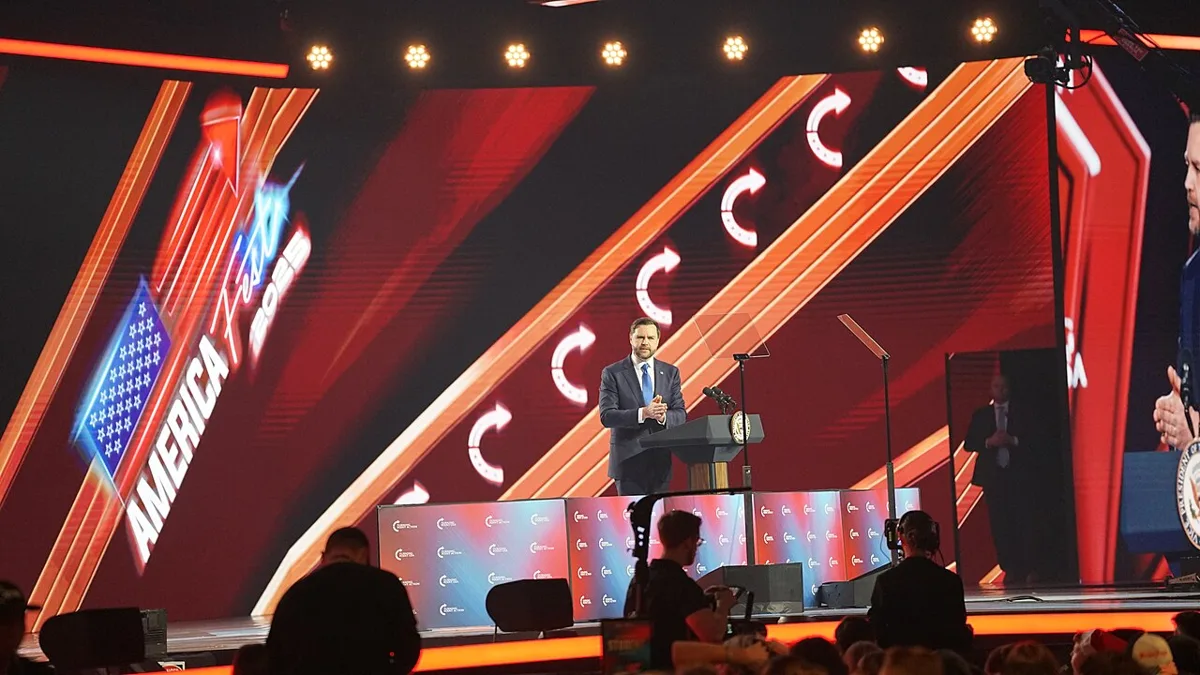
JD Vance, the Vice President of the United States, has written a book about his deep and sincere Catholic faith. He has also spent the past year publicly picking fights with the Pope. His new memoir, Communion: Finding My Way Back to Faith, asks readers to hold both of these things in their heads at once and somehow not laugh.
From 'Angry Atheist' to America's Top Catholic
The Guardian has a sweeping profile of Vance and his new book this week, and it is genuinely one of the stranger political documents you will read this year. The short version: Vance grew up in Appalachian Ohio in a household where Catholics were occasionally described as servants of the antichrist. He went through evangelical Pentecostalism, a phase where he was discouraged from reading Harry Potter, a firm belief that the Earth is 6,000 years old, and then a hard swing into militant atheism during college. Then, in 2019, Dominican friars talked him into Catholicism.
He was received into the church in a small ceremony, and he writes in Communion that at the moment of his baptism he heard his dead grandmother's voice urging him forward. Her exact words, which he quotes in the book: 'Time to shit or get off the pot.' This is the spiritual origin story of the most senior Catholic in the United States government. Take that in.
Vance is now, as he himself describes it in the memoir, 'the most senior Catholic in the United States government.' He is also, per The Guardian's reporting, the most prominent avatar of a revitalized conservative Catholicism that has allied itself with the MAGA movement. He is a probable 2028 presidential candidate who, if elected, would be only the third Catholic president and the first Republican one. So yes, this book matters, and yes, you should pay attention to what is actually in it.
The Pope Problem Nobody Wants to Talk About
Here is where it gets genuinely weird. Vance has found his faith, embraced the Church, written a whole memoir about it, and has also spent recent months in public spats with the actual Pope. Two of them, actually. He tangled with Pope Francis over immigration policy before Francis died, and then, according to The Guardian, took issue with Pope Leo's anti-war stances earlier this year.
Think about the theological pretzel you have to tie yourself into to simultaneously write a book called Communion: Finding My Way Back to Faith while publicly disagreeing with the leader of the faith you just found your way back to. Most Catholics who have beefs with Vatican policy quietly stew about it at Sunday dinner. Vance, as Vice President of the United States, just does it publicly and dares anyone to say something.
The Guardian notes this has put Vance in 'an embarrassing position between Trump and the Holy Father of his newly adopted faith.' Embarrassing is doing a lot of work in that sentence. The man converted five years ago and is already in a cold war with Rome. That is a speed run.
What the Book Actually Argues
Strip away the spectacle and Communion is making a specific political argument, not just a personal one. Vance argues, per The Guardian's reporting, that a Catholic-influenced 'third way' that is neither strictly left nor right could help fix what he sees as a politically, economically, and culturally deteriorating America. That is the intellectual pitch. The book is his attempt to position himself as something more than a MAGA loyalist, as a thinker with a coherent worldview rooted in genuine tradition.
It is worth understanding that this is not an entirely cynical argument on its face. Catholic social teaching is genuinely neither purely left nor right. It supports labor unions and critiques unchecked capitalism. It also opposes abortion and same-sex marriage. It is internally consistent in ways that do not map neatly onto American partisan lines. Vance has been making versions of this argument for years, and some smart people take it seriously.
The problem is that the man making the argument is the sitting Vice President of an administration that has, among other things, gutted social safety nets, waged war on immigrants, and concentrated power at a speed that would make the church fathers deeply uncomfortable. The third way sounds great in a memoir. It looks somewhat different from inside the current White House.
The Catholicism Takeover of American Conservatism
The Guardian's piece makes a point that does not get nearly enough attention in mainstream political coverage: Catholicism has had an outsized grip on American conservatism for decades, even as the media has fixated on southern evangelical voters as the face of the Christian right. William F. Buckley, the intellectual architect of the modern right, was a devout Catholic. Six of the nine current Supreme Court justices are Catholic, including nearly all of the court's conservatives.
Only about 20% of American adults identify as Catholic, and Catholics historically leaned Democratic. The transformation of that demographic into a cornerstone of Republican judicial and political power is one of the most underreported political stories of the last 40 years. Vance is not an outlier. He is the current loudest expression of a long-running trend.
And American Catholicism itself is in a strange moment. The church is still dealing with the wreckage of its sexual abuse scandals. Membership has been declining for decades. But The Guardian also reports that some parishes are seeing a genuine boom in new converts, often young adults who are, in the publication's words, 'disillusioned by the emptiness of modern life.' A leaner, more fervent church is taking shape. Vance is both a product and a symbol of that shift.
The Grandmother Who Believed in Abortion Rights
Buried inside the memoir, according to The Guardian's reporting, is a detail that is either deeply humanizing or deeply inconvenient for Vance, depending on your read. His grandmother Mamaw, the woman whose voice he heard urging him toward baptism, believed that abortion was 'an individual moral matter and should remain legal.' He includes this in the book.
Vance, of course, is the Vice President of an administration that has taken a sledgehammer to abortion access across the country and celebrated the fall of Roe v. Wade. The grandmother who shaped his faith disagreed with him on one of the central political causes he has used that faith to justify. He put it in the book anyway. That is either intellectual honesty or a failure to notice the contradiction sitting right there on the page.
The Dingo Take
Let's be clear about what this book is. It is a 2028 presidential campaign document wrapped in a conversion narrative. That does not mean the conversion was not real or that Vance's faith is purely performative. People find God, and sometimes it genuinely changes them. But when the most senior Catholic in US government writes a memoir about his Catholicism five years after converting, while running the country alongside a man he once said was unworthy of Christians' support, it is reasonable to ask what exactly the faith is doing in the political equation.
The argument Vance wants to make, that his Catholicism gives him a coherent, principled alternative to pure MAGA populism, would be more persuasive if he were not also picking fights with the Pope and serving as second-in-command to an administration that has systematically dismantled the kinds of protections Catholic social teaching has historically defended. You can be a sincere Catholic and hold those policy positions. But you cannot really claim the Church's moral authority while publicly countermanding its leadership on immigration and war.
What Vance has actually built is not a third way. It is a very American thing: a personalized, politically convenient religion that keeps the aesthetics and the identity while quietly setting aside the parts that create friction with power. His grandmother, who loved televangelists but suspected them of fraud, who believed abortion should be legal, who told him to shit or get off the pot, sounds like she would have had some thoughts about all of this. He should have left more room in the book for her.

Comments