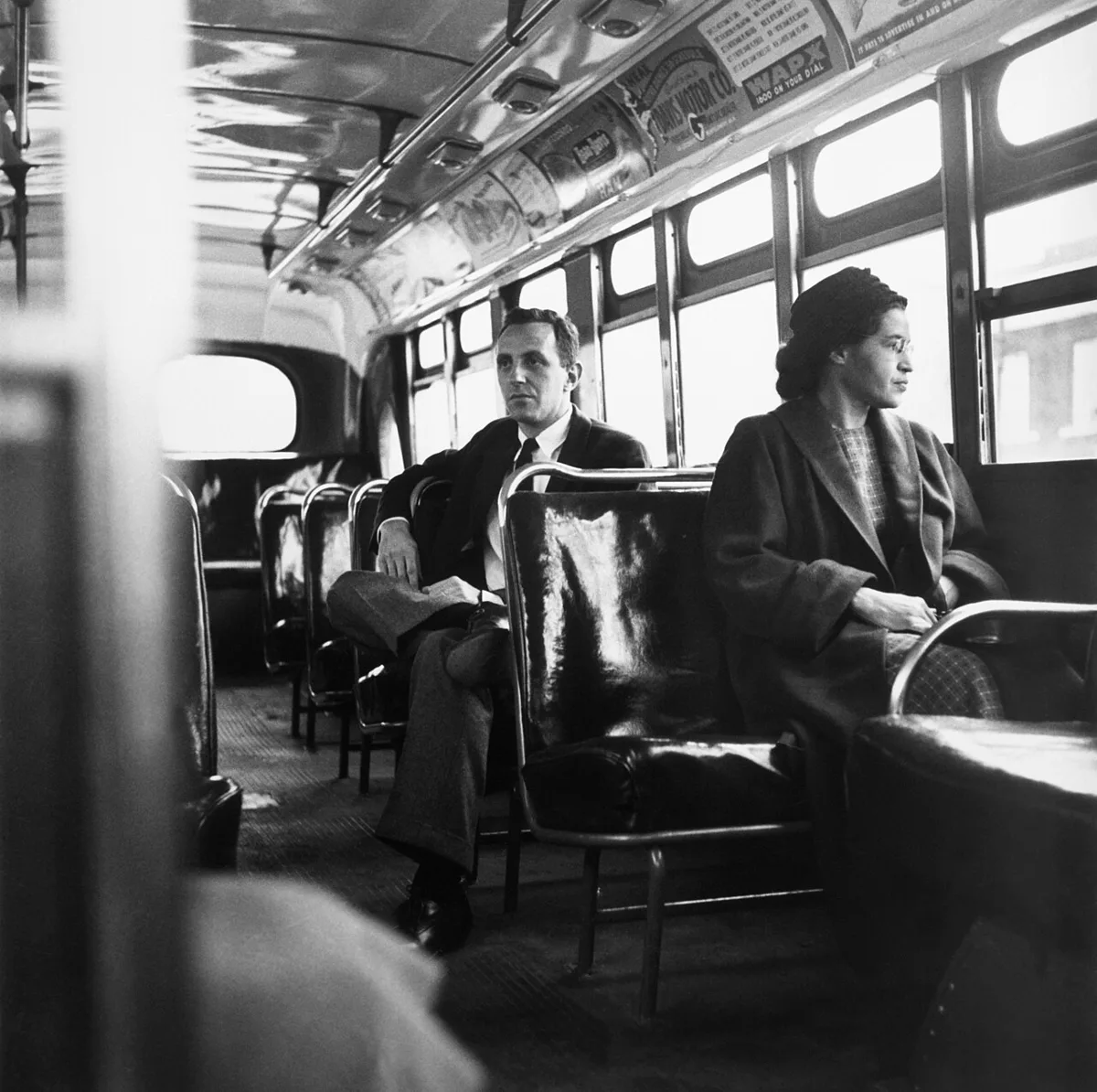
Bronze hands rise from the pavement in Montgomery, Alabama, holding a placard that reads 7053 — the booking number assigned to Rosa Parks when she was arrested in 1956. It is now a monument. Weeks after the square dedicated to her resistance opened, the conservative-majority Supreme Court gutted the Voting Rights Act that resistance helped produce. The timing was not subtle.
What 7053 Actually Means
The number was designed to reduce Parks to a criminal. That's what booking numbers do. They train the eye to see guilt before context, an arrestee before an act of deliberate, organized defiance that would crack the legal architecture of American apartheid.
At Montgomery Square, which The Guardian reports opened as the newest of four Legacy Sites built by the Equal Justice Initiative across the city, that function gets flipped. The hands holding the placard aren't in custody. They're holding it up like evidence of something. Which it is.
The square sits on Montgomery Street, the same stretch of Alabama pavement where voting rights marchers walked in 1965. EJI founder Bryan Stevenson told The Guardian he built it because Americans, in his view, 'haven't even fully appreciated what happened just 70 years ago during the civil rights era.' That's a polite way of saying: we have learned almost nothing.
The Supreme Court Picked Its Moment
Weeks after Montgomery Square's dedication, the conservative majority on the Supreme Court gutted Section 2 of the Voting Rights Act, the provision that prohibited racial discrimination in voting. The provision that people marched for. The provision that people bled for on that same street.
According to The Guardian, the decision immediately opened the floodgates for Republican efforts to redraw congressional maps and dilute Black political representation. So the monument went up, and then the thing the monument was built to honor got hollowed out by six justices in robes. Poetic is not quite the right word for it.
The inscription on the square's exterior wall, tall enough to read from the street, reads: 'We have come too far to turn around now.' Stevenson told The Guardian he added that line late in the process. He needed the dedication to declare something, not just commemorate something. Given what the Supreme Court did shortly after, it reads less like an inscription and more like a warning that nobody listened to.
The Memory Gap That Keeps Infecting Everything
Stevenson has spent four decades representing the condemned and the wrongly convicted. He wrote 'Just Mercy.' He has been making this argument for a long time, and it has not gotten less true. His core point, as The Guardian reports it, is that the United States has never built the kind of reckoning infrastructure that Germany built around the Holocaust or South Africa built around apartheid.
'We've never created spaces like that in this country that make us say never again to racial terror,' Stevenson told The Guardian. 'And because we never made that commitment, it just keeps manifesting itself.'
EJI's first two sites opened in 2018: the Legacy Museum, which traces the line from the Middle Passage to mass incarceration, and the National Memorial for Peace and Justice, honoring more than 4,400 victims of lynching and racist terrorism. A sculpture park followed in 2024 on the banks of the Alabama River, where enslaved people were once trafficked. The four sites now draw around half a million visitors a year, according to The Guardian. That is not nothing. It is also not enough.
The Personal Weight of the Thing
For some visitors, these sites are not abstract history. Josephine Bolling McCall was five years old in 1947 when her father, Elmore Bolling, a farmer and entrepreneur in Lowndes County, was shot six times with a pistol and once in the back with a shotgun. McCall told The Guardian he was lynched for being, in her words, 'too prosperous as a Negro farmer.' She grew up impoverished.
Her father's name is now etched into the National Memorial for Peace and Justice. Soil from the site where he was killed, collected by three generations of his family, is preserved at the Legacy Museum. 'We feel immersed and intimately connected,' McCall said.
This is the thing that critics of these sites never seem to reckon with. There are still people alive who remember. The children of the murdered are visiting monuments to their fathers. This is not distant history being relitigated for political reasons. It is living memory being finally, partially, acknowledged.
The Government Would Like You to Forget All of This
Unlike federal museums and public institutions, EJI built its sites with private funding. That matters right now, because according to The Guardian, federal institutions are facing enormous political pressure over how they present American history. Stevenson has more freedom than a Smithsonian curator to tell the story without, as The Guardian puts it, 'sanding down its indictment.'
When Florida announced a state-developed, anti-woke alternative to AP US History, Stevenson had a response that deserves to be printed on a billboard. 'It's like the government turning over to the tobacco industry all of the education that everybody will receive about smoking,' he told The Guardian.
He also gave The Guardian a description of how most Americans process the civil rights movement that should make you wince in recognition. 'When I hear people talk about the civil rights movement,' Stevenson said, 'it sounds like a three-day carnival. On day one, Rosa Parks didn't give up her seat on the bus. On day two, Dr King led a march on Washington. And on day three...' The article ends there, mid-sentence. You can fill in the rest yourself. The carnival ends, everyone goes home, and the work is declared finished. Except it wasn't.
The Dingo Take
Here's what the sequence of events actually looks like laid out plainly. A man spends years building a monument to civil rights history in Alabama because America refuses to properly reckon with that history. The monument opens. Then, within weeks, the Supreme Court dismantles the central legislative achievement of the movement the monument commemorates. The people who voted for the justices who did this will drive past the monument on Montgomery Street and feel nothing in particular, because the 'three-day carnival' version of history they were taught told them the story already ended happily.
Stevenson's analogy about the wound is the one that should stick. 'It's a severe wound that's infected,' he told The Guardian, describing how badly Americans underestimate the ongoing damage of racial injustice, 'and we're not going to recover from this wound if we don't treat the infection.' The current administration's response to that diagnosis has been to ban the doctors from the hospital and replace the textbooks with pamphlets written by the people who caused the infection in the first place.
Montgomery Square exists because private money can still do what public institutions are now being bullied out of doing. Bryan Stevenson gets to tell the truth because he built the building himself and nobody can defund him. The fact that telling accurate American history now requires that kind of workaround is itself the whole story. The bronze hands holding up that placard are not a relic. They are a live dispatch.




Comments