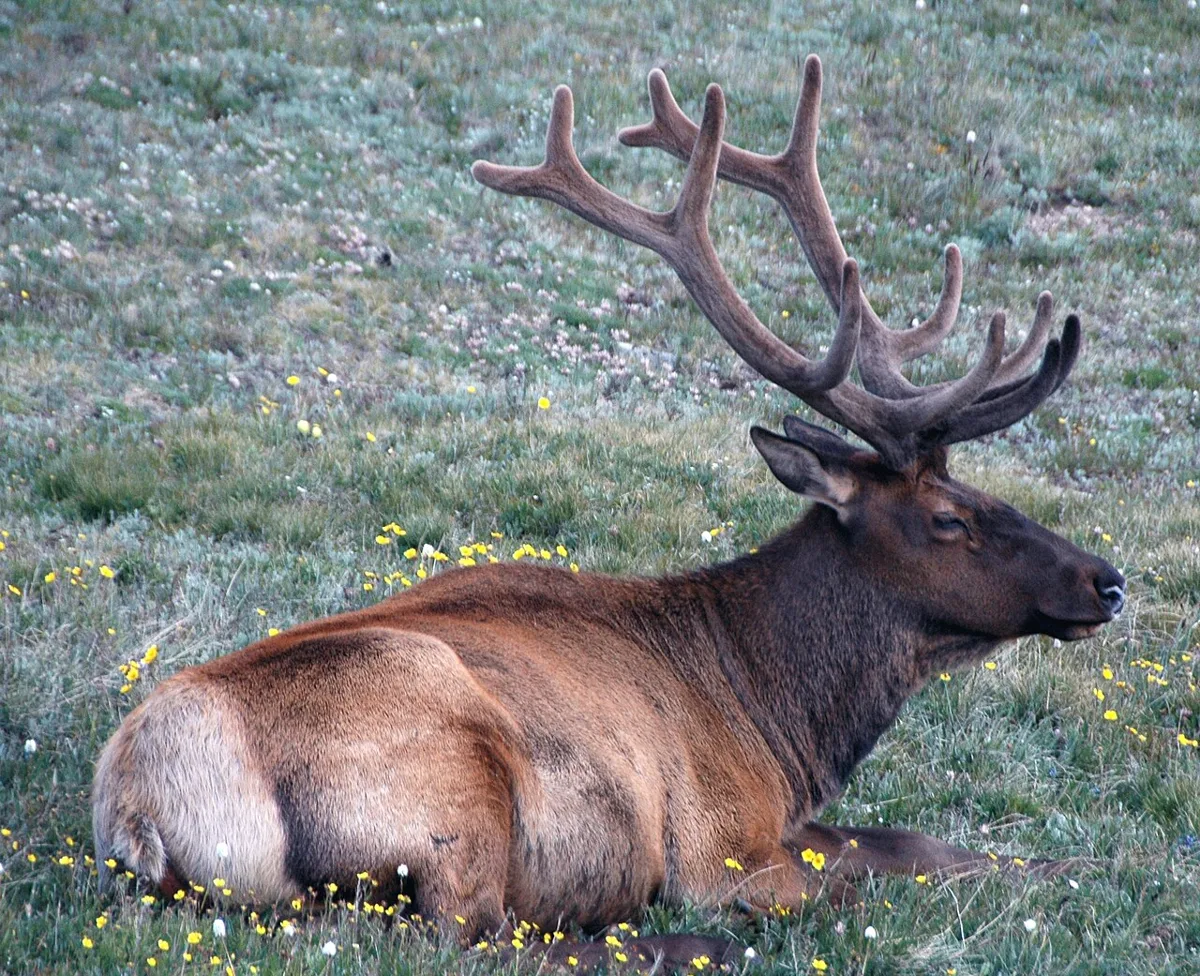
While the federal government is busy dismantling environmental protections at a historic clip, Arizona is quietly doing something that actually works. The state is finishing its 27th dedicated highway wildlife crossing, and according to Arizona Public Media, the existing network has already slashed wildlife-vehicle collisions by an average of 90 percent. Turns out if you build a bridge for the elk, the elk will use the bridge.
A $15.8 Million Bridge Built for Elk
The Willard Springs Wildlife Overpass is going up over Interstate 17, about 12 miles south of Flagstaff. As Good Good Good reports, it's a 100-foot-wide concrete bridge spanning all four lanes of the highway, with tall parapets on both sides, eight miles of new fencing, native vegetation plantings, escape ramps, and connecting structures designed to funnel animals onto the crossing.
The project costs $15.8 million, funded jointly by the Arizona Department of Transportation and the Arizona Game and Fish Department. Construction paused over winter and is expected to wrap by fall 2026. The state chose this location for a very specific reason: more than half of the collisions on this stretch of road over the last four years involved wildlife. That's not a fluke. That's a chokepoint, and the state actually did something about it.
The Game and Fish Department didn't just pick a spot on a map and start pouring concrete. According to Arizona Public Radio, researchers tracked radio-collared elk as they migrated, hunted for food and water, and found mates. They followed the animals and built the crossing where the animals actually needed it. Science-led infrastructure. Novel concept.
26 Crossings Already. 1,270 Collisions a Year Still to Chip Away At
Arizona currently has 26 dedicated highway wildlife crossings in operation, plus a broader network of underpasses and canals. Good Good Good breaks down what's already out there: 13 underpasses along State Route 260 for elk and deer, three overpasses and two underpasses along U.S. Highway 93 for Desert Bighorn Sheep, six structures along Interstate 11, and two along State Route 77 built specifically for the Sonoran desert ecosystem.
Despite all of that, there are still an average of 1,270 reported wildlife-vehicle collisions every year in Arizona. Which sounds like a lot until you consider what the number probably looked like before any of this infrastructure existed. A 90 percent reduction means the baseline was catastrophic. The crossings aren't a feel-good experiment anymore. They're a proven intervention that saves lives, both animal and human, and prevents billions in vehicle damage and insurance claims.
Willard Springs is part of a wave of three new overpasses being built simultaneously. The other two are a second I-17 crossing at Kachina Village and an I-40 crossing west of Parks. The state isn't treating this as a one-off project. It's building a system.
Arizona Put the Money Where Its Mouth Is
Earlier this year, Arizona passed its 2027 fiscal budget with a dedicated, recurring annual appropriation of $700,000 specifically for planning and constructing wildlife crossings. Good Good Good reports that this is a standing line item, not a one-time grant that dries up the moment the political winds shift.
Andres Esparza of Pew's conservation program in Arizona put it plainly: "By investing in dedicated funding for wildlife crossings, the state can help reduce dangerous and costly collisions while reconnecting animal habitat across the landscape. These projects are proven to deliver lasting benefits for drivers, wildlife, and local communities." That's the kind of quote that buries itself in a press release but deserves a louder spotlight. This is infrastructure that pays for itself in reduced emergency response costs, vehicle damage, and insurance claims, before you even count the ecological value.
Once the Willard Springs overpass opens, researchers won't just declare victory and walk away. They plan to re-collar elk and deploy cameras to monitor how animals actually use the crossing. That kind of post-project accountability is rarer than it should be in public works, and it matters. If the data shows problems, they can fix them.
How a Wildlife Bridge Actually Works
The fencing is the part most people don't think about. The bridge itself is obviously important, but eight miles of tall fencing on either side acts as a funnel. Arizona DOT explained in a September 2025 video that the fencing "will act as a funnel to guide [animals] through the crossing." Without it, animals can still wander onto the road anywhere along the corridor. The crossing and the fencing work together as a system.
The wide design matters too. A narrow overpass looks like a threat to a prey animal conditioned to avoid exposed, confined spaces. At 100 feet wide, with native vegetation planted across it, the Willard Springs overpass is designed to feel less like a bridge and more like a continuation of habitat. Animals aren't supposed to know they're crossing a highway. That's the whole point. It's ecological design thinking applied to concrete and rebar, and it works.
The Dingo Take
Here's a thing that is genuinely hard to write in 2026: unambiguous good news from a state government. No asterisk. No "but the funding was clawed back six months later." Arizona identified a problem, tracked it scientifically, built a solution, measured the results, got a 90 percent improvement, and is now institutionalizing the funding to keep building. That's just... government working. It feels almost disorienting to type.
The cynical read is that $700,000 a year is not a lot of money and 1,270 collisions a year is still a lot of collisions. Fine. Both things are true. But the trajectory here is exactly what competent public policy looks like: evidence, investment, iteration, results. At a moment when the federal government is treating scientific expertise like a liability and gutting conservation programs with gleeful efficiency, a state DOT quietly following radio-collared elk through the wilderness to figure out where to build a bridge is almost radical.
The elk don't know any of this, obviously. They're just going to walk across a very expensive concrete overpass and eat some carefully planted native vegetation without a second thought. And that's exactly the goal. Sometimes the best infrastructure is the kind nobody notices.



Comments