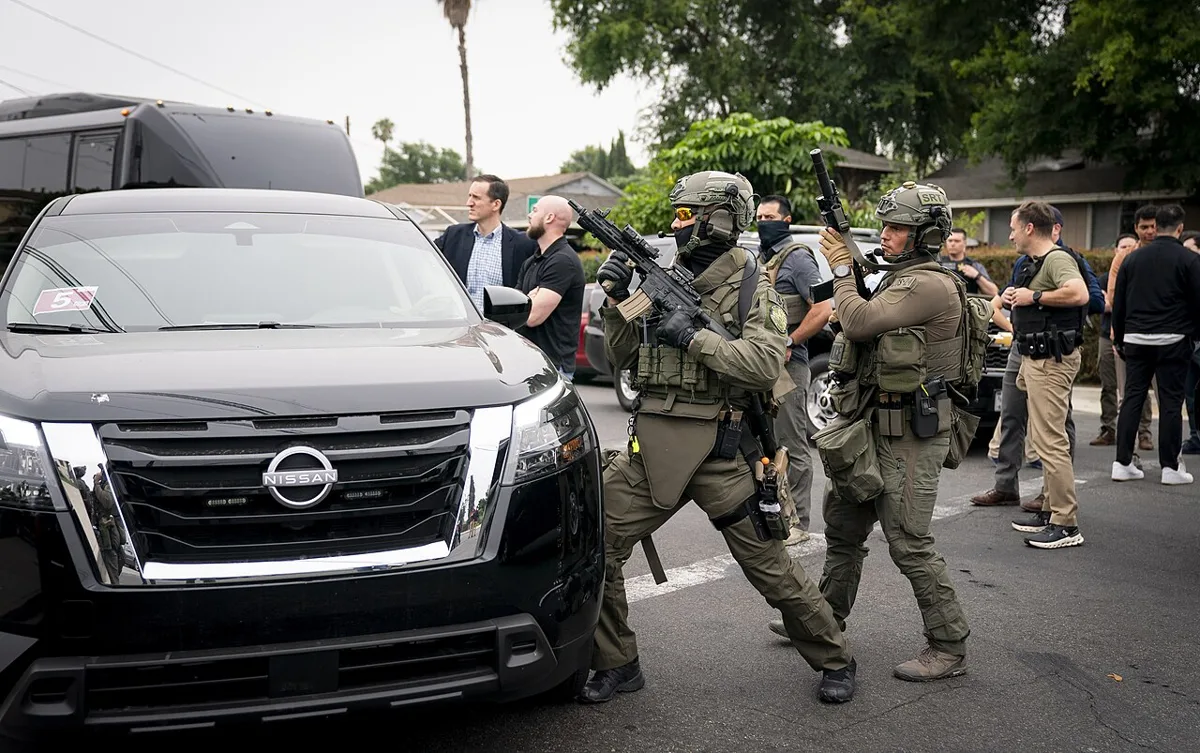
A federal agent shot Carlitos Ricardo Parias near his left elbow during an immigration arrest in Los Angeles. Eight months later, he is still in detention, still in pain, and still waiting for physical therapy that has never come. His doctors note tears in his eyes when they touch his forearm. His treatment plan, per medical records reviewed by NPR, is essentially Motrin and muscle rub cream.
His Son Heard the Gunshot Five Minutes After Saying Goodbye
Ulises Parias is 20 years old and drives two hours every Saturday to visit his father at the Adelanto Detention Center in California. They talk on the phone between visits. His dad asks about his 16-year-old sister. About college classes. Occasionally the pain comes up.
The morning his father was shot, Ulises said goodbye and walked back inside. Five minutes later, he heard commotion in the street. He went outside and found his father's car with the window shattered. "My heart stopped for a minute," he told NPR.
That was over eight months ago. His father, Carlitos Ricardo "Richard" Parias, is still in federal custody. The arm still hurts. The headaches, fevers, and blurry vision have not gone away. And according to immigration attorneys representing Parias, the medical care he has received inside detention does not come close to addressing what a gunshot wound to the elbow actually requires.
How a TikTok Account Got a Man Shot
Parias came to the United States from Mexico in 2002, without documentation, and spent the next two decades in the Los Angeles area raising two U.S. citizen children and working. For most of that time, he was exactly the kind of person ICE enforcement tends to overlook: no criminal record, no infractions, unremarkable to the federal government in every way.
Then the Trump administration ramped up immigration enforcement in Los Angeles. Parias, who had built a following of more than 250,000 people on TikTok by covering community events, started documenting immigration arrests and federal officer presence in his neighborhood. He monetized that account. He was, by any reasonable definition, a journalist doing what journalists do.
According to NPR, his attorneys believe that activism is what put him on ICE's radar. His son had been warning him for months. "The only thing they care about is that you're not a citizen," Ulises told him. "That's all."
The Shooting Itself, On Camera
In October, Parias was leaving his house when federal vehicles blocked his path. Body camera footage released by the Los Angeles Times shows what happened next. An agent smashed the passenger-side window while holding a gun in the other hand. Officers yelled instructions in Spanish: "I am going to shoot you." "Turn off the car." "If you move we will shoot."
Parias can be heard yelling back, also in Spanish: "I don't have anything." And then: "Kill me."
Seconds later, an officer opened fire. Parias was hit near his left elbow. A U.S. marshal involved in the operation was also struck. Following the shooting, the federal government charged Parias with assault on a federal officer. DHS told NPR that all use-of-force incidents are "documented and subject to internal review." When NPR asked what the outcome of that review was, DHS did not respond.
Eight Months of Pain, Motrin, and Muscle Rub
NPR reviewed medical records from November through May covering Parias' time in detention. They describe a man in consistent, worsening pain. Decreased shoulder mobility. Pain radiating from his neck down his arm to his hand. A medical report from May notes that when staff palpated his left forearm, Parias had tears in his eyes from the pain. He had been in a sling for six months. No physical therapy had been completed.
For the bulk of this period, his pain management consisted of Motrin, gabapentin, and muscle rub cream. DHS told NPR that Parias has been seen by a nurse multiple times between November and June, but the agency's statement was cut off before detailing what that nurse actually did for him.
"There are not enough people, and there's not enough concern," said Margaret Hellerstein, one of Parias' immigration attorneys. "And that's leading to permanent disability and death." Attorneys have tried to secure his release while his immigration case plays out. That request has been denied.
A System With No Good Answers and Fewer Checks
Parias' case lands at a particularly ugly intersection. He was injured by the same federal agency that is now detaining him, and that agency also controls access to his medical care. His attorneys say the legal avenues available to him have been exhausted. The oversight bodies that might otherwise intervene are, by all available evidence, not intervening.
This comes as NPR and other outlets have documented record numbers of people in immigration detention and a rising number of deaths in custody. Earlier this year, two federal agents shot and killed two U.S. citizens in Minneapolis, raising broader questions about use-of-force accountability across federal law enforcement. Parias' situation is a version of that same question, just slower and quieter: what happens when federal agents injure someone, and then that someone disappears into a system with no real mechanism to hold anyone accountable?
The answer, in Parias' case, appears to be: they get Motrin and they wait.
The Dingo Take
Let's be precise about what is happening here. A man with no criminal record documented immigration enforcement activity in his neighborhood, which is a constitutionally protected thing to do. Federal agents then blocked his car, smashed his window while pointing a gun at him, yelled contradictory instructions in two languages simultaneously, and shot him. He was then criminally charged for the encounter. He was then detained. He is now, eight months later, receiving pain management that a high school athletic trainer would find inadequate for a sprained ankle, let alone a gunshot wound that has left him with tears in his eyes when someone touches his arm.
DHS says all of this is subject to internal review. DHS also declined to share the results of that internal review. This is the oversight system working exactly as designed: just well enough to generate paperwork, not nearly well enough to produce consequences. Parias' attorneys say the legal avenues are exhausted. The detention request denials keep coming. The arm keeps hurting. His son keeps driving two hours every Saturday.
If you are looking for a single case that captures everything wrong with how this administration is running immigration enforcement, you could do a lot of searching and not find a cleaner one than this. Shot by the agency detaining him. Denied release. Given muscle rub. Charged with assaulting the people who shot him. His son, a college student, counting the miles on a Saturday drive, trying to hold together whatever is left of his family.


Comments