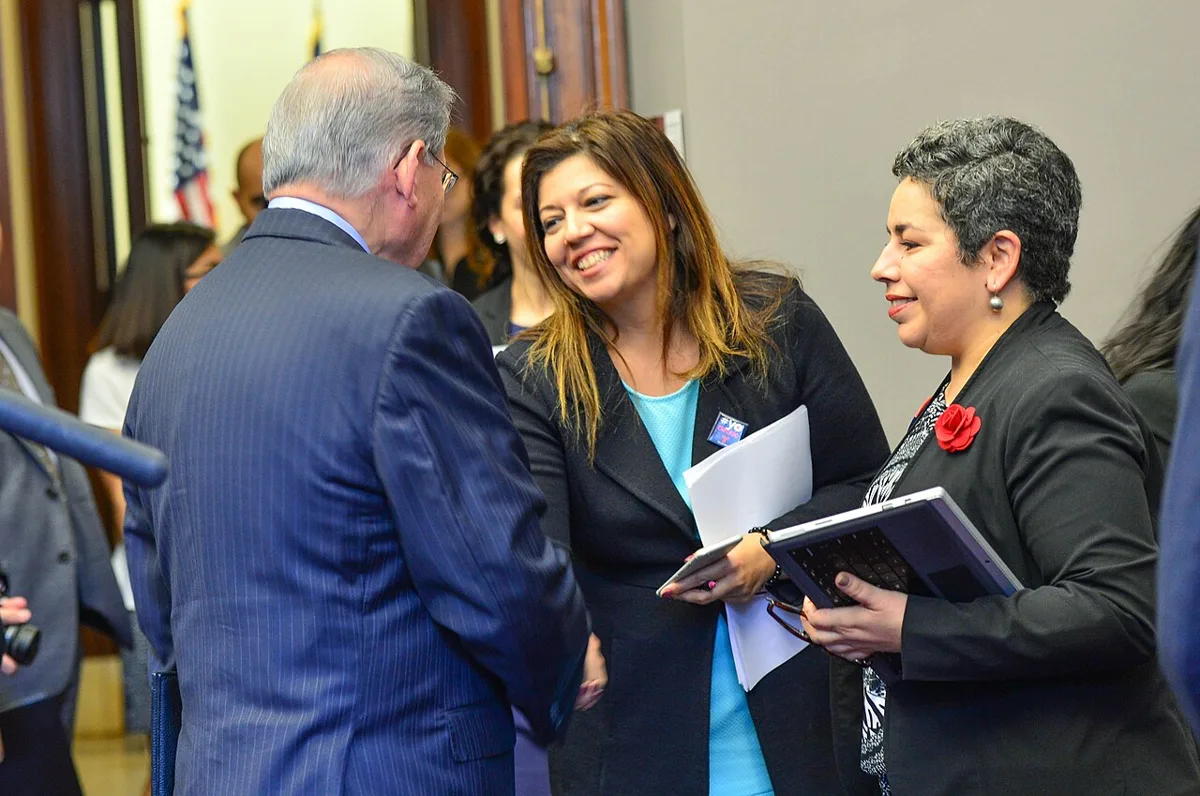
At a summit full of the sharpest minds in Latino politics, Arizona Senator Ruben Gallego walked up to a microphone and told his own party something it has refused to hear for about a decade: stop trying to tell Latino voters who they are. He said it clearly, he said it on the record, and there is roughly a zero percent chance the Democratic Party's donor class was listening.
The House Map Is 'Very Latino' — And Democrats Are Playing Catch-Up
On Tuesday, Latino political strategists, pollsters, and campaign operatives from both parties gathered in Washington for the Latino Vote Summit, and the message out of the room was consistent and urgent. The 2026 midterms will, in significant part, be decided by Hispanic voters. Not as a side story. As the main event.
Carlos Odio, co-founder of Equis Research, a political data firm that specializes in Latino voter behavior, put it bluntly to CBS News: "The House map especially is very Latino." He ticked through competitive districts with high Hispanic populations that could determine which party controls Congress. This is not a minor footnote. This is the whole ballgame.
The backdrop here matters enormously. In 2024, Latino voters swung hard toward Trump. CBS News exit polls show Trump won Texas Latinos by 55%. Nearly half of all Hispanic voters nationally went for him, including a majority of Hispanic men. Democrats lost ground with a group they had spent years assuming was safely in their column, and now, with the House majority potentially decided by a handful of seats, they are scrambling to win it back.
Texas Could Swing the Entire Senate Math
Odio told CBS News that the Texas Senate race between Democrat James Talarico and Republican Ken Paxton is a race where Latino voters don't just matter, they could determine the entire arithmetic of Senate control. "Texas' map, in particular, is a place where, where Latinos land could be the difference between Republicans netting four Senate seats and Democrats walking away either even or walking away with one Democratic seat," he said.
According to data compiled by UnidosUS, the nation's largest Latino civil rights and advocacy organization, roughly one in four registered Texas voters in 2024 were Latino. In some of the state's most competitive House districts, that share runs even higher. Recent polling, CBS News reports, shows that many Texas Hispanics who backed Trump in 2024 have since swung back toward Democrats, though nobody is popping champagne about it yet.
The economy is why. It was the economy in 2018 when Democrats swept the House. It is the economy now. Odio's three-word answer when asked what Hispanic voters care about most: "The economy, and the economy, and the economy." Trump's ratings on economic handling are currently weaker than they were at the comparable point in 2018, Odio said, which is the kind of detail that should be making Republican strategists at least a little nervous.
Latinos Are Growing Where You Least Expect It
California Senator Alex Padilla made a point at the summit that deserves more attention than it will probably get. The Latino electorate is not just a Texas-and-California story anymore. It is a Georgia story. A North Carolina story. Apparently, now, a Louisiana story.
"Georgia, the biggest battleground state on the Senate map right now, more than a million Latinos in Georgia, that's a surprise to us," Padilla said at the event, per CBS News. He mentioned North Carolina's growing Latino population and pointed to New Orleans, which now has a Latina mayor, as evidence that the community's footprint is expanding in ways that campaign models have not fully caught up to.
This matters for Senate Democrat Jon Ossoff's reelection race in Georgia specifically. Any campaign that is not actively building Latino outreach infrastructure in Georgia right now is making a strategic error that will be very obvious in hindsight.
Gallego Says What Democrats Won't Say to Themselves
Here is where it gets uncomfortable. Senator Ruben Gallego of Arizona, who actually won a competitive Senate race in a state Trump carried, delivered what might be the most honest assessment of Democratic dysfunction with Latino voters that any sitting Democrat has said in public.
"The Democratic Party still does not understand that there is no national Democratic Party without the Latino vote being part of that coalition," Gallego said, according to CBS News. "Part of that is that you have to answer to where the Latino voter is, not where you want the Latino voter to be."
Then he went further. "There has been this want by special, very liberal organizations and very liberal donors and very liberal groups that they want Latinos to be liberal, and the fact is not all of them are." That is a sitting Democratic senator, on the record, telling his party's donor class that they have been projecting their own politics onto a heterogeneous community of tens of millions of people and then acting confused when it backfires. The amount of money that has been spent to not learn this lesson is genuinely staggering.
The Rubio Warning Nobody Wants to Hear
Gallego also fielded questions about 2028, and said something that should be getting a lot more coverage than it is. On the prospect of Secretary of State Marco Rubio as the Republican presidential nominee, Gallego was direct: "If Marco Rubio is the nominee to be president of the United States, we're in trouble."
His reasoning, per CBS News, was not that Rubio's policies are good. He said Democrats would "hit him on everything we can." The problem is symbolic. Rubio would be the first Latino candidate on a major party presidential ticket, and Gallego is saying plainly that this fact alone will move votes in ways that policy arguments cannot fully counter. Republican consultant Mike Madrid, who specializes in Hispanic voting trends, agreed with that assessment.
This is the kind of honest political calculation that usually happens in private. Gallego said it into a microphone. Whether anyone in the party infrastructure is taking notes is, as usual, the open question.
The Dingo Take
Let's just sit with the fact that a Democratic senator had to stand at a summit in 2026 and explain to his own party that Latino voters are not a monolith that will obediently vote however progressive donors imagine they should. This is not new information. Equis Research has been publishing data on Latino voter complexity for years. Democrats lost ground with Hispanic voters in 2022 and then lost even more in 2024, and the response from too much of the party apparatus was something between denial and a lecture about what Hispanic voters should really care about. Gallego is done with that.
The structural math here is brutal and simple. The House majority could come down to a handful of districts with large Latino populations. The Texas Senate race could flip the entire chamber's balance. Georgia, of all places, has over a million Latino voters who are increasingly relevant in a state that has been decided by razor margins for three consecutive election cycles. Democrats do not have the luxury of running a condescending outreach operation and hoping affordability anxiety does the rest of the work for them.
Odio's comparison to 2018 is the most important number in this whole story. Democrats need something closer to that environment than to 2022 to retake the House. They might be trending that way. Trump's economic approval is soft. Cost-of-living anxiety is real and pointed directly at the party in power. The conditions for a genuine wave exist. Whether Democrats can actually talk to Latino voters like adults, meet them where they are, and not blow a winnable election by being insufferable about it is, somehow, still an open question.


Comments