A Norman Rockwell painting from 1943 is finally on public view, and it turns out the thing contains multitudes: a lawsuit, at least two women who claim to be the Miss America in the artwork, and one fighter pilot who spotted a Navy woman in a magazine and decided, on the spot, that he was going to marry her. He did. They were together 46 years.
The Painting That Started With a Fire and a Very Awkward Letter
Norman Rockwell's So You Want to See the President! ran in the Saturday Evening Post in November 1943, commissioned by FDR's press secretary Stephen Early. According to NPR, the whole point was to make Roosevelt look like a man of the people at a time when most Americans only knew what was happening in the White House by reading a newspaper or huddling around a radio. So Rockwell went to the West Wing, sat with the visitors, and sketched everything he saw, including, in a detail that hits differently 80 years later, a gas mask on a coat rack labeled 'President's gas mask.'
Then Rockwell took his sketches back to his Vermont studio and the studio burned down. All of it. Gone. So he wrote what the White House Historical Association's president Stewart McLaurin described to NPR as a 'timid' letter back to the White House asking if he could, please, maybe come back and do it again. The White House said yes. Which is either a great story about grace under pressure or proof that even in 1943, nobody wanted to be the person who said no to Norman Rockwell.
Two Women, One Miss America, Zero Clear Answers
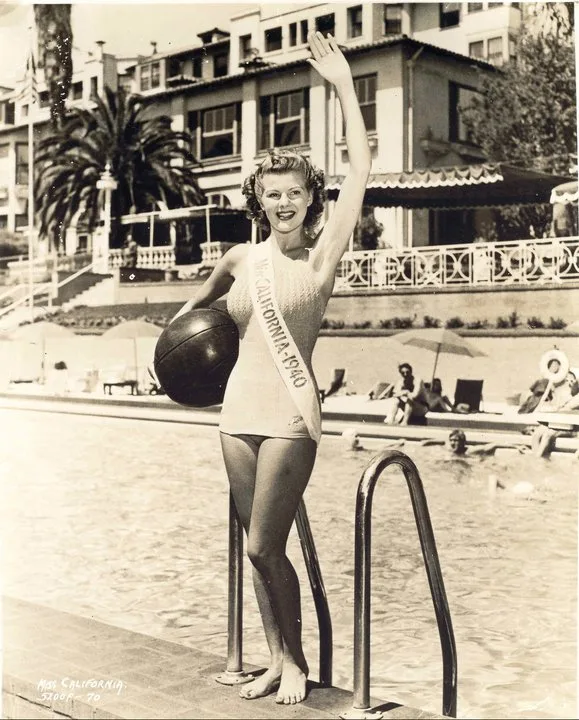
Here is where the painting's clean historical narrative gets messy in the best possible way. The White House Historical Association says the Miss America figure in the painting is Rosemary LaPlanche, who won the title in 1941 and was involved in the war bonds effort. LaPlanche, according to NPR, personally visited the Roosevelt family in D.C. in the early 1940s. That all checks out.
Except another family says that's their mother. Marie McIntyre, born Baumer, was 17 years old when she posed for Rockwell as a model for the Miss America figure, according to her son Neil, who told NPR she described Rockwell's demeanor as 'business-like.' She made her own dress for the shoot. Rockwell changed it to yellow in the painting. He also changed her hair from blonde to red. So what you are looking at in that painting is a composite: the title and biography of one woman, the face and figure of another, wearing a fictional dress in a fictional hair color. Norman Rockwell was out here doing creative reinterpretation before anyone called it that.
The Navy Woman Who Sparked a Love Story From Across a Waiting Room
Then there is Eloise English, a member of the WAVES, which stood for Women Accepted for Volunteer Emergency Service. She visited the White House in 1943 and ended up in the painting wearing white. The problem, her daughter Meredith Davies Hadaway told NPR, is that Eloise was actually wearing her dress blues that day, and this caused 'a bit of a stir in military circles.' Rockwell apparently felt bad enough about it that he sent her the original sketch, which shows her in the dark suit, as if to say: I know, I know, I changed it.
But the bigger consequence of Eloise ending up in the Saturday Evening Post was this: a fighter pilot somewhere picked up that issue of the magazine, saw a WAVE in a white uniform, and made a decision. Hadaway told NPR exactly what her father told her and her siblings: 'As soon as I get back stateside, I'm going to look her up.' And that is exactly what he did. Thomas and Eloise English Davies were married for 46 years. Thomas died in 1991. Eloise died in 2015. Their daughter Meredith exists because a man saw a Norman Rockwell painting and fell in love with a woman wearing the wrong color uniform.
What This Painting Was Actually About
The full context of 1943 matters here. Eloise English's father, a rear admiral in the Navy, had recently died in a plane crash around the time she visited the White House. An ex-boyfriend of hers, according to NPR, died in the Bataan Death March. The world these people were living in was catastrophic in ways that are difficult to fully absorb from the distance of eight decades.
And yet here was Rockwell, sitting in the West Wing, sketching a Scottish soldier and a bored cameraman and Miss America on a red sofa, commissioned to show that the President of the United States was still connected to his people. FDR himself appears only as a small sketch in the lower right corner. That was the whole message: the people matter more than the man. It is a genuinely lovely idea, and the fact that we had to look up what the White House Historical Association is to write this article tells you something about how far we've traveled from that idea since.
The Dingo Take
Look, in a week where the news has been largely a rotating carousel of things that make your teeth hurt, it is a genuine relief to write about a Norman Rockwell painting that turns out to contain a real love story, a dress sewn by a 17-year-old, and a fighter pilot who kept a promise he made to himself over a magazine. This is the kind of American history that doesn't require any caveats. It just is what it is, in the best sense.
The White House Historical Association has put the painting on public view, and NPR has done the work of tracking down the descendants and digging up the real stories behind the figures in the frame. That is journalism doing what journalism is supposed to do: pulling the human beings back out of the icons. Eloise English was a real woman who wore the wrong color in a famous painting and ended up as someone's reason for existing. That is a better story than most things Rockwell could have invented.
The painting was commissioned to show a president who was accessible, engaged, connected to ordinary Americans. The White House wanted people to feel like the door was open. Whether or not that was ever fully true, it was at least the aspiration. Somebody thought it was worth paying for. Somebody thought it mattered what regular people believed about their government. File that one wherever you like.



Comments