A stranger shows up at your house late at night, doesn't identify herself, and demands a urine sample. You say no. Four years of your career disappear. This is apparently how anti-doping enforcement works in professional tennis, and the 2023 Wimbledon champion is now paying for it.
What Actually Happened
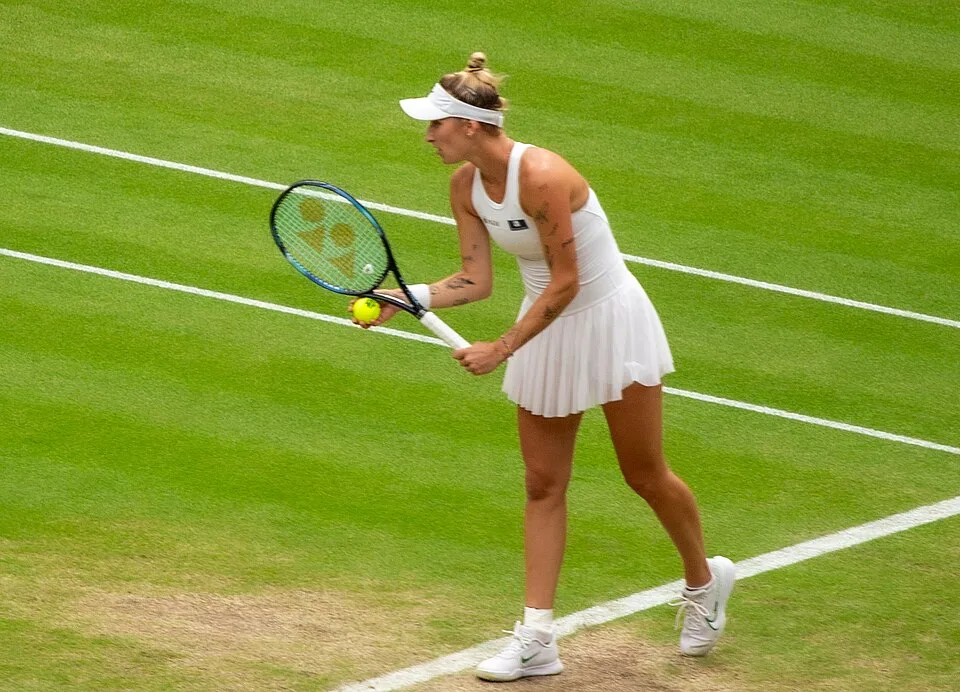
Marketa Vondrousova, 26, received a four-year suspension this week after refusing a drug test last December. The verdict, which bans her from competing, coaching, or even attending ITF, WTA, ATP, Grand Slam, or national federation events until June 21, 2030, was announced Monday.
Vondrousova's explanation, shared in an April Instagram post and elaborated on in interviews this week, is not the profile of a cheater trying to hide something. According to the New York Post, she says she "reached a breaking point after months of physical and mental stress" when a testing agent arrived at her home late at night without identifying herself. Vondrousova was scared. She said no.
Three days later, she took a test. The result was negative. Just like every single test she had taken before it.
No Positive Test. Four Years Gone Anyway.
Let's be very clear about what is and isn't in dispute here. Vondrousova did not test positive for a banned substance. The New York Post reports explicitly that she apparently never had a positive test, and Vondrousova herself confirmed the negative result taken just days after the incident in question.
The suspension is purely for the refusal itself. Under the World Anti-Doping Agency's code, refusing a test is treated as equivalent to a positive test for a serious substance. That rule exists for a legitimate reason: athletes can't be allowed to simply dodge testing whenever they feel like it. But "legitimate rule" and "appropriate outcome" are not always the same sentence.
A woman home alone, late at night, confronted by someone who doesn't announce who she is, decides not to open the door to a stranger demanding access to her body. The penalty is four years of her professional life. She will be 30 years old when she is eligible to return.
Vondrousova Speaks, and It's Gutting
Vondrousova gave an interview this week in Czech that the New York Post translated, and what she said should make anyone who follows this sport deeply uncomfortable. "On Monday after the verdict was announced, I was completely broken," she said.
She wasn't just venting. She went somewhere darker and more specific. "What scares me the most is their unlimited power and the absolute calm with which they destroy people's lives. An individual has almost no power against them."
That's not the statement of someone trying to spin a guilty conscience. That is someone who feels crushed by a system that holds all the cards and plays them without blinking. Whether you think the rules were applied correctly or not, the human reality here is a 26-year-old whose career has effectively been paused until she hits 30.
The Uncomfortable Comparison Nobody Can Ignore
Here's where this gets even messier. Jannik Sinner, currently one of the biggest stars in men's tennis and a reigning Wimbledon champion, tested positive for an actual banned substance last year. His suspension: one month. Iga Swiatek, the dominant force in women's tennis for years, also received a short ban after a positive test.
Vondrousova never tested positive. Her ban is four years.
Now, the legal and procedural reasons for the length difference are real. Sinner and Swiatek's cases involved arguments about contamination and intent that were accepted by arbitrators. A refusal carries an automatic presumption under the code. But the optics of this are genuinely hard to defend. Two of the sport's biggest names test positive and play on within weeks. A frightened woman says no to an unidentified late-night visitor and loses half a decade.
The tennis community has noticed. Several of Vondrousova's fellow players have offered public support on social media, according to the New York Post.
What Comes Next
Vondrousova's next move is an appeal. She said as much in her interview, framing the fight as bigger than herself: "I feel that I have to fight not only for myself, but for the principle."
That is either the statement of someone who knows they were wronged and has the guts to say so publicly, or it is extraordinary spin. Given that she volunteered a negative test three days after the incident and has a spotless testing record otherwise, the former seems considerably more plausible.
The appeal process could take months. In the meantime, Vondrousova cannot set foot inside a tournament in any capacity. Not to compete. Not to coach. Not even to watch.
The Dingo Take
The anti-doping system exists for a necessary reason. Athletes cheating with performance-enhancing drugs corrodes sport at its foundation, and testing has to be rigorous and consequential to mean anything. Nobody serious is arguing otherwise. But a system that hands a 26-year-old woman a four-year ban for being frightened by an unidentified stranger at her door late at night, with no positive test anywhere in her history, and does it with, in her own words, "absolute calm," is a system with a problem it needs to look at directly.
The Sinner and Swiatek comparisons will follow this case through every stage of the appeal, and the governing bodies deserve every uncomfortable question those comparisons generate. This is not about whether Vondrousova broke a rule. She probably did, technically. It's about whether a rule applied this way, producing this outcome, against this backdrop, reflects anything resembling proportionality or justice. The answer, looking at it plainly, is no.
Vondrousova said an individual has almost no power against them. She's trying to prove herself wrong. Good luck to her. She's going to need it.





Comments