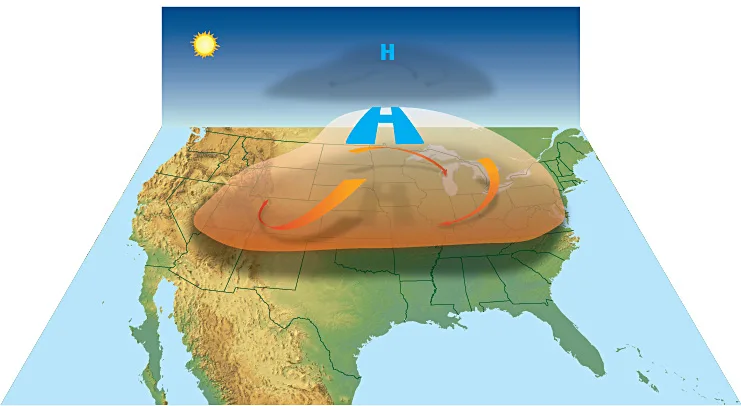
The National Weather Service is warning that 'dangerous to record-setting heat' will blanket the eastern two-thirds of the United States through the July 4 holiday weekend, driven by a heat dome that is trapping scorching air over most of the country. Heat indices in parts of Ohio, North Carolina, Iowa, Missouri, and Kansas could hit 110 degrees. And here's the fun part: it won't cool down at night either.
What a Heat Dome Actually Is (And Why You Should Be Worried)
A heat dome, for the uninitiated, is exactly what it sounds like. A massive bubble of superheated air parks itself over a region, gets trapped under a high-pressure system acting like a lid on a pot, and just sits there cooking everything underneath it. There is nowhere for the heat to go. It just accumulates.
NPR spoke with National Weather Service forecaster Bryan Putnam on Sunday, and he was not exactly reassuring. 'You get temperatures in the 90s to low 100s, that's obviously pretty hot,' Putnam said. 'But you combine that with the humidity, those heat indices will go well into the 100s and that's the temperature that it's going to feel like.' The NWS puts the heat index range at 100 to 110 degrees for large chunks of the central and eastern U.S.
Parts of Iowa, Missouri, and Kansas are already under extreme heat warnings. Ohio, parts of North Carolina, and Washington, D.C. are in the NWS's crosshairs for the most threatening combination of heat and humidity, particularly for elderly people and anyone with respiratory problems.
Don't Count on the Fireworks to Cool Things Down
A lot of people are planning to spend July 4 outdoors, watching fireworks at night, and assuming the evening will give them some relief. Putnam would like a word.
'Your temperatures might stay in the 80s and the 90s in the heat in the evening, as well as the fact is with the humidity, that's going to keep those heat indices high as well,' he told NPR. 'Just because the sun goes down doesn't mean it still isn't going to be hot.' So if you were planning to stand in a crowd for three hours after dark and assume you were in the clear, recalibrate.
The NWS also says the heat risk is expected to continue after July 4, and will spread further into the West, where daytime temperatures could feel like 100 to 105 degrees. This is not a long-weekend problem. This is a sustained, grinding, dangerous heat event.
Heat Stroke Kills People. Here's What That Actually Looks Like.
New York City Health Commissioner Alister Martin came out on Saturday and did not soften the message. 'Heat strokes are fast, deadly, and almost always preventable,' he wrote on social media. Martin is an emergency room doctor, and he added: 'As an ER doctor, I watched heat stroke come through the doors on days exactly like the ones ahead.'
The CDC is clear on what heat stroke looks like: confusion, altered mental status, slurred speech, and loss of consciousness. It can cause permanent disability. It can kill you. Heat exhaustion comes first, with symptoms including nausea, headache, dizziness, and confusion, and people often mistake that stage for just feeling lousy in the heat. By the time full heat stroke sets in, the window for easy intervention has closed.
Martin's advice was direct: use air conditioning, drink water, and check on your neighbors. That last one is not optional if you live near someone elderly or isolated. Heat waves kill people quietly, alone, in apartments that turn into ovens.
What Officials Are Actually Telling You to Do
The Missouri State Emergency Management Agency issued guidance Sunday telling residents to 'plan accordingly and limit prolonged outdoor exposure if possible,' and to 'take immediate action' if anyone shows signs of a heat-related illness. That is about as close to 'please stay inside' as emergency management language gets.
The NWS's broader advice tracks with what every heat event produces: hydrate aggressively, find air conditioning, avoid the hottest parts of the day, and do not assume you are too young or too healthy to be at risk. Heat does not care about your fitness level. It cares about how long you've been standing in it and whether you've had enough water.
Cooling centers are typically opened by local governments during events like this. If you don't have air conditioning, find out where yours is now, before the weekend, not after you've already started feeling sick.
The Dingo Take
Let's be straightforward about what this is. A heat dome cooking two-thirds of the country through a holiday weekend when tens of millions of people are planning to be outside is a genuine mass public health event. The National Weather Service is using words like 'dangerous' and 'record-setting.' An emergency room doctor who runs New York City's health department is publicly saying he has watched people die from exactly this kind of weather. This is not a weather advisory you skim past.
And yet, every summer, people die in these events who did not have to. Elderly people in apartments with no AC. People who didn't recognize heat exhaustion in time. People who figured the night air would save them. The information to prevent most of these deaths is freely available and takes thirty seconds to absorb. The barrier is not knowledge. It is the very human tendency to assume that bad things happen to other people, until they don't.
So check on somebody this week. An elderly neighbor, a family member who lives alone, someone you know doesn't have good cooling at home. It costs you nothing. The alternative, statistically, costs some of those people everything.



Comments