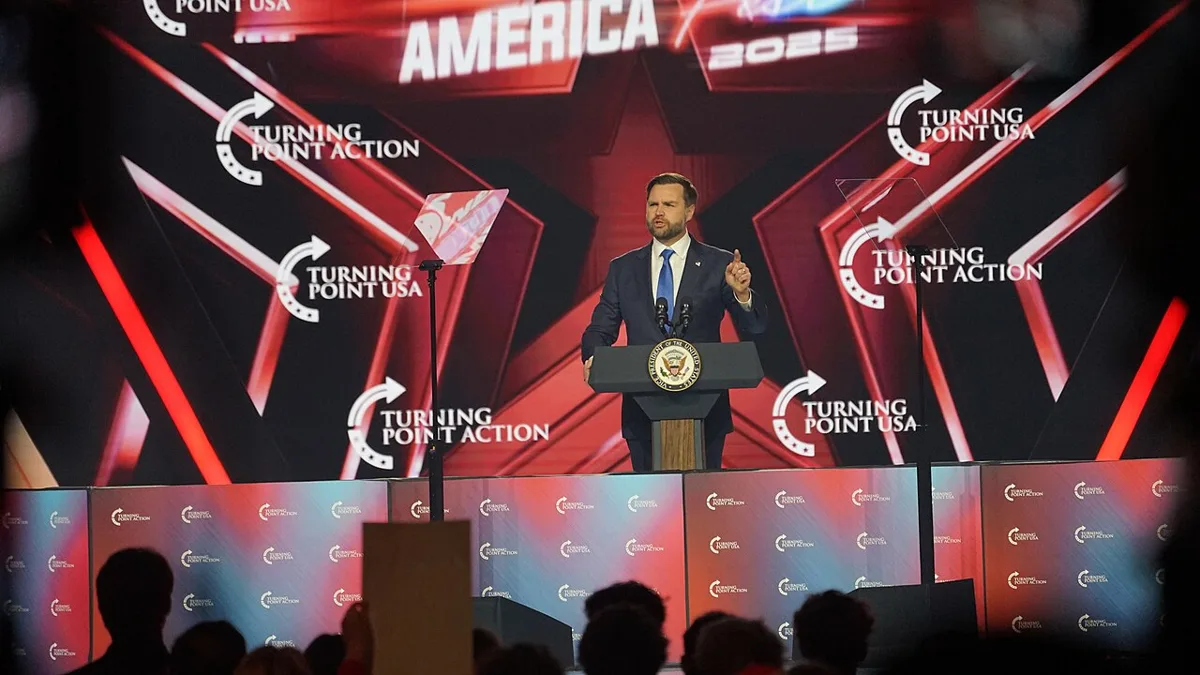
JD Vance walked into the Richard Nixon Presidential Library last week, cracked open his new book about finding God, and casually declared that Watergate was a deep state operation that unfairly destroyed a presidency. Commentators acted like they'd never heard anything so audacious. They should have paid more attention in history class.
What Vance Actually Said, For the Record
Speaking at the Nixon library, according to The Guardian, Vance told the crowd that "the idea that it [took] down a presidency is crazy" and that it was the "deep state that took down Richard Nixon," not anything Nixon actually did. Let's be clear about what Nixon actually did, since Vance apparently needs a refresher.
Nixon directed a conspiracy to bribe the Watergate burglars into lying in court, using a secret illegal slush fund. When his own lawyer John Dean warned him it would cost a million dollars that would need to be laundered, noting that "this is the sort of thing mafia people can do," Nixon's response was not horror. It was reassurance. "You could get it in cash," he told Dean. "I know where it could be gotten."
The president of the United States told his lawyer he knew how to get a million dollars in untraceable cash to pay off criminals. The deep state didn't invent that. There were tapes. There were transcripts. There was a conviction. This is not contested history.
Here's the Part Everyone Keeps Forgetting
The Guardian's Rick Perlstein, who has spent his career studying the American right, points out that the shock and outrage greeting Vance's comments reveals a spectacular collective memory failure. Republicans have been saying this exact thing since Nixon's first Watergate speech in April 1973. Almost word for word.
The day after that speech, a prominent Republican ally stood in front of a group of students and called the break-in a prank, "part of the usual atmosphere of campaigning," and said the burglars were "not criminals at heart." That Republican was Ronald Reagan, then governor of California. The media mocked him. The New York Times columnist Tom Wicker was furious. Reagan did not care.
When Nixon's secret taping system was revealed, Reagan called the investigation a "witch-hunt" and a "lynching." When Nixon gave a speech insisting there was nothing to cover up and only 25 percent of Americans believed him, Reagan called it "the voice of reason." His own political aides leaked their frustration to columnists, horrified that their boss kept treating confirmed conspirators as, in Perlstein's phrase, "no worse than double parkers."
And It Worked. That's the Whole Point.
Here is the thing that should make you put down your coffee. Reagan's Watergate minimization was not a political liability. In Perlstein's 2014 book The Invisible Bridge, he argues it was precisely Reagan's ability to rhetorically absolve fellow Republicans of sin for supporting Nixon that made him so attractive to the conservative base. Attractive enough that he came shockingly close to defeating an incumbent president, Gerald Ford, for the Republican nomination in 1976.
That same talent for letting people feel innocent even when they had supported crimes eventually made Reagan president of the United States. The lesson the Republican Party took from this is not hard to identify.
Pat Buchanan, a Nixon White House aide, testified to the Senate investigation committee that the entire inquiry was just the liberal Washington establishment trying to steal back the White House after Nixon won it fair and square. He was rewarded with a widely syndicated column and became enough of a conservative hero to mount a serious primary challenge against George H.W. Bush in 1992. George H.W. Bush, who himself spent Nixon-era Watergate as RNC chair doing his own brand of minimization. The ecosystem has always selected for this.
The Propaganda Pipeline That Produced Vance
The Guardian's Perlstein traces a direct line from Reagan to Vance through decades of books, columns, and documentaries spinning alternative Watergate theories. There was a 1984 book blaming the CIA. A 1992 book blaming John Dean himself, claiming he was covering for a prostitution ring run by his wife. A 2008 book from a former Nixon aide titled The Secret Plot to Make Ted Kennedy President.
That same Nixon aide published two more books in 2015 and 2021, then wrapped the whole project up in a 2024 documentary that, Perlstein reports, has proven highly influential in the young MAGA circles Vance travels in. So Vance did not arrive at his Nixon library remarks by accident. He has been marinating in fifty years of carefully constructed revisionist propaganda, some of it produced specifically for his generation.
There was also William Safire, Nixon's former speechwriter turned New York Times columnist, who pioneered the rhetorical technique of slapping the suffix "-gate" onto a parade of much smaller Democratic controversies: Koreagate, Billygate, Monicagate. The goal was simple. If everything is Watergate, then Watergate is nothing special. It worked. The phrase "everyone did it, Nixon just got caught" became, as Perlstein writes, an American commonplace. He heard it from his own father.
The Tradition Has a Finishing Move
One legendary conservative activist, quoted by Perlstein, captured the movement's most honest position on all of this: "I didn't like Nixon until Watergate." That is the end state of the argument. Not that Nixon was innocent. Not that the deep state was real. But that what Nixon did was actually good, and the problem was getting caught.
Vance standing in the Nixon library and calling the investigation a deep state operation is not a gaffe. It is not ignorance. It is the fully matured fruit of a fifty-year project to rehabilitate a criminal presidency and make Republican voters feel fine about it. He learned from the masters. The masters learned from Reagan. Reagan learned that it works.
The audience at the Nixon library apparently loved it.
The Dingo Take
The reason everyone keeps acting surprised by JD Vance is that everyone keeps treating each new statement as an isolated event rather than what it obviously is: a man fluently speaking the language his political tradition built specifically for him. There is no bottom to find here. The bottom was poured fifty years ago and has been setting ever since.
What Perlstein's reporting in The Guardian actually reveals, if you read it straight, is that the Republican Party made a choice in the early 1970s. Faced with a president who ran a criminal operation out of the White House and got caught cold, they could have cut him loose completely and rebuilt. Instead, they chose the Reagan path: defend, minimize, reframe, and reward everyone who did the same. Every single person who pushed that line got a column, a nomination, a book deal, a TV show. The incentives have never changed.
So no, Vance is not a new low. He is the logical product of a machine that has been running without interruption since before most of his supporters were born. The scary part is not that he said it. The scary part is that it will work just as well for him as it worked for everyone else who said it first.



Comments