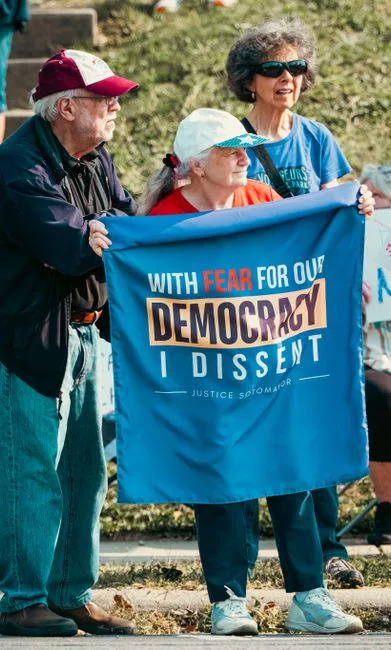
Democratic Party leaders are now openly worried they're watching their own Tea Party moment unfold in slow motion, and according to Axios, they don't think they can stop it. A wave of primary upsets by democratic socialists and outsider candidates has blindsided party brass. The rage, apparently, did not arrive without warning.
The Panic Is Real and It's Earned
Axios is reporting that senior Democrats are increasingly alarmed by what they're seeing in primaries across the country. Hand-selected party candidates, the kind who fundraise well and don't say anything interesting, are getting knocked off by outsiders the establishment didn't recruit, didn't want, and definitely didn't prep for Sunday shows.
The comparison being drawn internally is to the Tea Party wave of 2009 and 2010, when a furious Republican base started eating its own moderates alive and the party establishment watched helplessly from the sidelines. That experiment eventually produced Donald Trump. The Democrats watched all of that happen and apparently filed it under 'not our problem.'
Now it is very much their problem.
This Has Been Building for a Decade, Not a News Cycle
Here's the thing the party insiders always get wrong: they treat voter fury like weather, something that shows up suddenly and passes if you wait it out. But as Axios makes clear, the rage inside the Democratic base has been building for ten years. You don't fix that with a better consultant or a tighter messaging grid.
Progressive candidates have been signaling this for years. The 2016 Bernie Sanders primary run wasn't a fluke. The 2018 AOC upset wasn't a fluke. Every time a nobody from nowhere knocked off a comfortable incumbent backed by every acronym organization in Washington, the party establishment called it an anomaly and went back to lunch.
At some point, anomalies become a pattern. At some point, the pattern becomes the story.
It's Not Left vs. Center Anymore
The framing that lazy political coverage defaults to, the moderates versus progressives civil war, is actually missing the point of what Axios describes here. This isn't really an ideological fight. It's an insider versus outsider fight, which is a completely different and much harder problem for a party to solve.
When voters are mad at the institution itself, not just its policy positions, you can't fix it by moving left or right. You can't triangulate your way out of institutional distrust. The Democratic Party has spent years asking voters to trust the process, trust the experts, trust the people who've been doing this a long time. Voters, apparently, have some follow-up questions.
And those follow-up questions are currently arriving in the form of primary challengers.
The Trump-Shaped Fear Sitting in the Room
The most alarming detail in the Axios reporting is this: some Democrats now believe the party is primed for a Trump-esque figure to come in and ride this wave straight to the top. Let that sink in. The people who spent years warning about the existential dangers of authoritarian populism are now sitting in rooms whispering about whether their own base is ripe for the same kind of takeover.
To be clear, a left-wing populist and a right-wing authoritarian are not the same thing and should not be treated as equivalent. But the underlying political mechanics, a discredited establishment, a furious base, and a charismatic outsider with nothing to lose, those can absolutely rhyme across ideological lines.
The establishment's fear isn't really about ideology. It's about control. They're scared of losing it. Which, honestly, tracks.
What the Party Could Have Done Differently
Look, it is genuinely worth asking what the Democratic Party was supposed to do with all this feedback it was getting for a decade. The answer is not nothing, which is more or less what happened.
The party could have made space for the insurgent energy instead of trying to manage and contain it. It could have treated progressive primary challengers as information rather than threats. It could have asked, more than once, why voters who should be their base keep telling them they don't feel represented. It largely chose not to do those things.
Instead the party doubled down on the consultant class, the donor class, and the candidate-recruitment model that prioritizes electability metrics over actual voter connection. Now those chickens are in the coop and they are loud.
The Dingo Take
The Democratic establishment watching this insurgency spread and saying they can't stop it is like a restaurant owner watching their dining room empty out and announcing that customer taste is unpredictable. You had the feedback. It came in the form of Bernie Sanders drawing arena crowds in 2016. It came in the form of Alexandria Ocasio-Cortez beating a ten-term incumbent in 2018. It came in every poll showing that young voters did not find the party inspiring so much as slightly preferable to the alternative. The party looked at all of that and decided the lesson was better get-out-the-vote infrastructure.
The Tea Party analogy is useful but it has limits. The Tea Party was, at its core, fueled by racism, paranoia, and corporate money dressed up as grassroots anger. What's happening on the Democratic side is messier and more genuinely bottom-up. Voters who are broke, who watched the party hold power and produce modest results while income inequality kept compounding, are making a rational decision that the current model isn't working for them. That's not irrational. That's actually democracy doing its thing.
The question isn't whether the Democratic establishment can stop this. They probably can't, and Axios is right to say so. The question is whether what replaces it is better or just louder. The party built this runway through years of condescension and managed decline. They don't get to act surprised about what's landing on it now.




Comments