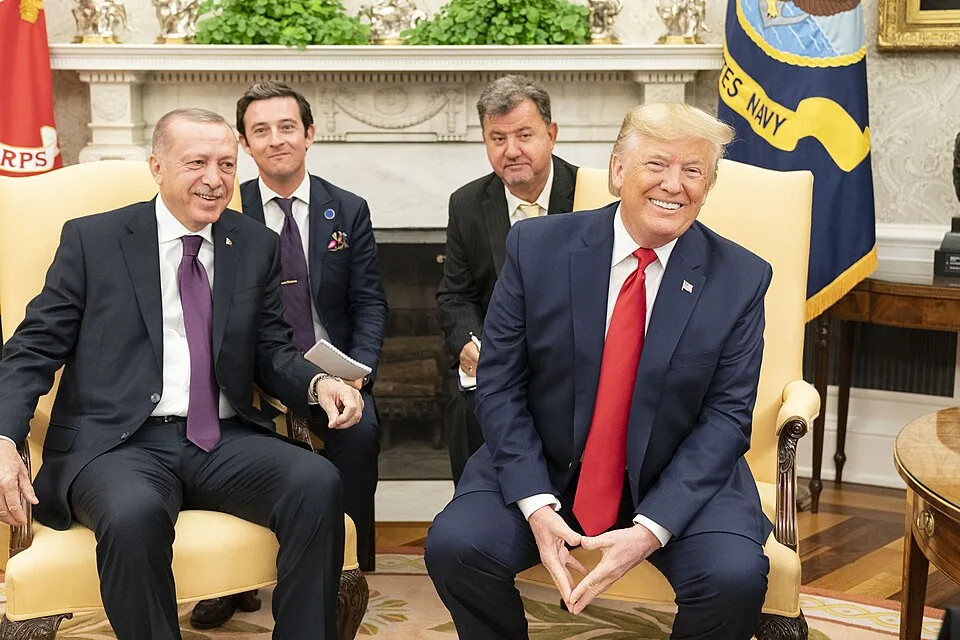
Donald Trump flew to Ankara on Tuesday and, in classic Trump fashion, casually floated selling some of the most advanced fighter jets on the planet to a NATO ally that the United States kicked out of that same jet program seven years ago. Israel, which has spent decades carefully cultivating a U.S.-guaranteed military edge over its neighbors, is not taking this well. Shockingly, none of this was on anyone's bingo card for July.
What Trump Actually Said in Ankara
At the top of his meeting with Turkish President Recep Tayyip Erdogan, Trump signaled he is leaning toward allowing Turkey back into the F-35 Joint Strike Fighter program and selling the jets to the Turkish air force, according to Axios. That's it. That's the whole thing. A lean. At the top of a meeting. Before anyone had apparently worked out any of the details that typically accompany a decision of this magnitude.
To be clear about what this meeting was: the President of the United States sat down with a man who has spent years consolidating authoritarian power, jailing journalists, and using his country's NATO membership as leverage whenever he wants something from the West. And Trump's opening move was apparently to hand him a gift that previous administrations had specifically withheld as a consequence for bad behavior.
Why Turkey Got Kicked Out in the First Place
Turkey was booted from the F-35 program in 2019, and the reason is not complicated. Erdogan bought a Russian S-400 missile defense system, which the U.S. and NATO said was a security risk because it could potentially be used to collect data on F-35 radar signatures. The logic was straightforward: you do not get to buy Russian military hardware designed to shoot down NATO jets and then also receive those NATO jets. That was the deal.
Congress backed this position. The Pentagon backed this position. The intelligence community backed this position. It was one of the rare cases where the American national security establishment had a clear, coherent, and defensible policy. So naturally, seven years later, Trump showed up in Ankara and started undermining it before the appetizers arrived.
Israel's Specific, Documented Objection
Israel's concern here is not vague or hypothetical. As Axios reports, Israel fears this move would tilt the regional balance of power and violate explicit U.S. commitments to maintain Israel's qualitative military edge, which is a formal policy principle that successive American administrations have upheld for decades. The qualitative military edge doctrine essentially means the U.S. promises Israel will always have better weapons than its neighbors. That promise has shaped arms sales policy across the entire Middle East for years.
If Turkey gets F-35s, Turkey becomes the first country in the region to be part of the F-35 development and production program, per Axios. The second country to actually operate the jets in the region would be Turkey, coming in right behind Israel. You can see why Jerusalem might feel like someone just invited a rival to their exclusive club without asking.
The Broader Strategic Incoherence
Here is the part where you have to stop and think about what American foreign policy actually is right now, because it is genuinely hard to tell. The U.S. still has sanctions on Turkey related to the S-400 purchase under the CAATSA law. Those sanctions have not been lifted. The underlying reason Turkey was removed from the program has not changed. The S-400 is presumably still sitting in a Turkish warehouse somewhere.
And yet Trump is in Ankara, leaning toward F-35 sales. This is not a policy shift that emerged from a review process, or a diplomatic framework, or a congressional authorization. It appears to be a vibe that Trump telegraphed at the start of a bilateral meeting. American foreign policy, ladies and gentlemen, now runs on vibes and bilateral summits with authoritarian leaders who are good at flattering the guy in the room.
The broader NATO picture here is also a mess. Turkey has spent the last several years blocking or delaying alliance decisions, threatening Greece, and maintaining warmer relations with Moscow than most NATO partners are comfortable with. Rewarding all of that with cutting-edge American fighter jets sends a message to every other alliance member about exactly how much behavior is tolerable if you're willing to wait Trump out.
What Happens Next (Probably Nothing Coherent)
Rejoining the F-35 program is not something a president can do alone with a handshake and a lean. Congress has a say. The CAATSA sanctions have a legal framework. Lockheed Martin, which builds the F-35, has its own production and supply chain considerations. And the existing allies in the program, many of whom have their own complicated feelings about Turkey, would need to be managed.
None of that means it won't happen. It means it would take sustained effort, diplomatic groundwork, and legislative maneuvering to pull off in any legitimate way. The Trump administration's track record on sustained effort and diplomatic groundwork is, to put it gently, not its strongest suit. The likelier outcome is that this becomes a prolonged source of tension with Israel, confusion within NATO, and leverage for Erdogan without actually producing any jets.
The Dingo Take
Let's just say the quiet part out loud. Turkey bought Russian weapons. The U.S. punished Turkey by removing them from an American weapons program. Trump then visited Turkey and offered to undo that punishment without requiring Turkey to get rid of the Russian weapons. That is not diplomacy. That is a hostage negotiation where you pay the ransom and then ask if they want dessert.
The Israel angle deserves more attention than it's getting. The qualitative military edge commitment is not an informal gentleman's agreement. It is a cornerstone of American Middle East policy that has survived administrations from both parties, shaped billions of dollars in arms decisions, and served as the bedrock of Israel's security calculus for generations. Trump is now casually floating blowing a hole through it on a diplomatic visit to a guy who has been cozying up to Vladimir Putin. The fact that this is being treated as a routine foreign policy story and not a five-alarm crisis says a lot about how numb everyone has gotten.
Erdogan is very good at this, by the way. He has spent years playing NATO against Russia and extracting concessions from the West by making himself just troublesome enough to require management. He apparently sized up Trump correctly and understood that all he had to do was roll out a nice meeting, say some flattering things, and wait for the offer to come. It worked. Congratulations to Turkish diplomatic strategy, which continues to run circles around whatever the United States is currently calling its foreign policy.




Comments