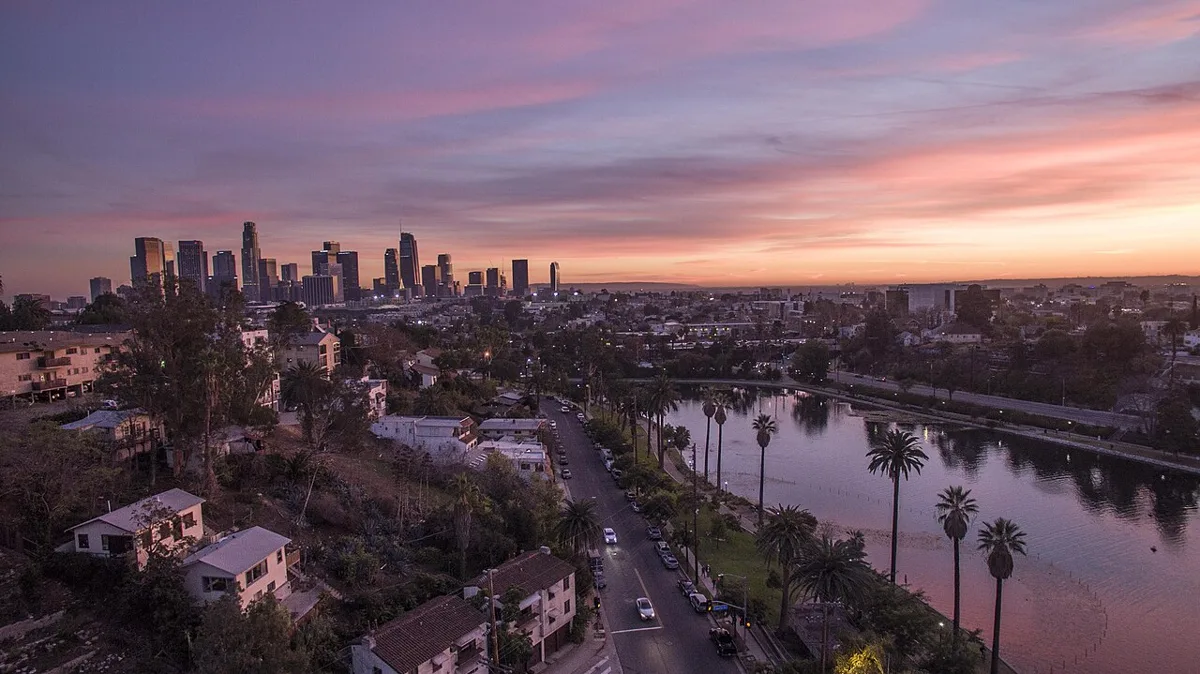
After a half-million-square-foot warehouse burned for a week in Los Angeles, the company that owns it hired a firm to test the air and tell everyone it was fine. That firm just happens to be the freshly rebranded version of the same company that told East Palestine, Ohio residents their homes were safe after a toxic train derailment, right before those residents started having migraines, nausea, and seizures. Sleep tight, LA.
The Fire, the Smoke, and the Company Nobody's Heard Of
The June 17 fire at a Lineage logistics facility in Los Angeles was not a small thing. A 500,000-square-foot cold storage warehouse burned for an entire week. California declared a state of emergency. Plumes of smoke spread across the city, and residents started asking the very reasonable question: what exactly are we breathing?
Lineage, the logistics giant that owns the facility, had a convenient answer. They hired Arkansas-based Onterris to conduct air quality testing. Onterris came back with good news: air quality was "good," hazardous gas levels were low, nothing to worry about. The company is still testing.
The problem, as CBS News reports, is that independent air pollution experts and local activists don't buy it. And when you look at who Onterris actually is, and what they've done before, their skepticism starts to look less like paranoia and more like pattern recognition.
Meet Onterris, or Whatever They Were Calling Themselves Last Month
Onterris rebranded in April of this year. Before that, for 29 years, it was called the Center for Toxicology and Environmental Health, or CTEH. According to CBS News, "while the name has changed, the team, expertise, and services remain the same," which is exactly what a company says when it wants you to forget the name but can't actually change anything else.
So who was CTEH? A firm with a very specific business model: get hired by the company responsible for an environmental disaster, test the air and water, and come back with reassuring results. Oil companies, rail carriers, heavy industry. You've got a spill, they've got a clipboard.
"It's like the fox guarding the henhouse," Lesley Pacey, an environmental investigator for the nonprofit Government Accountability Project, told CBS News. That's a polite way to put it.
The Track Record Is, Uh, Not Great
Let's run through the resume quickly, because it's a lot.
After the Norfolk Southern train derailment in East Palestine, Ohio in 2023, the railroad hired CTEH to test homes and declare them safe. Residents later suffered migraines, nausea, and seizures. Independent experts, as CBS News reported at the time, said CTEH's tests didn't look for the full range of dangerous compounds and sampled air for too short a period to get accurate readings. "If you have the polluter doing the testing, they have a built-in financial interest in not finding problems," former EPA regional administrator Judith Enck told CBS News then.
After Hurricane Katrina, Murphy Oil Corp. hired CTEH to test contamination from an oil spill at its Louisiana refinery. The New York Times reported that CTEH didn't follow the EPA's soil sampling plan, produced clean toxicology reports, and used the data to discourage locals from filing lawsuits. After BP's Deepwater Horizon disaster in 2010, BP hired CTEH, and two members of Congress wrote a letter to BP's CEO warning that CTEH had "a history of being hired by companies accused of harming public health and releasing findings defending the corporate interests that employ them."
Then there's the Chinese drywall situation. CTEH tested drywall products for a manufacturer in 2006 and found no hydrogen sulfide emissions. The Consumer Product Safety Commission later ranked two of that manufacturer's products as the top hydrogen sulfide-contaminated "problem drywall" in the country. A class action lawsuit ended in a $1.1 billion settlement for around 5,000 U.S. homeowners in 2011. And after a coal ash dam break in Tennessee in 2008 released more than a billion gallons of sludge, CTEH declared the air safe, residents reported rashes, swollen eyes, and tarnishing wedding bands, and an EPA audit found CTEH's tests "failed to meet quality assurance procedures."
What CTEH, Sorry, Onterris Says About All This
In every single case above, CTEH or Onterris has a response. They followed best practices. They were only contracted for the emergency phase. The noxious gas levels weren't high enough to cause harm. Their Deepwater Horizon data was used to protect human health. They pride themselves on accurately representing the facts.
This is fine. Companies get to respond to criticism. But there is something almost impressive about a firm that has been at the center of this many disputed environmental health assessments, across this many disasters spanning nearly three decades, and has managed to walk away from each one with a prepared statement and a new contract.
The rebrand to Onterris in April feels less like a fresh start and more like a company that realized its name had become Googleable in unfortunate ways.
People on the Ground Are Not Waiting Around
CBS News reports that East Yard Communities for Environmental Justice, a local group, is working with independent air quality experts to take their own measurements after the Lineage fire. Dr. Jill Johnston, a UC Irvine exposure scientist and environmental epidemiologist, is conducting independent testing.
"We've been out there collecting samples doing the best we can," Johnston told CBS News, noting that the foam used to insulate warehouses can release significant amounts of volatile organic compounds when it burns.
This is where things stand in Los Angeles right now: a massive industrial fire burned for a week, residents have legitimate health concerns, the responsible company hired a firm with a documented history of clearing polluters, and scientists outside the corporate feedback loop are doing their own work because nobody else trusts the official version. This is not a new story. It is, depressingly, a very familiar one.
The Dingo Take
Here's the thing about hiring the polluter's preferred testing firm to assess the pollution: everyone knows what it is. The residents know. The activists know. The independent scientists know. The two members of Congress who wrote that letter to BP knew in 2010. This is not a secret or a revelation. It is a completely legal arrangement that produces results favorable to the company paying for them, and then everyone acts surprised when it happens again.
Onterris can dispute every single case on this list. They have, and they will. But at some point the accumulation of disasters where they found nothing, followed by evidence that there was something, stops being a series of unfortunate coincidences and starts being a business model. East Palestine. Deepwater Horizon. The Tennessee coal ash spill. The Hurricane Katrina refinery. The drywall. Now Los Angeles. The team, expertise, and services remain the same. They said so themselves.
LA residents who want to know what's actually in the air they're breathing are right to fund independent testing. Right to distrust the results from a company that was paid by Lineage to test Lineage's mess. The fox-and-henhouse metaphor is almost too generous. At least the fox has to pretend.




Comments