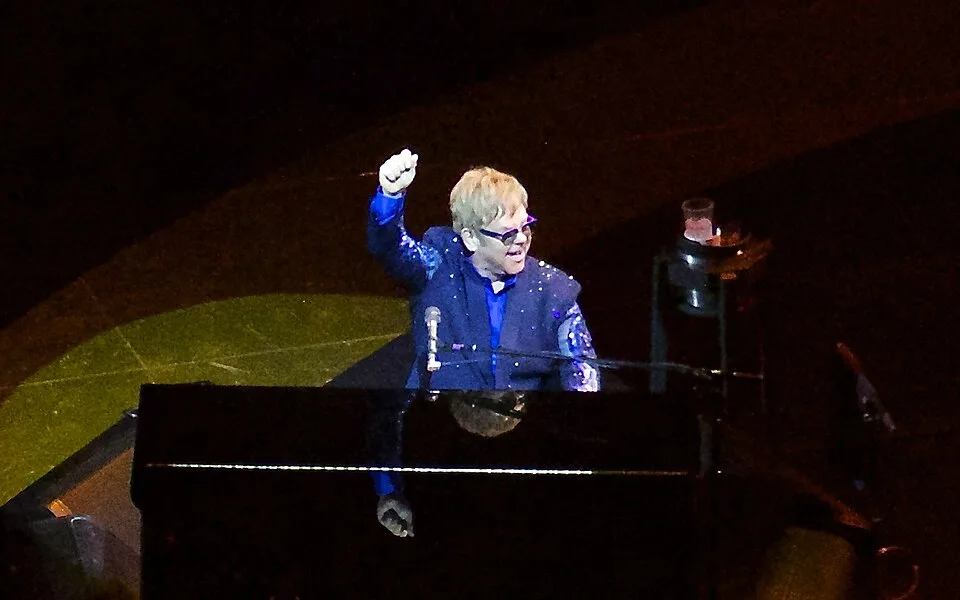
A new book argues that Elton John spent the entire early 1970s hiding in plain sight, stuffing queer longing into chart-topping hits that millions of straight people sang along to without once catching the subtext. The piano man was doing it on purpose, and "Goodbye Yellow Brick Road" was the moment he stopped being subtle about it. You've been humming a coming-out album for fifty years.
The Beige Years: When Elton John Was Pretending to Be Normal
Look at the early album covers. Just look at them. Beige. Denim. The occasional field. This is a man who would later perform in a sequined Donald Duck costume, and his debut aesthetic was "regional bank manager on a casual Friday."
According to a CBS News excerpt from Barry Walters' forthcoming book "Mighty Real: A History of LGBTQ Music, 1969-2000," published by Viking, that plainness was deliberate. Walters argues that Elton John spent his early career carefully keeping his personal life out of the frame while building an audience large enough that eventually coming out wouldn't destroy him. The songs were earth-toned. The presentation was restrained. The garishness was coming, but it had to wait.
Walters writes that even when the music was expansive, emotionally overpowering stuff, it avoided the autobiographical. Elton and lyricist Bernie Taupin built imaginary worlds instead of confessional ones. It was a very specific kind of closet: ornate on the inside, completely sealed on the outside.
The Codes Were There If You Knew to Look
Here's where it gets interesting. Walters traces the queer subtext running through the early hits, and once you see it, you genuinely cannot unsee it.
"Rocket Man," according to the CBS News excerpt of Walters' book, is sung by someone fundamentally removed from ordinary life, whose central confession is "I'm not the man that they think I am at home." When most gay and queer people in the early 1970s were still firmly in the closet, that line did a lot of heavy lifting for a lot of listeners who had no one else speaking for them. "Honky Cat" is about a kid from the provinces who finds salvation in the city. Which is, let's be honest, the plot of approximately seventy percent of queer memoirs ever written.
And then there's "Daniel," from 1973's Don't Shoot Me I'm Only the Piano Player. Walters calls it, in the CBS News excerpt, "the closest we got to a ubiquitous '70s same-sex love song." It's sung from one brother to another, which gave it just enough plausible deniability to get on the radio. Plausible deniability was the whole game.
Goodbye Yellow Brick Road: A Coming Out in Crimson Platform Shoes
Then 1973 happened, and Elton apparently decided subtlety was for people without enough piano.
Walters argues in the book, as reported by CBS News, that Goodbye Yellow Brick Road is Elton John's musical coming out, years before he said anything publicly. The album artwork alone tells the story: Elton in a pink satin bomber jacket, stepping onto the yellow brick road in glittery crimson platform shoes. The ruby slippers. The Wizard of Oz reference so obvious it practically has footnotes. Walters writes that Elton "flees the drab reality he was born into as Reg Dwight, his birth name, and trades it for the emerging LGBTQ dream of a multicolor utopia he could only reach as Elton John." He's even wearing rose-colored glasses in the image. The man was not being subtle.
The opening of the album drives it home. Walters reads the dirge "Funeral for a Friend" as a eulogy for Elton's former closeted self before it crashes into "Love Lies Bleeding." A farewell to the beige years. Everything after is Technicolor. It would be three more years before Elton told Rolling Stone he was bisexual, and another twelve before he came out as gay in 1988. The music, apparently, got there first.
Lesbians on a Number One Album in 1973
The album also contained "All the Girls Love Alice," a hard-rocking track eulogizing, per the CBS News excerpt of Walters' book, a "well-bred but licentious sixteen-year-old lesbian." It was on a number one album. In 1973. That is not a sentence you expect to type.
Walters is careful to note that Taupin's lyric does not exactly reflect deep understanding of gay experience, and that the song borrows from a 1968 film in which, as in many LGBTQ movies of that era, queer passion leads inevitably to death. Not exactly an affirming portrayal. But Walters' point is that it was something. A catchy, loud, lesbian-themed song on the biggest album of the year, heard by millions of people who had no framework for what they were hearing. For LGBTQ listeners who were hungry for any reflection of their lives in mainstream culture, "any likeness" was better than the silence they were otherwise getting.
Why Any of This Matters Now
Walters' book, "Mighty Real," covers LGBTQ music history from 1969 to 2000, and CBS News published this excerpt as part of a broader release ahead of an appearance on CBS Sunday Morning on July 12. The timing is not accidental. Fifty years after Goodbye Yellow Brick Road, the cultural and legal rights that made Elton's eventual openness possible are being actively dismantled.
The argument Walters makes throughout the excerpt is really about survival through culture. Queer artists found ways to speak to queer audiences through coded language, through symbolism, through plausible deniability, because they had to. The Dorothy's-slippers imagery on a 1973 album cover wasn't kitsch. It was communication. It said: we are here, we see each other, we exist. That kind of communication has always mattered more during the periods when more direct communication was dangerous.
We are, demonstrably, back in one of those periods.
The Dingo Take
There is something genuinely moving about the picture Walters paints: millions of people in 1973 buying Goodbye Yellow Brick Road, singing along to "Crocodile Rock" at parties, and completely missing the guy on the cover stepping into his own liberation in crimson glitter shoes. And then there are the people who weren't missing it, who were holding onto it, who had been reading "Rocket Man" like a secret message because it was the closest thing they had.
The book arrives at a moment when the conversation about LGBTQ representation in music and culture has taken a grim turn. What Walters is documenting is a history of incremental, hard-won visibility, built note by note across decades, by artists who risked everything and often lost. Elton John's public coming out took sixteen years from his first oblique signal in a pink satin jacket to actually saying the words. Sixteen years of letting the music carry the weight. That is what it cost.
Now we have a federal government working overtime to erase that history from libraries, schools, and public life, and a pop culture conversation that treats any LGBTQ visibility as a political provocation. Walters' excavation of where this all came from is not nostalgia. It's a reminder of what people built, what it cost to build it, and exactly what is being targeted when someone decides that history is too dangerous to acknowledge.



Comments