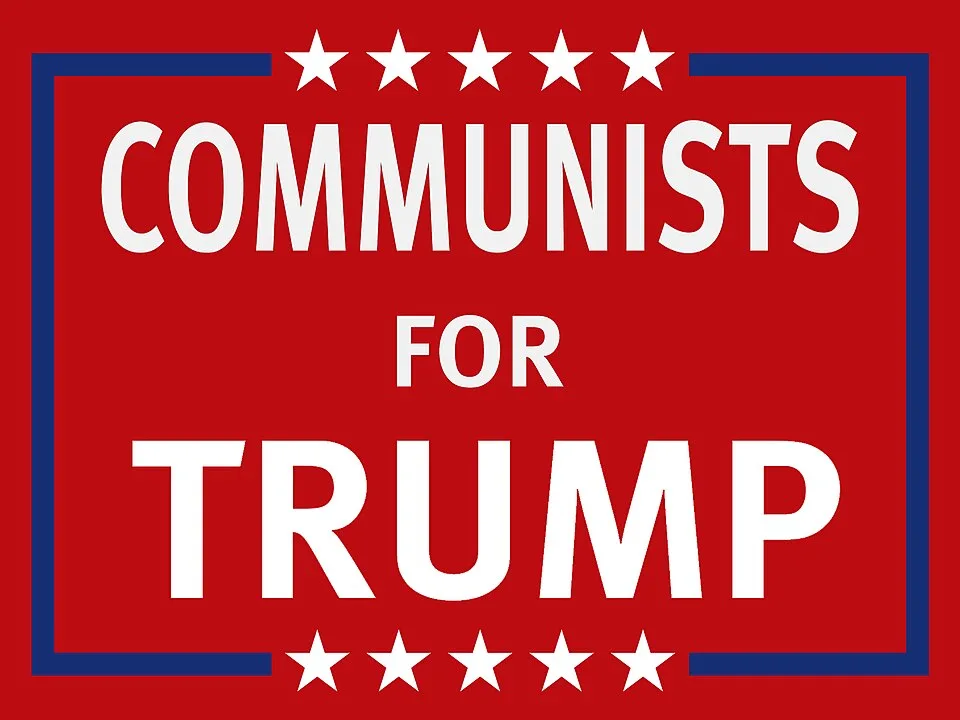
Donald Trump, standing at a NATO summit in Ankara, Turkey, told the world that communism is the greatest threat America has faced since its founding and then, in the same breath, bragged that he personally would be really good at it. "I would be the greatest communist in history," Trump said. "I'd be right up there with Lenin." Sure. Normal press conference stuff.
The Attack Line That Never Dies
NPR reports that Trump used his post-NATO press conference not to talk about the Iran ceasefire that dominated the summit, but to road-test his midterm messaging. The message: Democrats are communists. The subtext: please stop talking about tariffs and grocery prices.
This is not a new play. Trump ran the same game in 2024 with "Comrade Kamala," complete with a fake photo of Kamala Harris addressing a crowd bathed in red light and waving communist flags. That time, when pushed on the attacks, Trump was remarkably candid about his strategy. "All we have to do is define our opponent as being a communist or a socialist or somebody who is going to destroy our country," he said. So at least he's honest about the fact that it's a rhetorical bludgeon rather than a sincere policy critique.
The tactic has gotten louder lately. According to NPR, Trump has specifically ramped up the communist rhetoric following primary wins by democratic socialist candidates in New York and Colorado. He's also taken it into religious territory, telling the Faith and Freedom Coalition conference last month that Democrats "will close your churches" and "will kill your people." Just breezy summer politics.
Where This Stuff Actually Comes From
Presidential historian Tevi Troy, who served in the George W. Bush White House, told NPR that this worldview is genuinely baked into who Trump is. "This is in his bones," Troy said. Trump turned 80 this year, meaning he grew up in the 1950s, when anti-communism wasn't a partisan attack line but the defining American consensus.
And then there's Roy Cohn. Trump's longtime mentor, fixer, and personal lawyer was a key figure in Joe McCarthy's communist-hunting Senate crusade. Troy put it plainly: Cohn "worked on the McCarthy staff." McCarthy's tactics eventually produced massive political blowback, his name becoming synonymous with paranoid, evidence-free persecution. Trump, raised in Cohn's orbit, absorbed the playbook without apparently absorbing that lesson.
Jennifer Stromer-Galley, who studies political messaging at Syracuse University, told NPR that Trump is deliberately conflating democratic socialists with communists to fire up his base. These are not the same thing, at all. Democratic socialists want expanded social programs, universal healthcare, and reduced inequality within a capitalist system. Communists want to abolish private property and end capitalism entirely. One of these is Scandinavia. The other is the Soviet Union. Trump is not confused about this distinction. He just finds the confusion useful.
How Much Gas Is Left in This Tank
The honest answer, according to experts NPR spoke with, is: it depends on how old you are. Raymond Robertson of Texas A&M's Bush School of Government says the communist label still carries real emotional weight with older voters who remember the Cold War as lived history. For younger Americans, not so much.
"The younger generations don't have that context," Robertson told NPR. "They only really remember the first Trump administration and maybe the Obama administration. They don't remember the end of the Cold War. That is ancient history." If your political memory starts with Obama's second term, "communist" is basically a word your grandfather uses when he's upset about bike lanes.
The other problem is that economic anxiety is what's actually driving Democratic socialist candidates' wins right now. NPR notes that concerns partly caused by the ongoing war in Iran have pushed voters toward candidates promising a stronger social safety net. Trump's communist framing is an attempt to make that economic conversation into an ideological one. Whether voters who are worried about prices and healthcare are persuadable on the "but socialism is bad" angle is, to put it charitably, an open question.
The Part Where Trump's Own Investments Get in the Way
Here is the part of this story that deserves a longer look. Robertson also pointed out to NPR something that should be getting more attention: Trump's administration has taken a stake in Intel and acquired what it calls a "golden share" in U.S. Steel. The federal government. Owning pieces of private industry. As a matter of policy.
Robertson says this directly conflicts with Trump's communist-threat messaging. The White House's response, per NPR, was to call such comparisons "idiotic" and insist Trump's agenda is about "revitalizing American industry and reshoring manufacturing here at home." Which is a fine thing to want. It's also a pretty solid description of state capitalism. The kind of thing that, in other contexts, Republican politicians have described as socialism.
Nobody is saying Trump is actually a communist. That would be absurd. But the guy calling Democrats Leninists while his administration acquires equity stakes in major American corporations is a sentence that should give pause to anyone who believes the communist attack is being deployed in good faith.
The Dingo Take
Let's be precise about what this is. Trump isn't confused about the difference between a democratic socialist who wants Medicare for All and a Marxist-Leninist who wants to collectivize the farms. He's a man who has been in electoral politics for over a decade. He knows the difference. He's choosing to blur it because scared voters are more useful to him than informed ones, and because his actual record on the economy is not the asset he needs it to be heading into the midterms. "Communist" is a distraction. It's a loud, red-lit, historically-loaded distraction.
The polls NPR references showing Trump bleeding support on immigration, his previous strongest issue, explain a lot about why we're here. When your best card stops working, you pull out an older one. This one is from the 1950s. Roy Cohn used it. Joe McCarthy used it. It worked great until it didn't, and then McCarthy's name became a dictionary entry for reckless character assassination. Trump is apparently willing to bet that younger voters won't do the historical homework.
He might be right about that. He's often right about things he shouldn't be right about. But at some point, a president who is presiding over government equity stakes in American corporations while calling his opponents the real state-ownership guys might find that the bit wears thin. Probably not before November. But eventually.


Comments