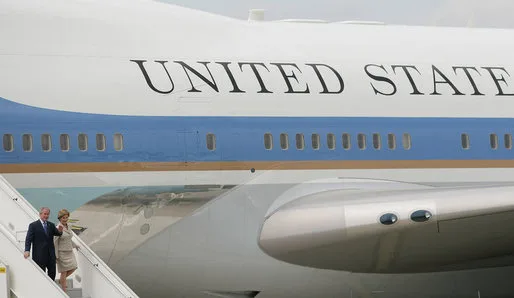
Federal agents showed up at New York Times journalists' homes to hand-deliver subpoenas, because those reporters had the audacity to write about security concerns with a plane the United States accepted as a gift from Qatar. This is the country now. FBI agents. On your doorstep. For covering the news.
What Actually Happened Here
The AP reports that the Department of Justice has subpoenaed four New York Times journalists after they reported on security concerns surrounding Trump's new Air Force One, the jet gifted to the United States by Qatar that the administration then spent $400 million retrofitting. The reporters who received subpoenas are Julian E. Barnes, Eric Lipton, Tyler Pager, and Eric Schmitt.
The subpoenas demand those reporters testify before a federal grand jury in Manhattan. Some of those subpoenas were hand-delivered by federal agents to the journalists at their private residences. Let that sit for a second. Agents of the federal government knocked on reporters' doors, at home, to hand them legal orders to appear before a grand jury.
According to AP, the subpoenas came after FBI Director Kash Patel and other Justice Department officials held a meeting at the White House on Friday specifically to discuss the matter. So this wasn't a rogue prosecutor running wild. This had White House fingerprints all over it before the ink was dry.
The Jet at the Center of This Mess
Some context on what triggered all of this. The new Qatari-gifted plane entered service last week after $400 million in American taxpayer money was spent on upgrades. And yet, when Trump left a NATO summit in Turkey, AP reports he flew on an older Air Force One model and later referenced threats against him made by Iran.
The Times reporters were covering security concerns around that new plane. That's it. That's the story that apparently required a White House meeting with the FBI director and federal agents fanning out to reporters' homes. Someone in the government apparently told journalists something unflattering about a foreign-gifted aircraft, and now four reporters are looking at grand jury subpoenas.
The Justice Department issued a statement saying reporters are "not the targets" and that the real targets are whoever leaked classified information. That's a nice thing to say right before you send agents to reporters' houses.
This Is Not Normal, Even by Current Standards
Press freedom experts are not mincing words. Bruce D. Brown, president of the Reporters Committee for Freedom of the Press, said the subpoenas "break from longstanding Justice Department practice" that required prosecutors to seek information from reporters only "as a last resort when all other avenues have been exhausted." AP quotes Brown saying Trump's "war on the press is looking for another victim."
David McCraw, a lawyer for the Times, put it plainly: "The appearance of federal law enforcement agents on the doorstep of news reporters should shock the conscience of any American who believes in the Constitution and the press freedom it protects."
It is genuinely rare for the government to try to compel reporters to reveal sources before a grand jury. The AP notes that while administrations have occasionally seized phone records in leak investigations, forcing reporters into a grand jury room is a step almost nobody takes. Almost.
How We Got Here: A Brief History of Dismantling Press Protections
This didn't start last week. In April 2025, then-Attorney General Pam Bondi rescinded a Biden-era policy that protected journalists from having their phone records secretly seized during leak investigations. That cleared the runway. Once that protection was gone, prosecutors got back the authority to use subpoenas, court orders, and search warrants to go after government employees who talk to journalists.
AP also reports that earlier this year, the DOJ issued subpoenas seeking testimony from reporters at the Washington Post and the Wall Street Journal. In both of those cases, the department eventually withdrew the subpoenas. Whether that happens here remains to be seen, but the pattern is clear: issue the subpoena, rattle the reporters, remind everyone in government what happens when you talk to the press, then maybe back down if the optics get too bad.
In January, FBI agents searched the home of Washington Post reporter Hannah Natanson, who covers Trump's transformation of the federal government, as part of a separate leak investigation. Searching reporters' homes. Subpoenaing reporters' phones. Sending agents to their front doors. This is a comprehensive, systematic project, not a series of unconnected incidents.
What the Administration Is Saying
The Justice Department's position is that it has no quarrel with the press, it just cannot allow people with security clearances to share classified information with journalists. "We value and appreciate the important role that the press plays in this country," the DOJ said in a statement, per AP, while defending the subpoenas issued to people whose job is to talk to the press.
The department acknowledged "there may always be natural tension" between press freedom and leak investigations. "Natural tension" is one way to describe agents showing up at reporters' houses. Another way to describe it would be "an attempt to identify and punish sources by pressuring journalists under threat of legal jeopardy."
Trump during his first term called the press the "enemy of the American people." He is now using the machinery of the federal government to act on that belief in ways that go considerably further than anything he attempted before.
The Dingo Take
Here is the core of what is happening. The president accepted a $400 million plane from a foreign government, spent another $400 million in American tax dollars fixing it up, and when reporters wrote about security concerns with that arrangement, the White House held a meeting with the FBI director and then sent agents to those reporters' homes. The story that caused this was about the plane. The plane that was a gift. From Qatar. If you were designing a situation engineered to keep critical reporting from ever seeing the light of day, you could not do better than this.
The DOJ's "reporters aren't the targets" framing is technically accurate in the narrowest possible sense and completely dishonest in every practical one. You don't have to charge a reporter with a crime to destroy their ability to do their job. You just have to make clear that anyone who talks to them will face federal investigation, and that the reporters themselves could be dragged in front of a grand jury if they don't give up those sources. That chill is the whole point. The subpoena is the message.
The fact that earlier subpoenas against Post and Journal reporters were eventually withdrawn does not make this okay. It makes it worse. It means the administration has figured out it can issue these things, watch newsrooms scramble and lawyers mobilize, remind every government employee what talking to journalists costs, and then pull back before the political damage fully lands. Rinse and repeat. A government that has learned it can harass the press without consequence will keep harassing the press. That's not a prediction. It's already the schedule.




Comments