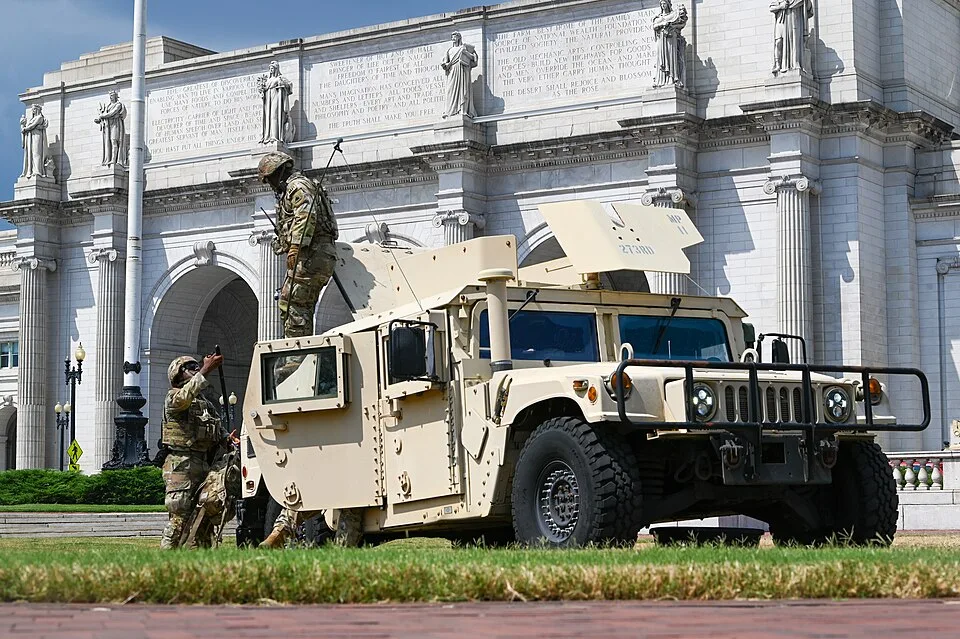
Democratic governors sent National Guard troops to Washington D.C. for a birthday party and somehow ended up providing armed neighborhood patrols for Donald Trump's ongoing military occupation of the nation's capital. Minnesota's Tim Walz is pulling his people out early after activists caught his troops wandering residential streets miles from the National Mall, visibly unsure where the Fourth of July celebrations even were. The question now is whether Michigan Gov. Gretchen Whitmer does the same, or keeps her 162 troops embedded in a mission she explicitly said she opposed.
How a Birthday Party Became a Trap
Here's the setup. Trump has had thousands of National Guard troops patrolling Washington D.C. since August 2025, as part of a federal Joint Task Force sold to the public as a crime-fighting and city beautification initiative. As NPR reports, crime in D.C. was already trending down when he launched it. Constitutional scholars and legal experts have called the deployment an anti-democratic use of the military. It now costs more than $3 million per day, according to a Congressional Budget Office estimate.
Then came America 250, the national birthday celebration tied to the July Fourth festivities near the monuments. Democratic governors from Minnesota, Michigan, Kentucky, North Carolina, Maryland, and Hawaii decided they could send troops for that specific, limited purpose. Parades. Monuments. Patriotic pomp. They wrote it into their orders explicitly: guard members were there for America 250 only, not for Trump's broader law enforcement mission.
It was, in retrospect, an extraordinarily optimistic thing to trust this administration to honor.
Spotted: Armed Troops, Wrong Neighborhood, No Idea Where the Party Is
Activist group Free D.C. did not take the administration's word for any of this. Within days of troops arriving, they had video of National Guard members from both Minnesota and Michigan armed with handguns and patrolling residential and commercial neighborhoods nowhere near the National Mall. NPR authenticated both videos.
In the footage, the guard members themselves say they are not sure how far away the America 250 celebrations are from where they're standing. Read that again. The troops sent exclusively for a celebration near the monuments do not know where the monuments are, because they have been deployed somewhere else entirely.
Days after those videos surfaced, Minnesota made its call. Walz's office confirmed to NPR that once it became clear his troops were being used on presence patrols in other neighborhoods, the decision was made to pull them out. They had originally been scheduled to stay until July 23.
The Fine Print They Should Have Read More Carefully
The D.C. Joint Task Force lists all state National Guard troops on its public website, including the Democratic-state arrivals, with a small notation that they are there for America 250. Cute. According to the Joint Task Force, every single state National Guard member on that list has been deputized as special police by the U.S. Marshals Service and issued a firearm. All of them. The "we're just here for the fireworks" carve-out is essentially cosmetic.
State guard members in D.C. are operating under Title 32 status, meaning the federal government is paying for them but governors technically retain command authority. Former National Guard officials told NPR that in practice, this is meaningless. Governors are not on the ground. They are not issuing day-to-day orders. Once those troops are folded into a complex federal operation, the idea that a governor in St. Paul or Lansing is directing their daily activities is a polite fiction.
Elizabeth Goitein, senior director of Liberty and National Security at the Brennan Center, put it plainly to NPR: "They were fundamentally trusting the Trump administration to respect those lines, and I think that was a mistake. No matter what limits they try to draw, as a practical matter, the governors are not there on the ground and are not giving the orders."
Kentucky Got Out Even Earlier, and Maryland Is Right Behind
Minnesota is not alone in heading for the exit. Kentucky Gov. Andy Beshear's communications director Scottie Ellis told NPR that a single Kentucky Guard member was pulled home before the main events even started, after being diverted to the broader task force without the knowledge or consent of the governor or the state's Guard command. One troop went to D.C., immediately got absorbed into Trump's operation, and Beshear yanked him back.
Maryland Gov. Wes Moore's office also confirmed to NPR that his state's guard members, who were only in D.C. for a brief window around the celebrations, would be returning home by the end of the week. The Democratic governors who sent troops are leaving. The question mark is Michigan.
All Eyes on Whitmer
Michigan sent 162 troops to D.C., and as of this reporting their deployment has not ended. That makes Gretchen Whitmer the last Democrat holding significant skin in this game, and the pressure on her is building fast.
The Brennan Center, along with a coalition of more than two dozen think tanks and civil rights, labor, and civic groups, sent a letter directly to Whitmer urging her to end the deployment. Free D.C., the activist group that caught Michigan troops on video in the wrong neighborhood, is one of the organizations that signed it. The optics are not great: every other Democratic governor is extracting their people from a mission that demonstrably exceeded its stated purpose, and Michigan's 162 remain.
The D.C. Joint Task Force, for its part, did not respond to NPR's questions about what specifically troops are doing in the city, but did claim that guard members sent for America 250 would not have their mission changed. Given that activists already have video evidence to the contrary, that statement is doing a lot of heavy lifting.
The Bigger Number Nobody Is Talking About Enough
Step back from the individual governor drama for a second and look at what is actually happening in Washington D.C. right now. The number of National Guard troops in the city has doubled over the past month to more than 5,100. Federal officials are calling it a "summer surge." The CBO puts the cost at upward of $3 million per day.
Thousands of armed troops have been patrolling residential and commercial neighborhoods of an American city for nearly a year. That is the baseline. That is what we have normalized while arguing about whether Tim Walz gets credit for pulling out early enough. The entire premise of this story, a president running a standing military patrol of the nation's capital at a cost of millions of dollars per day despite falling crime rates, is the part that should be making more noise than it is.
The Dingo Take
Give Tim Walz credit for one thing: when he found out his troops were wandering D.C. neighborhoods with handguns and no idea where the Fourth of July party was, he pulled them. That is the correct response. It is also embarrassing that it took activist video documentation to make it happen, rather than, say, a phone call to check in on the people he deployed into a federal military operation run by an administration he vocally opposes. "We trusted them to honor our restrictions" is not a governance strategy, it's a prayer.
The Whitmer situation is where this gets genuinely uncomfortable. She has been one of Trump's sharpest Democratic critics. She has spoken out against the D.C. deployment explicitly. And she still has 162 Michigan Guard members embedded in it, now documented to have been used in ways that contradict the terms she set. At some point the gap between what you say and what you allow to happen in your name is not a nuance, it's a problem.
But none of this individual governor accounting should distract from the main event. Over five thousand armed troops are patrolling an American city right now. It costs three million dollars a day. Crime was already going down before it started. Constitutional experts call it anti-democratic. And the response from most of official Washington is essentially a shrug and a quibble about mission parameters. This is not normal. We just keep describing it in increasingly procedural terms until it sounds like it is.




Comments