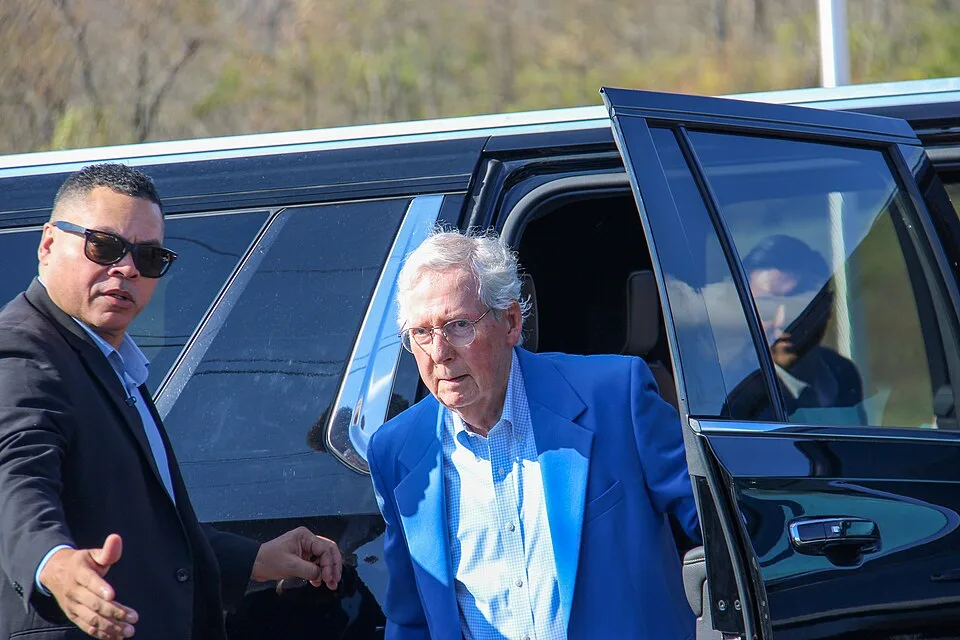
Mitch McConnell has been in a Washington-area hospital since June 14, emergency dispatch audio captured CPR being performed at his home, and his office's official position is essentially: he's fine, trust us. The Senate comes back from recess on Monday. McConnell will not be there. And somehow, nearly a month in, nobody in his orbit has explained a single thing.
What We Actually Know, Which Is Almost Nothing
Here is the full, unvarnished inventory of confirmed facts. McConnell, 84, was admitted to a hospital in the Washington area on June 14. Emergency dispatch audio obtained by media outlets indicates first responders were sent to his home after reports of an unconscious person, with CPR already underway. On Friday, CNN released video footage showing a person on a stretcher being loaded into an ambulance, though their face was not visible.
McConnell's office has neither confirmed nor denied that the footage or the dispatch audio are connected to the senator. Their official updates have consisted of variations on 'he is continuing to improve' and 'he remains engaged with Senate business.' That is it. No diagnosis. No prognosis. No timeline. Nothing.
This is not a gray area. A sitting United States senator with committee chairmanships controlling Pentagon funding has been hospitalized for nearly a month following what emergency audio suggests was a cardiac event requiring CPR, and the official response from his own office has been to say as little as legally possible and hope everyone moves on.
The Speculation Filling the Vacuum His Office Created
When you refuse to give people information, they find their own. Malcolm Nance, a career counter-terrorism intelligence officer, told the Truth in the Barrel podcast this week that he believes McConnell is dead. 'I heard that 911 tape and I was an EMT when I was in the military,' Nance said. 'One of the things that teach you about CPR is the probability of coming back from CPR is very, very, very small.' His interview partner was Amy McGrath, the former marine fighter pilot who lost to McConnell in 2020, who responded with the diplomatic non-answer of 'We'll see what happens there.'
Reed Galen, president of pro-democracy coalition JoinTheUnion.us, told The Guardian he assumes McConnell is still alive only because 'if he was not alive that would be news that would be too hard to keep.' That is the bar we are at now. The evidence for McConnell being alive is that his death would be logistically difficult to hide.
Pollster John Zogby compared the situation to Generalissimo Franco in the 1970s, 'who was reported to be unawake but still alive, and no one believed it after about six weeks, because they hadn't figured out a transition yet in Spain.' When veteran political observers are reaching for Francisco Franco comparisons, the communications strategy has officially failed.
The Senate Consequences Are Not Theoretical
This is not just a morbid human interest story about a very old man and the loyalty of his staff. There are real legislative stakes right now. The Senate returns Monday for a four-week session covering defense spending, national security, and government funding ahead of the October 1 deadline. Republicans hold a 53-47 majority that sounds comfortable until you remember they currently have 52 effective votes because McConnell cannot be there.
McConnell chairs the Senate Rules Committee and a defense appropriations subcommittee where Republicans hold exactly a one-seat advantage. Without him, the already-grinding process of passing annual spending bills gets harder. Congressional leaders are already floating the idea of another temporary spending measure to avoid a government shutdown, according to The Guardian. So we may be looking at a government funding crisis that is partly attributable to one senator's office refusing to tell the public whether he can do his job.
Senate Majority Leader John Thune and Republican Whip John Barrasso have both publicly said they've spoken with McConnell and that he is alert and engaged. Asked aboard Air Force One how McConnell was doing, Donald Trump replied: 'I have no idea how he's doing.' At least someone's being honest.
The Constitutional Mess Waiting on the Other Side
Here is where things get genuinely complicated. If McConnell resigns or dies, Kentucky's Democratic Governor Andy Beshear cannot simply appoint a replacement. The Republican-controlled state legislature changed the law in 2024 specifically to strip the governor of that power. Instead, a vacancy triggers a special election on a timeline that is legally untested and could end up in court.
Depending on when a vacancy occurred, The Guardian reports, the seat could potentially sit empty until the new Congress is sworn in next January. Kentucky Republicans rewrote their own succession law to prevent a Democratic governor from appointing a Democrat to the seat, and in doing so created a scenario where their most powerful senator's seat might simply be vacant for months during a critical legislative period. Incredible work.
Beshear, for his part, published an open letter urging McConnell to provide some reassurance to his constituents. 'Kentuckians have grown increasingly concerned about the current state of your health and well-being, and ability to hold office,' Beshear wrote. McConnell's office responded by saying the senator appreciates the 'outpouring of support.' That's a response the way a stock photo is a painting.
This Has Happened Before and We Learned Nothing
The Dianne Feinstein comparison has become unavoidable, and The Guardian makes it explicitly. Feinstein died in office at 90 while concerns about her mental acuity had been building for years. Her staff made decisions. Her office issued updates. Senators showed up to vote in her name when she could barely make it to the chamber. It was a slow-motion institutional failure that everyone could see and almost nobody in a position of power was willing to name out loud.
Galen put it plainly to The Guardian: 'While he is incapacitated, there are staff who are basically making decisions on behalf of the people of Kentucky. These are all people with pretty significant political equities of their own. We saw this, frankly, with President Biden's people. It's the next example of a gerontocracy in Washington DC that thinks more of itself than it does of its people.'
McConnell's health history made this moment predictable. He suffered a concussion after a fall in 2023. He froze twice while speaking to reporters that same year. He sprained his wrist in another fall. He spent more than a week in a hospital earlier this year with flu-like symptoms. Every one of those incidents produced the same cycle: concern, sparse updates, reassurances from allies, no substantive information. The system has no mechanism to force transparency, so there is none.
The Dingo Take
Let's be honest about what McConnell's office is doing. They are betting that the discomfort of asking hard questions about an old man's health will be greater than the public's appetite for answers. They are probably right, at least for a while. The Senate's genteel culture of institutional courtesy makes it very hard for colleagues to stand up and say: we need to know if this man can do his job. So instead you get Thune and Barrasso saying he seemed sharp on the phone, and Trump saying he has no idea, and everyone shrugging and hoping for the best.
The problem is that Kentucky voters elected a senator, not his staff. The people drafting responses on his behalf, fielding calls from leadership, deciding what gets his attention and what doesn't, those people were not on the ballot. This is not a privacy matter anymore. A private citizen is entitled to handle a medical crisis however they see fit. A senator who chairs committees controlling hundreds of billions in federal spending gave up that particular right when they took the job.
McConnell has spent decades as one of the most effective and ruthless institutional operators in American political history. He understands power and leverage better than almost anyone alive. The silence from his office is not an accident or an oversight. It is a choice. Someone in that orbit has calculated that opacity serves their interests better than transparency. The question the rest of us should be asking is: whose interests, exactly, are being served here, and are they the same as Kentucky's?




Comments