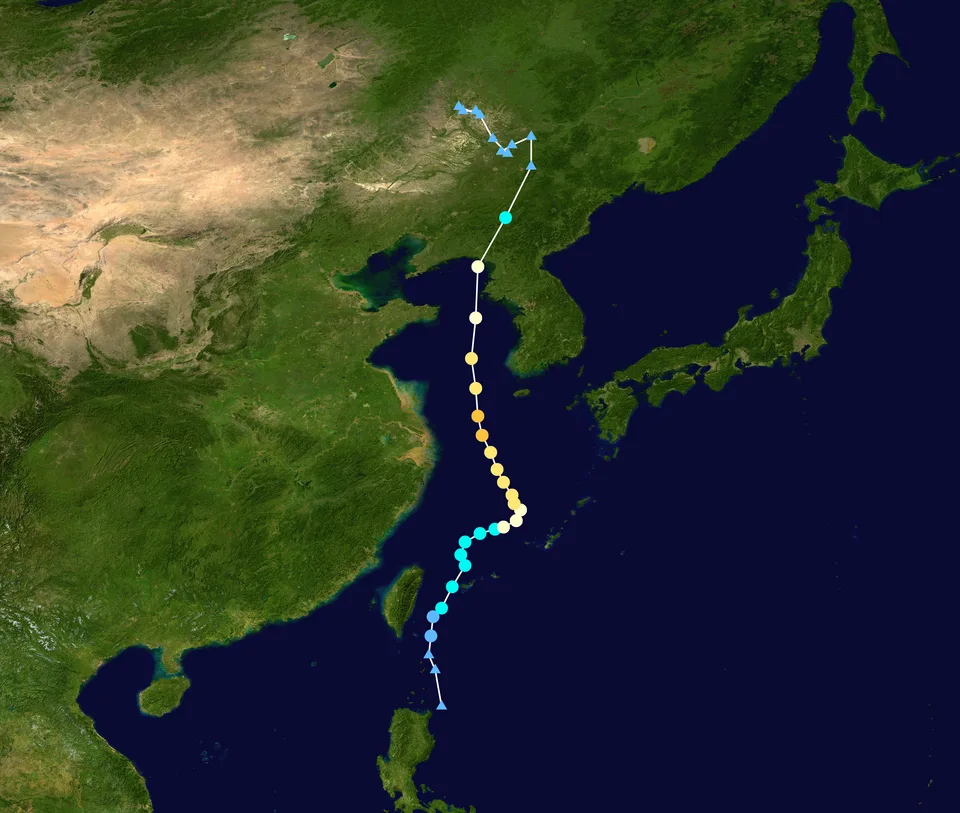
A typhoon that started life as a super typhoon slamming Guam has now sent nearly two million people running for their lives across China, while killing 18 in the Philippines and knocking out power to more than 170,000 homes in Taiwan. Typhoon Bavi is still going, and it hasn't even made landfall on the Chinese mainland yet. Buckle up.
The Numbers Are Staggering
Let's just run through what CNA is reporting, because the scale of this thing deserves a moment of silence. More than 1.7 million people evacuated in China's Zhejiang province alone. Another 130,000 in Fujian. Around 34,000 from Shanghai's coastal areas. More than 14,000 evacuated in Taiwan. Eighteen dead in the Philippines. Over 18,000 households without power in Okinawa.
That is not a weather event. That is a slow-motion catastrophe spread across an entire region of the planet, and it is still unfolding.
Bavi is expected to make landfall early Sunday in Zhejiang, on China's eastern coast. The city of Wenzhou, a metropolis of nearly 10 million people, put out a statement describing its response as a "proactive, all-out mobilisation, sparing no effort or cost" to guard against worst-case scenarios. That is government-speak for: we are genuinely scared.
Taiwan Took the Opening Act
Northern Taiwan got hit first, and the island has been largely shut down for two days running. Streets deserted. Businesses closed. Hundreds of flights cancelled. The port city of Keelung, one of the expected hardest-hit areas, was a ghost town, according to CNA.
Taiwan's Central Weather Administration warned of "extremely torrential rain" across the north and waves of up to 10 meters along the coast. Ten meters. That is a three-story building, in water, crashing into your shoreline.
Bavi had been tracking on Friday to potentially be the largest typhoon to hit Taiwan in more than 30 years, before its strong-wind radius shrank somewhat to 350 kilometers. CWA forecaster Jason Cheng confirmed the wind radius reduction, which is the kind of update you greet with relief only because the original projection was so catastrophic it broke your brain a little.
Some Locals Were Not Impressed
Here is where the story gets very human, and honestly, very relatable. Not everyone in Taiwan was cowering indoors. A breakfast shop owner in Keelung surnamed Li complained to AFP about the loss of business, pointing out that shelves had been cleared out in a grocery panic and yet, from his perspective, there had not been all that much wind or rain. "The government reports make it sound absolutely terrifying, panicking everyone, right?" he said.
A 19-year-old convenience store worker in Bali, a coastal district of New Taipei, summed it up differently: "It's just like a rainy day."
Look, this is the eternal tension with disaster preparedness. Governments overestimate, people get annoyed, people stop taking warnings seriously, and then one day the storm is exactly as bad as advertised and nobody evacuated. The alternative, being underprepared for a typhoon that packs 173 km/h gusts and 10-meter waves, is considerably worse than a lost day of breakfast sales. The Wenzhou government's framing, that the response is designed to guard against the worst-case scenario, is actually the correct answer here even if it does not feel that way when you are watching your shop sit empty.
The Philippines Paid the Highest Price
While Taiwan's locals debated whether the fuss was warranted, the Philippines was counting its dead. CNA reports the death toll from landslides and other Bavi-related incidents rose to 18, with most of the deaths on the southern island of Mindanao. Nearly 11,000 people fled their homes across the archipelago, and 313 vessels took shelter with dozens of ports still closed.
The Philippines gets hit harder partly because of geography, partly because of infrastructure, and partly because storms like Bavi still carry enormous destructive power even after weakening from super typhoon status. Bavi's maximum sustained winds were clocked at 137 km/h on Saturday, with gusts around 173 km/h, after the system slowed down crossing the Pacific following its initial slam into Guam and the Northern Mariana Islands earlier in the week.
Yes, Climate Change Is in This Story
CNA flagged something that should not be buried: the European Union's Copernicus Marine Service reported last week that oceans experienced their hottest June on record, and could set new highs in the months ahead. Warmer oceans fuel stronger tropical storms. They add more moisture. They turn bad situations into catastrophic ones.
On top of that, El Nino is back. The natural climate phenomenon, which warms Pacific Ocean surface temperatures and typically cycles every two to seven years, is layering onto an already-overheated baseline. This is not a coincidence. This is what scientists have been predicting for decades, and it is arriving on schedule, just with considerably more destruction than the models made sound bearable in a policy briefing.
The Dingo Take
Two million people do not abandon their homes over nothing. The logistical scale of what China pulled off in Zhejiang alone, evacuating 1.7 million people ahead of a single storm's landfall, is extraordinary. You can criticize authoritarian governance for a long list of legitimate reasons, but mass disaster evacuation is one area where the Chinese state, when it decides to move, moves fast. Whether the response holds up after Bavi actually hits is a different question.
The deeper story here is the one we keep almost telling ourselves and then looking away from. Hottest June on record in the oceans. El Nino returning. A storm that was a super typhoon last Monday and is still killing people, knocking out power, and forcing millions from their homes almost a week later. This is not a fluke weather event. This is the new operating environment for an enormous chunk of the world's population, and the political will to match that reality with serious climate policy remains, almost everywhere, embarrassingly inadequate.
The breakfast shop owner in Keelung complaining about lost revenue because the storm was not as bad as advertised is not a villain in this story. He is just a guy trying to make a living. But the instinct his frustration feeds, the idea that preparation is overreaction, that officials are crying wolf, that the disruption costs more than the risk is worth, is exactly the instinct that gets people killed when the next storm does not shrink on approach. Eighteen people in the Philippines are not around to offer their take on whether the warnings were excessive.





Comments