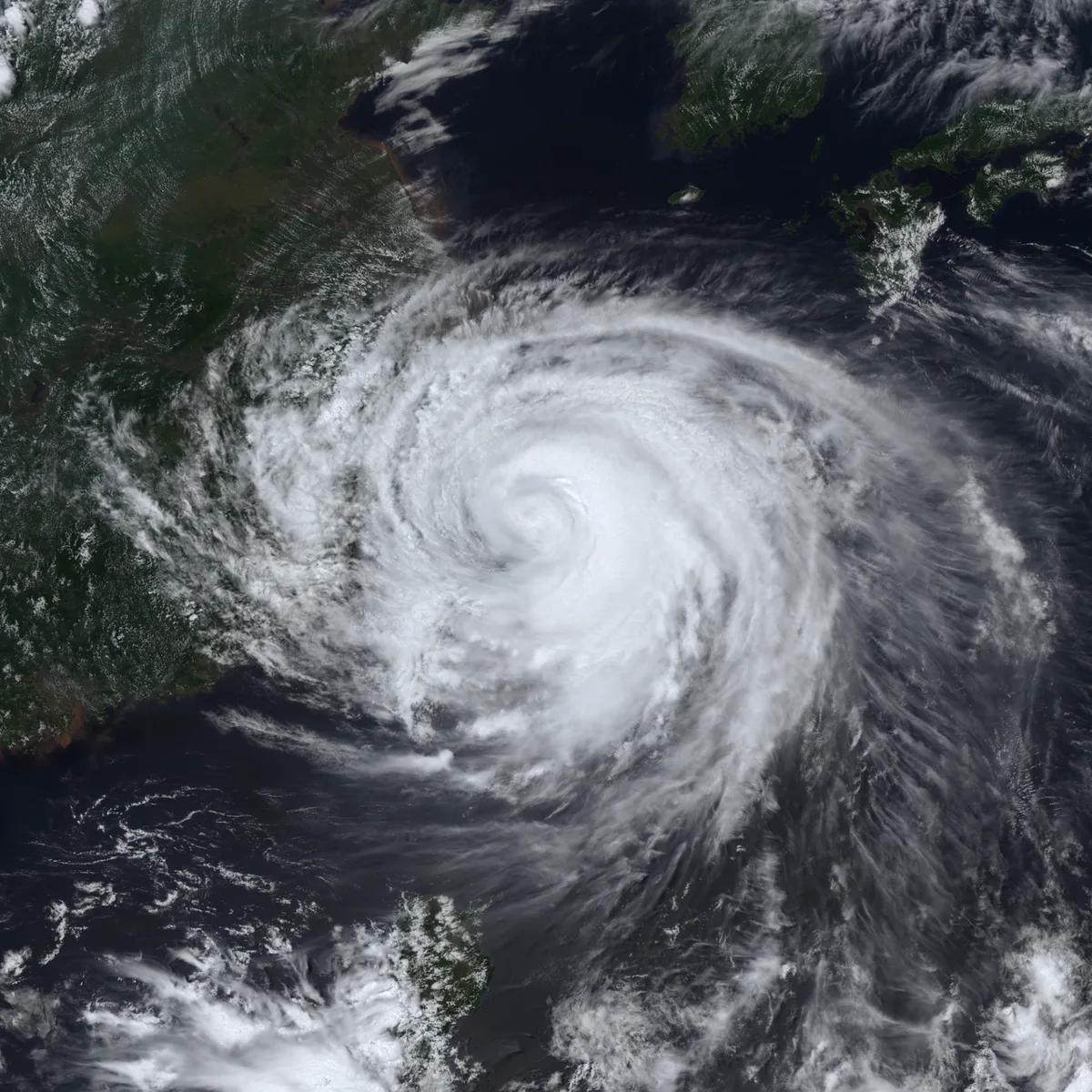
A typhoon roughly the size of France is about to make landfall on a Chinese city of 10 million people, and China has already moved 1.8 million residents out of the way. Typhoon Bavi battered Japan's southern islands, grazed Taiwan, and helped kill 17 people in the Philippines before turning its full attention toward Wenzhou. Sunday morning is when this gets real.
The Size of France, Pointed at Your City
Let's just sit with that for a second. The rain bands on Typhoon Bavi stretch across an area roughly equivalent to the entire country of France. That is not a storm. That is a weather event with its own postal codes.
As of Saturday morning, the National Meteorological Center reported that Bavi had maximum sustained winds of 90 mph, which puts it at Category 1 on the Saffir-Simpson scale, and it was sitting about 124 miles southeast of Wenling in China's Zhejiang province. It was slowing and weakening over cooler seas, but the New York Post reports that meteorologists aren't exactly celebrating, because the sheer volume of moisture locked inside this thing makes it dangerous regardless of wind speed. Rain kills. Rain in biblical quantities kills faster.
Bavi is forecast to make landfall near Wenzhou early Sunday. Wenzhou has approximately 10 million residents. The math there is straightforward and uncomfortable.
China Moves 1.8 Million People in a Weekend
Say what you want about China's government, the evacuation apparatus here is not messing around. According to the New York Post, state media confirmed that more than 1.7 million people were evacuated across Zhejiang province alone, with another 100,000 moved out of neighboring Fujian province. That's 1.8 million human beings relocated before a storm makes landfall. The logistics of that operation are staggering.
Wenzhou resident Huang Xinghuan, 50, was out buying groceries at a wet market before it shut down ahead of the typhoon. His vibe was calm, if cautious. "I'm a little worried, but I think it'll be OK. We've been through typhoons before," he told the Post. He said his family had stocked two to three days' worth of water and didn't feel the need to panic. That is either admirable composure or a deeply practiced form of regional fatalism. Possibly both.
Another Wenzhou resident, Chen Qiuqin, was heading to her elderly parents' apartment to move her mother's flowerpots inside from the balcony. That detail lands differently than the million-person evacuation numbers. Someone's mom has flowerpots she's worried about. A storm is coming. The scale and the small human details coexist in a way that spreadsheets can't capture.
Taiwan Closed Down an Entire Country for the Weekend
Before heading to China, Bavi gave Taiwan a thorough roughing up without even making landfall. The New York Post reports that nearly all cities and counties across Taiwan declared a typhoon holiday for Saturday, closing offices and schools. Taiwan's fire department counted 87 injuries, most of them people knocked off motorcycles or bicycles by the wind, or struck by flying objects.
The government evacuated more than 14,000 people from mountainous areas, and 920 international flights were cancelled, effectively shutting down Taoyuan International Airport outside Taipei. All 282 domestic flights were also grounded. The main high-speed rail line kept running but at reduced capacity. Some restaurants and convenience stores in Taipei stayed open, because nothing fully stops a convenience store.
In Taipei's Beitou neighborhood, up in the foothills, gusts of around 100 kph knocked down trees and swelled rivers. Out in the streets of downtown Taipei, 68-year-old Yeh Mao-hsiung was taking his morning walk with his dog. "It's OK, it's not that serious," he said. "It's just a little bit more wind." Sir, there are 100 kph gusts knocking trees over in your city's hills. Respect the commitment to the routine, though.
The Philippines Got the Worst of It and the Least of the Attention
Here is the part of the story that tends to get buried under the logistics of Chinese evacuations and Taiwanese airport closures: 17 people are dead in the Philippines. The New York Post reports those deaths came from heavy rains brought by an enhanced southwest monsoon that Bavi made significantly worse. Bavi didn't even directly hit the Philippines. It just made an existing weather system more lethal.
This is how these storms work. The headlines track the landfall, the evacuation numbers, the wind speeds. The countries without the resources to evacuate millions or shut down their airports get a line or two. Seventeen people died. Their names aren't in the story. They rarely are.
Japan Took the Hit Before Anyone Else
Before Bavi pointed itself at Wenzhou, it spent time pummeling Japan's southern Sakishima island chain with heavy rain and violent winds, according to the New York Post. Japan has not reported any deaths from the typhoon, which given the intensity of what Bavi threw at those islands is genuinely good news.
Bavi has been busy. Japan's southern islands, Taiwan's mountains, the Philippines through a proxy weather system, and now the eastern coast of China. This storm has been working its way through East Asia like it has a checklist. Wenzhou is next.
The Dingo Take
There is something clarifying about watching a government move 1.8 million people before a storm hits. You can hold a lot of complicated feelings about the Chinese government and still recognize that the logistical capacity to do that, and to do it apparently over the course of a single day, is something the United States hasn't demonstrated it can replicate anywhere close to that scale. Hurricane Katrina killed nearly 2,000 people in 2005. The conversation about why tends to get uncomfortable pretty fast.
The death toll so far sits at 17, all of them in the Philippines, none of them in Japan or Taiwan where the storm hit directly and hard. That number will likely change once Bavi gets onshore in Wenzhou Sunday morning. We hope it doesn't. We expect the Chinese government's evacuation effort, whatever its motives, will save lives. We note that the people who died were in the country with the least infrastructure and the least international coverage, which is how it almost always goes.
Check back Sunday. Wenzhou is a city of 10 million people with a Category 1 typhoon aimed directly at it, carrying a rain band the size of France. The guy with the flowerpots is about to find out how good the preparations actually were.




Comments