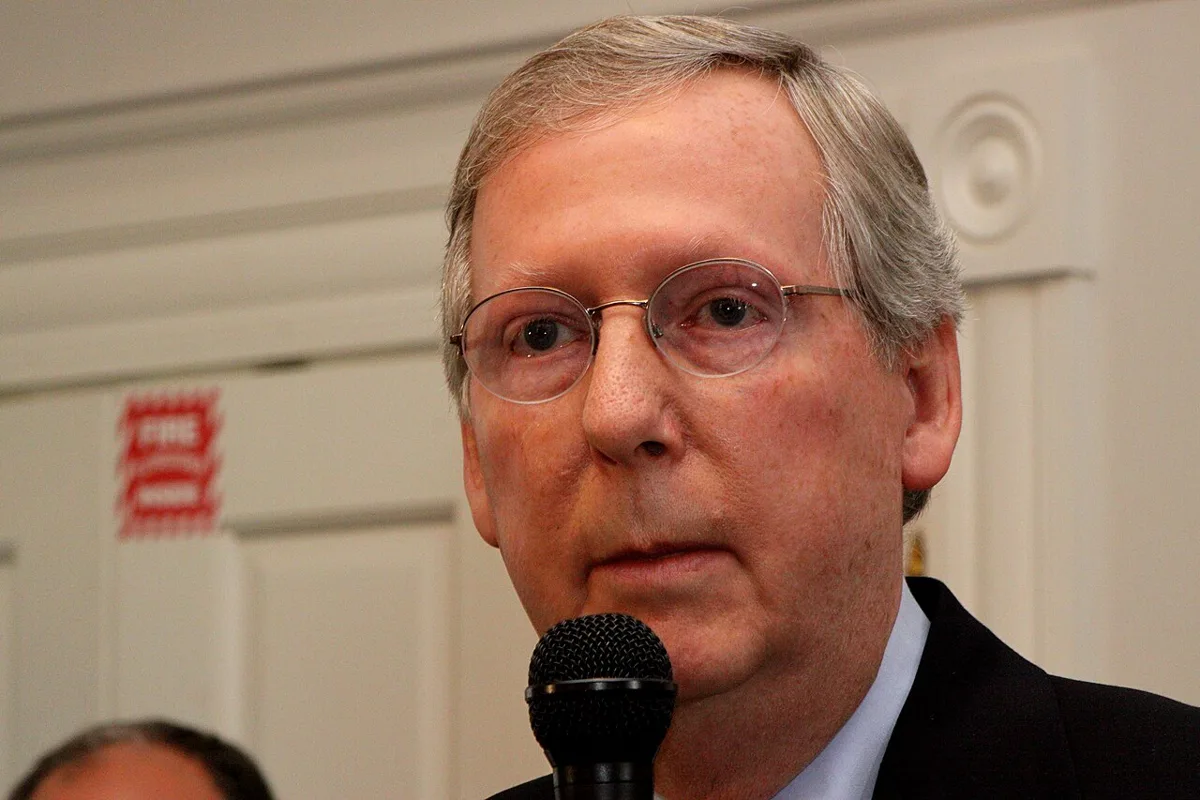
Mitch McConnell spent four weeks telling the American public precisely nothing about why he was hospitalized, and now we know why: he fell, lost consciousness, got pneumonia, and ended up in a rehabilitation facility. The 84-year-old Kentucky Republican finally broke his silence Sunday, releasing a statement that answered some questions and somehow managed to raise several more.
Four Weeks of Nothing, Then a Statement on a Sunday
According to NPR and the Associated Press, McConnell's office had been stonewalling since June 14, the day he was first hospitalized. The official line for a solid month was that he was "receiving excellent care" and recovering. That's it. That's the whole update. For a sitting United States Senator.
The silence got so loud that Kentucky's Democratic Governor Andy Beshear did something genuinely unusual last week: he sent a public letter asking McConnell to please, for the love of God, tell people what was going on. That's the governor of your own state treating you like a missing person case. And it still took another week before McConnell said anything.
When the statement finally arrived on Sunday, McConnell explained the delay by saying that "folks of my generation often hesitate to share the vulnerability that comes with growing older." Which is a very gracious way of describing what the rest of us would call a four-week information blackout on the health of an active federal legislator.
What He Actually Said Happened
Here is the medical rundown, per the statement McConnell released and reporting by the Associated Press: he fell, he was "briefly unconscious," he was treated for mild pneumonia, he has been moved to a rehabilitation facility, and his doctors confirmed no broken bones, no concussion, no heart attack, no stroke, no tumors, no hemorrhages.
The Congressional physician's office added some important context, noting that McConnell "has experienced several falls through the year" because of his post-polio condition. He had polio as a child and has had documented difficulty walking and climbing stairs for years. His physical therapy is now specifically focused on reducing the risk of future falls.
McConnell also included a photo of himself smiling with his wife Elaine Chao, which his team clearly intended as a kind of visual proof-of-life. And look, fair enough. The speculation online had apparently gotten bad enough that a cheerful photo op felt like a necessary rebuttal.
This Is Not McConnell's First Rodeo, Health-Wise
It would be a mistake to treat Sunday's disclosure as some isolated incident. The Associated Press lays out a pattern that goes back years. In March 2023, McConnell was hospitalized with a concussion after falling at a Washington hotel. After returning from that, he froze twice at public news conferences, staring blankly ahead while colleagues stood awkwardly nearby. In 2024, he fell again and sprained his wrist walking out of a Republican luncheon.
This is a man with a documented, ongoing history of falls and medical incidents who has, until now, stepped back from Senate leadership. He gave up the Republican leader role last year. But he is still a sitting senator, still casting votes, still relevant to the GOP's current majority math. That context matters a great deal.
He has remained active on the Senate floor, often using a wheelchair to get around. The man is 84 years old with post-polio syndrome and is committed to finishing his term through January. Whether you respect that determination or find it alarming probably depends a lot on what you think the Senate is actually for.
The Timing Could Not Be Worse for Republicans
McConnell's hospitalization arrived at a genuinely inconvenient moment for the Senate GOP. His fellow Republican Senator Lindsey Graham of South Carolina died unexpectedly this week at 71, as NPR reported. Two Republican senators now suddenly unavailable, right as the party is trying to push through military funding, advance the Trump agenda, and confirm nominees.
With both Graham's seat temporarily vacant and McConnell sidelined, the Republican majority shrinks to 51-47 for the time being. That's still a majority, but it's thin enough that any further complications could create real headaches for Senate leadership.
McConnell, for his part, says he's coming back. "I still have unfinished business to complete on your behalf," he wrote in his statement to Kentuckians. He said he cannot return to the Senate "quite yet" but is determined to finish the job. Whether his physical condition will cooperate with that determination is a question no one can honestly answer right now.
The Transparency Problem Nobody Wants to Talk About
Here's the part that should bother everyone regardless of party: there is no legal requirement for members of Congress to disclose anything about their health. As NPR has previously reported, health transparency in Congress is a choice, not a requirement. McConnell chose silence for four weeks while remaining a sitting senator with voting privileges and committee responsibilities.
McConnell is not unique in this. John Fetterman's severe depression. Dianne Feinstein's cognitive decline before her death. The Senate has a long, bipartisan history of members staying in office while their colleagues and staff quietly manage around deteriorating health. The institution seems almost structurally designed to avoid confronting this problem.
But the pressure that finally got McConnell to speak came from outside the Senate entirely. It came from a Democratic governor writing a public letter that amounted to: please tell your constituents you are alive and give them some actual information. That the governor of his own state had to do that tells you everything about how the Senate polices itself on this.
The Dingo Take
Let's be direct about what happened here. A man who wields real political power in the United States government fell down, lost consciousness, got pneumonia, ended up in a rehabilitation facility, and then his office spent a month telling the public nothing. Not a vague update, not a "he's recovering from a procedure," nothing. And the only reason we know any of this now is that the pressure from a Democratic governor and a growing wave of public speculation finally made silence more costly than disclosure.
McConnell's explanation, that people of his generation hesitate to show vulnerability, is human and probably even true. But it is also completely irrelevant to the question of what the public is owed from a functioning legislator. Your feelings about aging are yours to keep. Information about whether you can do your job belongs to the people you represent. Those are different things, and the Senate has spent decades pretending they're not.
He says he's coming back. He says he has unfinished business. He is 84 years old, has post-polio syndrome, has fallen multiple times this year alone, and just got out of a rehabilitation facility. We genuinely wish him well, because wishing ill on an 84-year-old man in a rehab center would be monstrous. But wishing him well and demanding basic transparency from him are not mutually exclusive. The Senate has not figured that out yet, and it probably won't until someone forces it to.




Comments