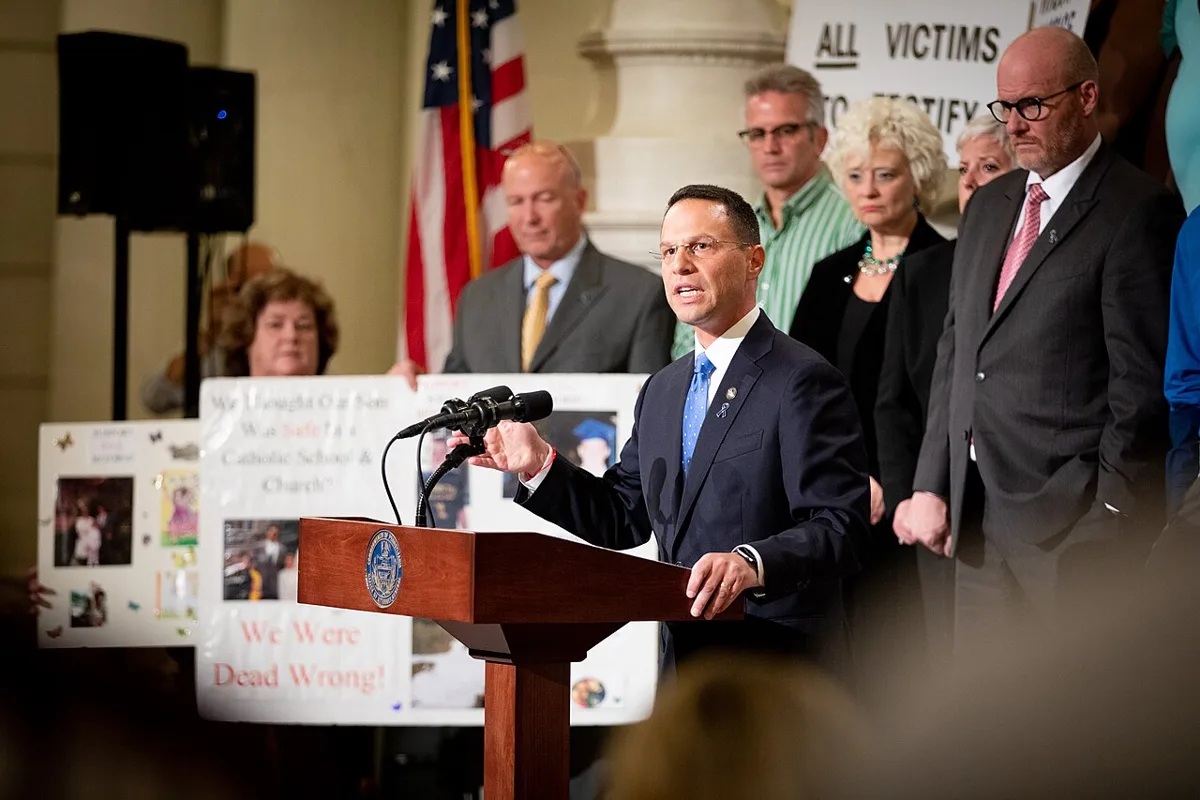
Josh Shapiro thinks the Democratic Party is at a crossroads. He thinks 2028 could be a once-in-a-generation reckoning over what the party actually stands for. He just doesn't seem particularly interested in being the guy who does anything about it.
Big Talk, Very Small Stick
According to Axios, Shapiro has been framing the 2028 presidential race in almost cinematic terms, describing it as a defining battle for the Democratic Party's core identity. That's a bold posture. The problem is that when you actually watch him operate in real time, you see a politician who flinches every time the moment arrives to back that posture up.
As progressives and outright socialists have been racking up primary wins across the country in recent weeks, the Pennsylvania governor has mostly responded with the political equivalent of a group hug. A 'we're-all-in-this-together' vibe that sounds nice at a party retreat and means absolutely nothing when the other side of 'this together' thinks your entire worldview is a relic of failed neoliberalism.
This is a pattern as old as the Democratic Party itself. Announce a willingness to fight. Decline to throw a punch. Repeat until your window closes.
The Centrist Void Nobody Wants to Fill
Here's the actual problem, and Axios lays it out plainly: the center-left of the Democratic Party is actively looking for a national leader. Not a vague one. Not a moderate-adjacent figure who occasionally makes noises about electability. A genuine champion who will stand in front of a microphone and tell the socialist wing of the party, clearly and without a twelve-part hedge, that their current direction is a losing one.
Shapiro is, on paper, the most credible person to do this right now. He's a two-term governor of Pennsylvania, which is the kind of state that actually decides presidential elections, unlike the coastal strongholds where most of the intra-party warfare gets waged. He has real executive credibility. He can point to actual governance.
But credibility on paper doesn't do much when you won't spend it. Every week he doesn't step into that vacuum, someone else fills it, or more likely, nobody does, and the vacuum just gets bigger and uglier.
What the Progressive Wave Actually Means
Let's be clear about what Axios is describing when it talks about progressives and socialists winning primary after primary in recent weeks. This isn't a fringe phenomenon anymore. The left flank of the Democratic Party has been systematically building organizational infrastructure at the local and state level for years, and it is now delivering electoral results that the party establishment cannot simply dismiss as flukes.
Whether those wins translate into general election success is the real question, and it is the exact question that a credible centrist challenger like Shapiro could be asking loudly and publicly. Primary wins in safe blue districts are one thing. Running a democratic socialist in a purple state in 2028 against whatever the Republican Party puts forward is a different proposition entirely, and the historical evidence is not comforting.
But you have to actually make that argument. You have to be willing to take some fire for it. Right now, Shapiro is watching the argument happen from a comfortable distance and offering no help.
The Clock Problem
There's a timing issue here that doesn't get discussed enough. The 2028 race feels far away, but the conditions that will define it are being set right now. Every primary the progressive wing wins cements their organizational advantage and their grip on the party's activist base. Every month a credible centrist alternative sits on the sidelines and says nothing, the ground shifts a little more.
Shapiro reportedly sees this as a once-in-a-generation fight. That framing suggests urgency. But urgency and restraint are not a winning combination. You do not win a generational battle by waiting to see how the generational battle turns out before picking a side.
At some point, 'I'm keeping my powder dry' becomes 'I missed my moment.' The Democratic Party has a long and storied history of watching that transition happen in real time.
The Dingo Take
Look, the instinct to keep everyone in the tent is not a stupid one. Democrats have a spectacular gift for internal circular firing squads, and a leader who pours gasoline on that fire just to establish their brand is not doing anyone favors. We get it.
But there is a difference between avoiding unnecessary conflict and refusing to engage in necessary conflict. If Shapiro genuinely believes that the direction the progressive wing is taking the party is electorally dangerous, and based on his positioning it seems like he does, then staying quiet is not neutrality. It is a choice. It is choosing the comfort of vague coalition language over the harder work of actually leading something.
The Democratic Party in 2026 is not short on people willing to give inspiring speeches about the party's soul. It is extremely short on people willing to do the unglamorous, politically risky work of making an actual argument and defending it when the blowback arrives. If Shapiro wants to be the adult in the room in 2028, he's going to have to start acting like one before the room burns down.




Comments